
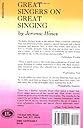
Great Singers on Great Singing: A Famous Opera Star Interviews 40 Famous Opera Singers on the Technique of Singing (Limelight)
Desertcart purchases this item on your behalf and handles shipping, customs, and support to Morocco.
Description
Jerome Hines has interviewed 40 singers, a speech therapist, and a throat specialist to provide this invaluable collection of advice for all singers. This collection includes the commentary of Licia Albanese, Franco Corelli, Placido Domingo, Nicolai Gedda, Marilyn Horne, Sherrill Milnes, Birgit Nilsson, Luciano Pavarotti, Rose Ponselle, Beverly Sills, Joan Sutherland and many others. “Probably the best book on the subject.” Publishers Weekly
Specifications
| Dimensions | 5.5 x 0.74 x 8.25 inches |
| Edition | Revised ed. |
| Isbn 10 | 0879100257 |
| Isbn 13 | 978-0879100254 |
| Item Weight | 1 pounds |
| Language | English |
| Print Length | 356 pages |
| Publication Date | July 1, 2004 |
| Publisher | Limelight |
Reviews
User
Excellent book about singing by singers who do it!
Having sung myself in Europe, studied with Maestro Arrigo Pola in Italy and researched the vocal phenomena for many years, I found this book quite valuable, because the singers themselves are asked of what they are aware. Jerome Hines did a good job of interviewing the singers. However his questions are all oriented toward the accepted concepts of the instrument. Thus, the singers attempt to describe their perceptions to fit in with the popular theory, which by the way has never been proven. It was merely an assumption. No instrument based on the wind driven theory has ever been created that produced the simultaneous multiple frequencies of which the human vocal instrument is capable.In other words, Hines' questions confine the singer's answers to a prescribed box. And he artfully steers their answers into the grooves that he wants them to follow. Nothing wrong in that. I got the impression that Mr. Hines was endeavoring to understand finally for himself how the vocal instrument works. He was trying to explain, or get others to clarify, how all of the subjective sensations, we singers and speakers perceive, fit together to produce a voice. I admire his curiosity. And he reports in a friendly and engaging manner.Had Jerry Hines read my first book, "The Book of Singing, A Manual", which I published as a manuscript on a very limited scale in 1975, and later republished as, "How To Speak With Power", he might have asked some different questions.Trying to apply the tenants of the popularly accepted theory: air passing through the vocal cords is resonated somewhere in the masque, or head, can make a naturally balanced instrument sick and ruin it. I had experienced that first hand for fourteen years as my own beautiful natural voice was ruined by well meaning, but ill-informed teachers.That's why I began researching the voice.I was not hampered by trying to fit what I found into the existing theory. I knew that didn't work so I dared to think outside of the box. The popular theory was assumed a couple hundred years ago. Our scientific knowledge has greatly increased since then. Quantum theory deals with the very tiny, which is where the voice originates. This enabled me to contemplate how the voice worked from a whole new perspective and ask greater questions that did not have to agree with the "accepted" theories of classical science. I wasn't trying to prove someone else's theory, I was only trying to figure how my own voice worked so I could rebuild my broken instrument and accomplish my dream of singing opera.I discovered there are more components to the vocal instrument than just a diaphragm, vocal cords and some ill-defined "resonators". In Hines' otherwise excellent book, the singers often talk about solutions as if they applied to the whole range, and not just to a specific register. Obviously the confusion around the subject of registers did not originate with Hines. In my second book, which I am compiling now, I resolve the riddle of the registers. There are different solutions for different registers (there are more than three). Once you have that information you can make sense of the seeming contradictory statements made by the various singers in Hines's excellent book.Would I recommend Hines' book? Of course! Wholeheartedly. Singers need to be aware of exactly what they are doing. Putting energy in the wrong places can make an instrument sick and take it apart. On stage one is all alone, so one must be able to self correct. And in order to self correct one has to know of what the instrument is composed and how it operates. To be a great singer one must become a great athlete and learn to control the components of the instrument by her/his thoughts.
User
I found this book to be both profoundly useful and comforting
I am a recent graduate with a vocal performance degree preparing to pursue a masters degree in opera. This book is a functional necessity for every serious singer's library. For me, I found this book to be both profoundly useful and comforting. I was fascinated by the different ways these great singers speak of and describe essentially the same concepts and techniques; it reminded me that our differing methods as singers are far more similar than sometimes it would appear. I think every singer will hit a wall at some point where the communication between teacher and student will fail and the student will require another source to explain the concept differently in order to grasp it. This book was just that source for me. I also found reading of the technical struggles and breakthroughs of singers that I deeply and admire and respect to be extremely comforting and encouraging!
User
Narrow in scope, rich in content
It would be worth the price of this book just for the interview with the distinguished operatic soprano Magda Olivero. Hers was a case of having the wrong teacher, failing miserably, then being guided to the right teacher who rebuilt her technique for singing; she sang professionally well into her seventies and could still give master classes in her nineties. She gives a riveting description of how the right teacher took her from the nadir, slowly and impatienly (hey, he was a very emotional Italian!), to a level at which she mastered verismo operatic roles. She was so good that even Renee Fleming was humbled by a demonstration of her breathing technique.Madame Olivero is one of many singers interviewed for this book; all of them had worthy, some had stellar, careers. Jerome Hines was a real character, and his character, warts and all, comes across in every page of this book. This is off-putting to people who are not entertained by his outsized personality, but again, what do you expect -- he was a larger-than-life operatic figure. Some of these singers, plainly, are characters themselves! The book is best taken with a grain of salt, I believe; but the sanity and down-to-earth practicality of Olivero made it a worthwhile purchase for me.
User
Stories from behind the stage curtain and Belcanto singers's precious insights about singing...
I love this book, because the author tells us intimate stories about great singers which are normally not known in the literature. The reader is taken behind the stage curtain and into the private sphere of these artists to learn more about their personal problems with their voices and their personally developped solutions and recommendations for others. I like this personal approach to the singing art very much and have to say that this book gave me as an author about Belcanto many insights how useful it is for all singers to hear more about vocal experiences on stage and vocal education from highly talented famous singers. I researched then deeper the stories of singers like Maria Callas and Joan Sutherland and many others more and took their insights to make them known in my book. I have to say thank you to Jerome Hines as his book was very inspiring for me on the way to my own book about Belcanto in Theory and Practice.Singing like Callas and Caruso: Belcanto Voice and Body TrainingBelcanto in Theorie und Praxis: Handbuch fuer Gesang und Buehne (German Edition)
User
Interesting and helpful
This is a great book for voice students because it includes a lot of information about good singing technique from many different successful singers. The short chapters make it easy for students to read and digest. Highly recommend it.
User
Some of the greatest classical singers of all time share their insights into ...
If anyone wants to receive invaluable information on vocal technique, they should read this book. I learned more from this book than I learned from years of vocal study in both group and private lessons. Some of the greatest classical singers of all time share their insights into proper and effective vocal production. Through applying some of the approaches these singers utilized in their careers, I've increased my vocal resonance, volume, and breath control in just a few weeks of experimentation with the tips given by these virtuosos. I am absolutely thrilled with the results I'm getting from applying my newly acquired knowledge.
User
A must read for any professional
Very well conceived and written. One of the very few books written with real authority (as opposed to ego trip and marketing in mind) and a must read for any professional singer to get a notion of what they are and are not aware of... Mr Hines is known to be an exceptional talent as a singer, but his interviewing style is breathtakingly spot on for this subject.
User
A wonderful man, a wonderful book.
I have had the great pleasure of knowing the great Jerome Hines for a number of years, and have been a student of his as well. This book will stand as one of the greatest resources for any professional singer or fan of opera. I can't tell you how many times I've turned to the pages of this book to gain a little insight into a particular artist and their voice. But no one should ever consider a book like this as a replacement for a good teacher. As the opening sentence of the book states "This book may be dangerous to your health". Use it only as a guide into the minds of some of the worlds greatest singers, not as a blueprint to singing success. I will guard my copy of this book jealously for as long as there is a song in my heart.P.S. Maureen Cote, his first book is more of an autobiography, and is, indeed, very inspirational. It also deals with many of his personal religious experiences in an uninhibited and straightforward manner (much like Jerome himself). He can be reached through the foundation he established in Newark, New Jersey called the Opera Music Theater International.(OMTI)
User
A must in the opera singer's library
Great book - a wealth of information, and connection to the past!
User
Must have Book for singers
Best buy. If you are singer and have basic knowledge and understanding for techniques you must read this Book it will help you alot.
User
A very interesting book
I suggest the seller's store as I was able to find a hard-to-find book!This book was suggested to me on the recommendation of an opera singer friend.The book presents insights and suggestions and various perspectives of how famous singers have sung and continue to sing.The reading is smooth and not heavy, it feels like you are present during the various interviews described in the book.I highly recommend the reading 😊
User
Solo para quien domina el tema (8 años de estudio o más en mi opinión)
Excelente para alguien que lleva tras de sí un estudio escolar de la voz, que domina el vocabulario técnico, conoce su instrumento y está buscando diferentes maneras de ver una técnica avanzada para el canto lírico. Si se es principiante (5º año de estudio o menos) es mejor esperar y asimilar sensaciones antes de pensar en leer acerca de las de otros. Se puede emplear bien varias de las escalas y los ejercicios de los artistas citados, pero siempre conociendo en principio el propio instrumento.
User
Ein Must für jeden Sänger
Was für ein Schatz an Information. Jeder Sänger sollte das gelesen haben!
Common Questions
Trustpilot