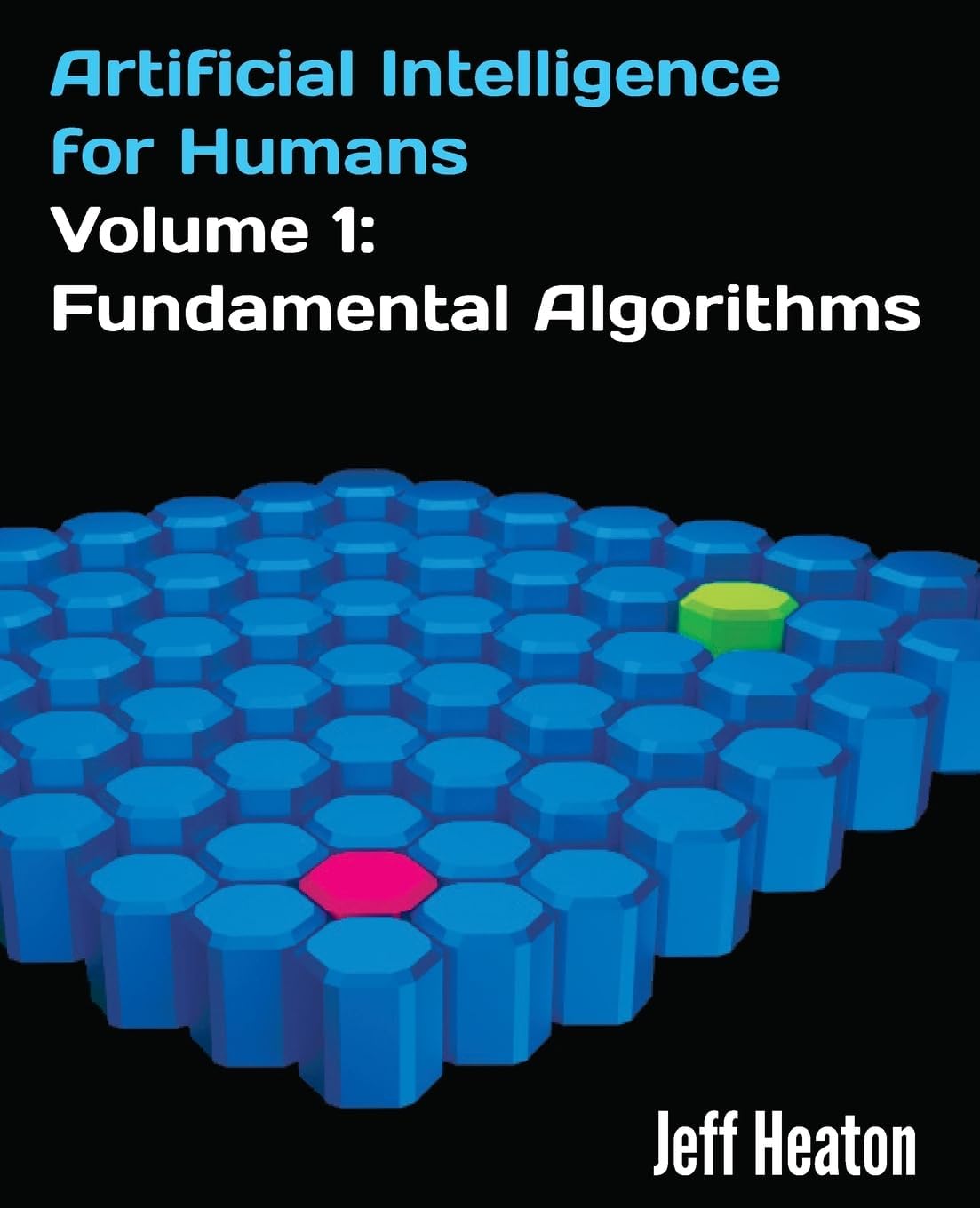
Artificial Intelligence for Humans, Volume 1: Fundamental Algorithms
Product ID: 7285922
Buy anything from 5,000+ international stores. One checkout price. No surprise fees. Join 2M+ shoppers on Desertcart.
Desertcart purchases this item on your behalf and handles shipping, customs, and support to Morocco.
A great building requires a strong foundation. This book teaches basic Artificial Intelligence algorithms such as dimensionality, distance metrics, clustering, error calculation, hill climbing, Nelder Mead, and linear regression. These are not just foundational algorithms for the rest of the series, but are very useful in their own right. The book explains all algorithms using actual numeric calculations that you can perform yourself. Artificial Intelligence for Humans is a book series meant to teach AI to those without an extensive mathematical background. The reader needs only a knowledge of basic college algebra or computer programming—anything more complicated than that is thoroughly explained. Every chapter also includes a programming example. Examples are currently provided in Java, C#, R, Python and C. Other languages planned. Review: Succinct, Pithy Overview: Puts "Data Science" Books To Shame! - This book has been excellent. I am an experienced practitioner, but am new to artificial intelligence, so I needed a book that would know what I didn't know that I didn't know, and explain it to me. This book is amazingly on-topic and to-the-point - I felt as if it were some sort of knowledge concentrate, there was so much information in each chapter. Am now reading the second book in the series :). Re "Data Science", I have been designing a system to feed ginat quantities of data to data scientists, so I thought I should know better what, in fact, "data science" was, so I bought some books. Most of the machine learning and modeling are actually the same, but this book explained in a few hundred pages what the data science books struggled to, in aggregate, in over a thousand pages! (I was blaming myself, until I read this book, in fact, since when ten external sources say you're wrong, and you say you're right, you're probably wrong :)) Review: A few issues, but really helpful overall - This book generally does a good job of not assuming prior math / notation knowledge. The problem I have with most ai or game theory books is that they assume you have a math undergrad or grad degree. I come from an applied arts (design) background and this book was really helpful for getting my head around the basics of ai algorithms. Some of the explanations were lacking completeness and the author doesn't clearly tie the last two chapters to the rest of the book with concrete examples. There are some formatting issues and errors in the book. However, the way most of the concepts were explained led me to order the next two books in the series in hopes of getting a few more valuable nuggets of understanding that many other books have failed to provide.
| Best Sellers Rank | #3,028,577 in Books ( See Top 100 in Books ) #2,374 in Artificial Intelligence (Books) #4,890 in Artificial Intelligence & Semantics |
| Customer Reviews | 4.0 out of 5 stars 253 Reviews |
S**E
Succinct, Pithy Overview: Puts "Data Science" Books To Shame!
This book has been excellent. I am an experienced practitioner, but am new to artificial intelligence, so I needed a book that would know what I didn't know that I didn't know, and explain it to me. This book is amazingly on-topic and to-the-point - I felt as if it were some sort of knowledge concentrate, there was so much information in each chapter. Am now reading the second book in the series :). Re "Data Science", I have been designing a system to feed ginat quantities of data to data scientists, so I thought I should know better what, in fact, "data science" was, so I bought some books. Most of the machine learning and modeling are actually the same, but this book explained in a few hundred pages what the data science books struggled to, in aggregate, in over a thousand pages! (I was blaming myself, until I read this book, in fact, since when ten external sources say you're wrong, and you say you're right, you're probably wrong :))
P**P
A few issues, but really helpful overall
This book generally does a good job of not assuming prior math / notation knowledge. The problem I have with most ai or game theory books is that they assume you have a math undergrad or grad degree. I come from an applied arts (design) background and this book was really helpful for getting my head around the basics of ai algorithms. Some of the explanations were lacking completeness and the author doesn't clearly tie the last two chapters to the rest of the book with concrete examples. There are some formatting issues and errors in the book. However, the way most of the concepts were explained led me to order the next two books in the series in hopes of getting a few more valuable nuggets of understanding that many other books have failed to provide.
D**R
A Basic Introduction to Machine Learning
This book claims to be an overview of artificial intelligence, but it’s not; it’s an overview of machine learning. It’s true that machine learning is a hot topic within AI just now, but it's hardly taken over the field, nor has it rendered all other methods obsolete. But, if you just want an informal introduction to the basic forms of machine learning, it's short and easy to read. The rubber never quite meets the road, but if all you need is the basic concepts, it's not a bad start. It does, however, contain errors that really should have been caught prior to publication. In addition to the errors mentioned by another reviewer, the references to equations 10.2 through 10.4 are wrong, and the description of the logistic function shown in Figure 10.3 doesn’t match the function shown. The notation specifies the curve as going from 0 to , but it is drawn from 1 to 0, which is backward from what the author intended. Also, the curve is described in the text as a logit function, which the author seems to confuse with the logistic. They both has S shapes, but they are very different things with different roles to play in terms of how they bound their values. To put it graphically, the S of a logit is horizontal, with the tails extending up and down, not vertical with tails to the left and right as shown in the figure.
B**R
A good primer for AI
I've wanted to better understand artificial intelligence for a long time. This book has opened the door for me. It requires a little mathematical aptitude, but little else, as the author starts with basic concepts and gradually builds on them. I like the examples and illustrations. They helped me digest and build my understanding one step at a time. I've been in contact with the author and found out that, with self-publishing, you can pretty immediately turn around reader feedback and make incremental improvements to the book. Since I bought the book last month, a number of improvements have already been made.
A**R
good primer
Easy to read and understand for someone with limited math background. I am looking forward to the next book. Word
G**K
I strongly recommend this book to anyone with an interest in machine ...
Jeff Heaton's book, Artificial Intelligence for Humans, is a highly-illuminating work that provides insights into the algorithms behind machine learning in an easily-accessible style. In describing complex processes, he first uses familiar metaphors, and follows up with mathematical explanations with each symbol and operation thoroughly explained. I strongly recommend this book to anyone with an interest in machine learning.
D**V
Not very useful
Seems easy to read but not very useful. The author tries to simplify the content so much that he makes it harder to understand it. Important bits are missed out or glanced over. I often found myself wanting to see a concise mathematical formula rather than a wordy attempt to describe an algorithm. There are errors and sloppiness too. Polynomial (7.2) 2x^2+4x+6 has a degree of 2, not 3. Equation (7.6) describing RBF network is confusing. It reads: "||X - ci||, where X and c are vectors". What is ci then? If it is i-th coordinate of c then the expression doesn't make sense. I had to go to Wikipedia for the explanation (ci is actually a vector and c is undefined). These are just couple of examples.
T**H
Excellent Introduction to Artificial Intelligence
I found this book to be an excellent introduction to machine learning and artificial intelligence. I was particularly impressed with the author's writing style which made the book very enjoyable to read. My only complaint would be that the latter chapters of the book contained less code. The initial chapters had plenty of code snippets to allow the reader to follow along and implement the algorithms but the latter chapters did not. His code is available online, so it wasn't a big deal but the book would be 5 stars if the latter chapters contained more code.
C**N
Demasiada verborrea
Lo dicho: demasiada verborrea. Llevo medio libro y todavía está contando el señor cómo supone él que funciona el cerebro humano, cómo convertir cualquier cosa en ceros y unos y bobadas parecidas. Espero que el nivel de los otros dos tomos sea mayor.
A**3
Nice book
Extremely good book, pages are printed properly
A**5
Good Introduction
Good introduction to AI (machine learning) problems modeling and optimization. The code could be way more "beautiful" and easier to understand.
D**I
Tutto OK
Tutto OK
B**E
Tres bien pour commencer
N'ayant pas fait de mathématiques depuis le lycée, et n'ayant aucune connaissance en machine learning, ce livre m'a permis d'en appréhender les concepts de bases. J'ai commencé le volume 2 qui je trouve est plus concret et, mais cela est personnel, plus utile pour moi.
Trustpilot
3 weeks ago
2 weeks ago