
DOWNLOAD THE APP


Customer Services
Copyright © 2025 Desertcart Holdings Limited
DOWNLOAD THE APP

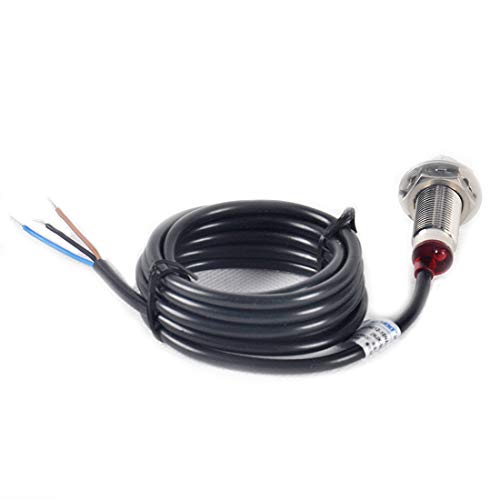
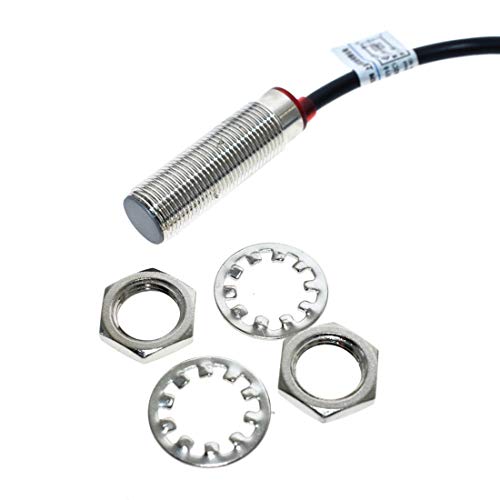


🔍 Elevate your sensing game with precision and style!
The HiLetgo NJK-5002C Hall Effect Sensor is a compact, metal-bodied proximity switch designed for detecting metal objects within a 10mm range. Operating on a wide 5-30V DC supply, it features an NPN open-collector output and a handy red LED indicator for real-time status. Ideal for smart home automation and DIY electronics, it integrates smoothly with platforms like Raspberry Pi, making it a must-have for tech-savvy professionals seeking reliable, precise sensing solutions.
| ASIN | B01MZYYCLH |
| Customer Reviews | 4.1 4.1 out of 5 stars (82) |
| Date First Available | 28 Nov. 2016 |
| Item Weight | 82 g |
| Item model number | 3-01-1229 |
| Other display features | Wireless |
| Package Dimensions | 10.9 x 7.9 x 2.9 cm; 82 g |
C**8
I'm currently using one of these to sense the state of my overhead garage door. It is behaving and functioning as a Hall Effect Proximity Sensor should. Each one comes with a small magnet for activation. I found a location where I could mount the sensor on a bracket the holds the garage door tracks. I just needed to enlarge a hole a bit to hold the sensor. I epoxied a magnet to the edge of the garage door where it would be aligned with the sensor when the door is closed. I have about 3/8" (about 9 - 10 mm) air gap between the magnet and sensor, and it is working fine. I have the sensor connected directly to the Raspberry Pi as follows: The sensor's brown wire connects to pin 2 of the GPIO header for the +5V supply. The sensor's blue wire connects to pin 6 of the GPIO header for the ground connection. The sensor's black wire connects to pin 8 (or any input of your choice -- configure your software to match.) The black wire/Pin 8 also needs to connect to a resistor (2200 - 4700 ohm is fine) and the other side of that resistor connects to pin 1 (3.3 V) of the Raspberry Pi GPIO connector. The black wire in the sensor provides an open-drain output, which means that it can provide a ground-level signal to pin 8 in one state, but to provide a voltage to pin 8 in the other state, you need to use the resistor (pull-up resistor) that connects to the Pi's 3.3V The Raspberry Pi inputs cannot tolerate more than 3.3 volts on an input pin. The specifications state that it has an NPN transistor output, and that configuration would be called open-collector, which in this application, works the same as the open drain output on what is clearly a FET: The on-state (conducting) voltage drop from black to blue wire was measured at about 20 millivolts.
W**M
It requires a magnetic field to change state. If a magnetic field is not involved -- NO WORKY PEOPLE! Magnets work well!
C**Z
I like these sensors because they are sealed hall effect sensors. The cylindrical shape makes them easy to mount with just a drill. They respond to the south pole of a magnet. However, if you need to interface them to 3V logic, you need to level shift, current limit, or use a blocking diode.
P**.
These hall sensors perform as well as sensors costing much more.
R**R
I should have paid more attention to previous reviews. Was looking for a magnetic hall effect switch to be used with a reluctor wheel for a tachometer on a shaft. This is not what this is. It needs to sense a magnet to change state. Also description shows supply voltage 5-30vdc. The label on the sensor shows Supply voltage 12-24 and the Switching voltage 5-30.
Trustpilot
4 days ago
2 months ago