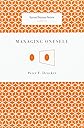
Managing Oneself (Harvard Business Review Classics)
Product ID: 48520000
Desertcart purchases this item on your behalf and handles shipping, customs, and support to Morocco.
We live in an age of unprecedented opportunity: with ambition, drive, and talent, you can rise to the top of your chosen profession regardless of where you started out. But with opportunity comes responsibility. Companies today aren't managing their knowledge workers careers. Instead, you must be your own chief executive officer. That means it's up to you to carve out your place in the world and know when to change course. And it's up to you to keep yourself engaged and productive during a career that may span some 50 years. In Managing Oneself , Peter Drucker explains how to do it. The keys: Cultivate a deep understanding of yourself by identifying your most valuable strengths and most dangerous weaknesses; Articulate how you learn and work with others and what your most deeply held values are; and Describe the type of work environment where you can make the greatest contribution. Only when you operate with a combination of your strengths and self-knowledge can you achieve true and lasting excellence. Managing Oneself identifies the probing questions you need to ask to gain the insights essential for taking charge of your career. Peter Drucker was a writer, teacher, and consultant. His 34 books have been published in more than 70 languages. He founded the Peter F. Drucker Foundation for Nonprofit Management, and counseled 13 governments, public services institutions, and major corporations. Review: Worth reading and remembering - The book is short and concise. It does not go into long winded stories but rather gives short examples straight to the point. It starts off with a simple yet powerful idea that we must build upon our strength. But in order to understand where our strength lies we must first understand how we operate. Key questions to ask ourselves on how we operate are: -How do we learn? -What are our values? -What are the best environments we efficiently perform at? -and of course knowing where we think we might belong? To achieve this the author describes an exercise called the feedback loop where we predict how far we will go and assess how well we fit this prediction to expose our weaknesses and strength. Once we have discovered our strength we must double down on it and minimize the time to improve our weaknesses. It is better to go from good to excellent instead of incompetent to mediocre. Finally the author mentions that as we become excellent in our job we might not have any challenges and this can make life less exciting, so we can try seeking for a different field to master once we are older. Absolutely loved the book. Review: sober, thought provoking and practical - This book is quite brief and more focused on one philosophical point than air how to or step by step book. However, I personally find the Sober yet direct tone of this book very refreshing in the world of business books that are overhyped. In a way the very absence of a 10 step plan to success and a realistic view of big business life is actually its strength. When it comes from an author who has been a management consultant for many decades and has had a business like that spanned the great depression right into the 70s and 80s, it is worth reading.
| Best Sellers Rank | 124,657 in Books ( See Top 100 in Books ) 170 in Business Life (Books) 179 in Business Careers (Books) 6,793 in Health, Family & Lifestyle Self Help |
| Customer Reviews | 4.3 out of 5 stars 7,647 Reviews |
P**P
Worth reading and remembering
The book is short and concise. It does not go into long winded stories but rather gives short examples straight to the point. It starts off with a simple yet powerful idea that we must build upon our strength. But in order to understand where our strength lies we must first understand how we operate. Key questions to ask ourselves on how we operate are: -How do we learn? -What are our values? -What are the best environments we efficiently perform at? -and of course knowing where we think we might belong? To achieve this the author describes an exercise called the feedback loop where we predict how far we will go and assess how well we fit this prediction to expose our weaknesses and strength. Once we have discovered our strength we must double down on it and minimize the time to improve our weaknesses. It is better to go from good to excellent instead of incompetent to mediocre. Finally the author mentions that as we become excellent in our job we might not have any challenges and this can make life less exciting, so we can try seeking for a different field to master once we are older. Absolutely loved the book.
M**L
sober, thought provoking and practical
This book is quite brief and more focused on one philosophical point than air how to or step by step book. However, I personally find the Sober yet direct tone of this book very refreshing in the world of business books that are overhyped. In a way the very absence of a 10 step plan to success and a realistic view of big business life is actually its strength. When it comes from an author who has been a management consultant for many decades and has had a business like that spanned the great depression right into the 70s and 80s, it is worth reading.
T**O
Managing Oneself reviewed by Tevin Gongo
Really good read. I might be biased as I know that Peter Ducker is a reference when it comes to Business matters but I really recommend this book. The book give you a few interesting questions to ask yourself to ensure you are functioning at your best. It is a short read so even if you have a busy life, those 30 minutes should be a good investment of your time .
V**S
A short read but essential tips
This book is only about 60 pages (large prints and small format) and it summarizes clearly concepts often found in self-development books. It encourages us to know our strengths, our modalities (how we perform best) and values. It urges us to take responsibility for our relationships, in terms of how we chose them and nurture them. In order to identify strengths and gain personal insights, it introduces the feedback analysis tool: "Whenever you make a key decision or take a key action, write down what you expect will happen. Nine or twelve months later, compare the actual results with your expectations." It helps us frame our personal contribution by answering the following question: "Where and how can I achieve results that will make a difference within the next year and a half ?" The answer must balance several things. First, the results should be hard to achieve but still within reach. Second, the results should be meaningful. Third, the results should be visible." Finally, the book ends with advice on how to deal with the second half of our life, during retirement.
V**7
Short and brilliant
I'd say it's grossly overpriced for the size. But otherwise it's pure brilliance, I'd say - especially because it is so succinct. It doesn't go around, it says what it should, quickly, in a very organized manner. But it also has some anecdotes to demonstrate some points and flows easily and nicely back to back. I didn't know what to expect, it is not the first book of this kind I've read, but it definitely made my day and hopefully helps me make more.
B**F
Concise and a good starting point for leaders, in my opinion
Okay, I'll try to be brief. This book is excellent and I like it. Though it states many things that may seem obvious, its execution does so in a way that it makes you feel like you've learnt something new, or have been reminded of something important. There are also many good reminders in here about leadership and managing a team. If you like to be a leader, regardless of what field you are in your life, I think this is a must-read. I don't regret this investment and I think it's great to make notes on as I go along; see how it truly relates to my current methods and how I can improve to achieve better results/satisfaction.
R**Y
One of the most amazing books I recommend to everyone!
I was not a book reader until I was recommended this book about managing one self. It bought tears to my eyes, because the knowledge gained from this book is invaluable. It has encouraged me to look within myself, and it helps you to realize things that were kept hidden from you. Anyone who is looking for a book in their list, I would highly recommend this is a great book for LIFE. Thank you to Tai Lopez for adding this to the recommended book list. I'd say please give this a try and I guarantee you will gain more than the price of the book. Knowledge is definitely powerful :)
M**S
If you want to be successful, this is a great way to start changing the way you think and act....
Great concise book, not a sentence wasted here- all phenomenally coherent and applicable. Luckily being so well written and to the point: one can read it again....and again...and so forth, which is necessary for this type of book. You simply must remind yourself of the topics and specific objective thinking strategies.
C**L
Autodesenvolvimento
Excelente. Livro maravilhoso. Uma pérola no que se refere ao autoconhecimento e autodesenvolvimento. Vale ler e tomar notas. Colocar em prática. Pois são dicas para a vida. Muda totalmente nossa maneira de encarar nossos pontos fortes e deficiências.
D**E
Change agent
This book is a simple but powerful read that will influence change in your life if you are serious about becoming a successful executive.
S**N
Managing oneself
Good one but less content
J**H
Greatest book of Management that exists
This is definitely an essential book for the person how is looking at career, working effectively, understanding themselves and getting the most out of life. It will teach you the path to cooperation, thriving and fulfilment. The is a must read by anyone who wants more control in their life
A**O
Recomendable
Es breve pero el contenido es bastante interesante.
Trustpilot
2 months ago
1 month ago