
Buy anything from 5,000+ international stores. One checkout price. No surprise fees. Join 2M+ shoppers on Desertcart.
Desertcart purchases this item on your behalf and handles shipping, customs, and support to Morocco.
📈 Elevate Your Leadership: Transform Teams, Transform Results!
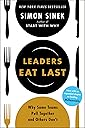
Leaders Eat Last by Simon Sinek explores the dynamics of successful teams and the role of effective leadership in fostering a culture of trust and collaboration. Through real-world examples and actionable insights, this book provides a roadmap for leaders looking to inspire loyalty and create a thriving team environment.


| Best Sellers Rank | #1,133 in Books ( See Top 100 in Books ) #6 in Workplace Culture (Books) #9 in Popular Social Psychology & Interactions #25 in Leadership & Motivation |
| Customer Reviews | 4.6 out of 5 stars 15,228 Reviews |
M**S
A Grounded, Insightful Read on Trust, Leadership, and Team Culture
A thoughtful look at what actually makes teams feel safe, connected, and willing to work together beyond just job descriptions. The core idea is simple but powerful: strong leadership isn’t about authority or control, but about creating an environment where people feel protected, valued, and able to trust each other. Sinek uses real-world examples from the military, business, and healthcare to show how cultures built on trust consistently outperform those driven by fear or self-interest. What makes the book resonate is how practical the message feels once you apply it to real teams. It highlights how small leadership behaviors—like consistency, fairness, and putting people first—can shape morale and performance in a big way over time. At times it can feel a bit repetitive in its messaging, but the central takeaway sticks: when leaders prioritize people, teams naturally become more stable, cooperative, and effective.
S**M
A Powerful Look at What Makes Teams Truly Work Together
Leaders Eat Last was a great read that really made me think about what leadership should look like. The main idea — that great leaders create environments where people feel safe, supported, and valued — stuck with me throughout the book. It explains why some teams naturally come together and perform well, while others fall apart even when they have talent. I really liked how Simon Sinek breaks down the “chemistry of leadership,” especially the way he explains trust, culture, and the biological side of teamwork. The stories he uses — from the military, business, and everyday workplaces — make the concepts easy to understand and apply. It helped me look at leadership from a different angle and think more about how my own actions can affect the people around me. The book also made me reflect on environments I’ve worked in where leadership either pushed people together or pushed them away. It’s eye-opening to see how much stronger a team becomes when people feel protected instead of pressured. If there’s one downside, it’s that some of the examples can feel a little long or occasionally repeat similar themes. But the core message is strong enough that it still feels worth reading. Overall, Leaders Eat Last is a meaningful book with lessons that apply far beyond the workplace. If you care about building trust, strengthening teams, and understanding what real leadership looks like, this is a great one to add to your list.
K**D
Good leadership tips about creating healthy, successful environments
I read this book as an assignment for one of my doctoral classes. Having never read Sinek’s work before, I was hoping to glean some leadership tips. Overall, this book gives some good, solid tips for creating successful work environments, changing the toxic idea of placing profits before people, and working with millennials. Although I enjoyed this book and took away many leadership ideas, I would have rated it higher if it hadn’t contained flawed information about human biology and millennials. Taking the title from a Marine Corps tradition where officers eat after the junior enlisted men, Simon Sinek uses this leadership practice to exemplify successful, safe and trustworthy environments. He claims there is a need to feel safe held by employees and that it is the job of leaders to create a protective environment, which he calls a Circle of Safety. To create this circle, Sinek shares his idea that human physical chemicals play a part in this process. He develops the idea that toxic environments are led by toxic chemicals which are unchecked by leaders. To create an environment of safety and trust, Sinek shows how to work with the “selfless” chemicals to create balance. As a former biology instructor, I felt this “research” behind these chemicals was flimsy at best. He claims that evolution has conditioned all humans to be led solely by their chemicals without any restraint by reasonable thought or self-will. He extends this to the realm of work environments, by naming those toxic environments as those led by the bad chemicals. He claims successful environments use the “selfless” chemicals to create environments where everyone is in the Circle of Safety. Contradicting himself, he claims at one point that everyone has these chemicals and that these primeval urges cannot be stopped. Then, he advocates for environments led by them to change their chemical makeup. If we can’t help it, how are we ever going to be able to change it? Despite this major flaw, using relatable stories from military and corporate leadership, Sinek provides great examples of failed and successful environments. He also gives steps to help create profitable and healthy environments. In an interesting section, Sinek points out the addiction of technology tools and social media and how it affects the workplace. He provides leaders with helpful and practical tips to manage these addictions in order to keep a safe, trusting environment within a work setting. This edition of the book contains an expanded guide to leading millennials in the workplace. His research reveals the tendencies of the group as a whole and how a leader can use those to develop them into workers of integrity, trust, and innovation that benefits everyone. This section was extremely helpful, but it has received criticism about its overgeneralization of millennial behavior. As someone who works with children and millenials, I found this criticism to be true. Many of the characteristics he mentioned -- especially impatience, inability to deal with failure, and task perseverance -- are seen in younger children rather than millennials. This can be attributed to the influence of technology from a young age, which was not experienced by most millennials since the boom of PCs and mobile phones occurred in the mid-90s. Also, he unleashes on the “Me” generation, parents of millennials, as the source of the troubles. He makes unfounded assumptions about the background and upbringing of the entire generation, of which he is a part, but never acknowledges as so. This book gives great advice about creating organizational environments that are healthy and successful. It is filled with real stories of organizations and people who have made a difference in the lives of workers. Although not providing any earth-shattering ideas, it gives solid advice for leaders about creating great environments for their followers.
R**A
Worth every penny.
Great book. About halfway through and it’s so insightful. Easy to read and so worth it.
D**N
A book for every business owner, as well as employees.
Simon Sinek has demonstrated in his book that we are all humans that should be treated with respect. In this regard businesses are starting to forget about the core fundamentals that make profit without considering people as just numbers. The more exposure leaders get with their employees the better the leaders should treat his company. In return for this generous care and safety employees start to take the company more then just a place to work. Employees will wear their company on their shoulders and would be proud to work at the company for as long as they would be allowed. Without safety or trust though comes a high stress environment where employees feel lifeless. They come for the money then leave, this leads to people not feeling safe and secure and causes them to not trust their leader in helping them support their family. Successful companies treat their employees like their children; they will not lay off employees when times get bad but actually treat them with even more safety. This simple act of kindness allows employees themselves to protect one another such as ideas of having mandatory no pay vacations in small doses so they can all pull together and wait out the bad times of the company. Simon talks about key terms such as the circle of safety as well as our biology with selfish chemicals such as endorphin and dopamine. The other two chemicals that we receive are called selfless chemicals and they are serotonin and oxytocin. Endorphins come from physical activity, or stress and fear. When it is released into our body it masks pain with pleasure. This is also seen when we start to enjoy exercising and how some people can complete long triathlons. This chemical gives us the next step in what we need to cover a great distance. Dopamine is the reward we receive when we accomplish something or become near to accomplishing a task. Dopamine is slowly released little by little when we get closer to finishing something. The dopamine amount is also relative to how hard the task is. Dopamine is the reason why we continue with projects because it makes us feel good about ourselves. Serotonin is the feeling we get when we feel recognized and appreciated. It gives us confidence and makes us strong when we receive a compliment of our abilities as a person. examples of this is when we walk receive an award for best employee in front of all your co-workers, or walking down graduation day being held your degree you worked so hard to get. Oxytocin is the chemical we receive when we develop deep trust with another person. When someone does something nice to us we get a rush of oxytocin in our blood and it is a feeling what some call the chemical love. Oxytocin is also responsible for making us vulnerable and open up. This gives us a equal share in the group to bare our inner circle of safety which gives us an easier time to focus on tasks. These two terms go hand in hand and it is up to the leaders to create the circle of safety for their employees in the work environment a place they feel safe and secure. Without the circle of safety being received by all employees, trust and integrity go down the drain and slowly grab the company in a slow but sure spiral of how the company should be. These chemicals should be in balance and it is up to how the leader structures their company to ensure their employees are receiving the circle of safety. The military and basic human fundamentals are clear examples Simon based his theories on and I feel he did a good job explaining himself. Fantastic book and a must read!
K**O
Helpful and Motivating Read, Good Condition
I was pleasantly surprised by the quality of this used book. It arrived in good condition, with minimal wear and little to no major damage. The pages were clean and easy to read, and the content itself is excellent on improving leadership skills and what makes great leaders who they are. A great value for anyone looking to enjoy this book without paying full price.
M**E
Create Protection To Create Teams
Good leadership books that translate into church leadership are rare. "Leaders Eat Last" is one of those rare books. This book is one of the best leadership texts for ministers and elders. At Castle Rock, we are journeying through this book together as a leadership team. We review each chapter, and talk about principles that we can apply to ourselves to improve the level of service we give to the congregation. This book is well written and informative. The beginning of the book developed the paradigm for the author. If you want people to follow you, you have to provide protection for them. You need to be loyal to them for them to be loyal to you. It is the idea of creating a sense of safety within the organization, because if people are busy fighting one another, there will be little attention given to developing the mission of the organization. Internal chaos causes people to be worried about self-preservation, and not about extending the reach of the group. The author talks about various chemicals within the body that help in this process. The book talks about various qualities that the leader needs, like the foxhole test. You have to have courage to do the right thing, even when the right thing seems wrong. Another valuable principle is the abstraction distance within an organization. The greater distance between the levels of people creates a sense of a lack of empathy, hence a lack of caring. You do not experience the pain of the people on the bottom level, so you feel comfortable firing them. The last part of the book develops various leadership lessons that are practical. Over and over again, I was highlighting this book, and thinking about how important this work was for church leadership. This is not a preacher or elder book per say, but in my opinion, every church leader should read it. Rarely do I come across I book I would recommend this strong, but this is such a book.
B**S
My entire understanding of leadership principles became much, much clearer.
As a military officer, I have been exposed to and worked to implement many theories on leadership and effective team building. After reading this book, my entire understanding of leadership principles became much, much clearer. Mr. Sinek's explanations of how five primary survival hormones (Endorphins, Dopamine, Serotonin, Oxytocin, and Cortisol) are used within human physiology and psychology gave me a whole new understanding of the underlying reasons why certain team-building techniques work so effectively. For example: " You build great teams by doing hard things, well, together and often." Doing Hard things: Endorphins help mask pain and make you feel good while doing difficult tasks. Well: Dopamine helps you feel good about accomplishments. Together: Seratonin helps you feel grateful those who participated and helped you through it. Often: Oxcytocin helps you feel bonded over time to others who are always suffering through the hard things with you. If there is an imbalance in that equation, especially with the last two "social" items missing, you will see teams fail to bond and stress produced Cortisol turn everyone against each other. If instead you able to create a balanced environment with a trusting "circle of safety", I have seen no limit to what the team can achieve. or "Forming, Storming, Norming, Performing, Adjourning" Forming: No bonds between team members, general stress and anxiety surrounding the new team creates Cortisol Storming: Team members begin achieving results with resulting Dopamine hits. Dopamine / Cortisol mixture causes conflicts within team Norming: As team begins to work together, Seratonin and Oxytocin begin to replace Cortisol Performing: Once the team bonds, and there is a balance of Endorphins, Dopamine, Seratonin, and Oxytocin, the team begins to excel. Adjourning: When disbanding, take the time to allow team members to gain closure to avoid abrupt Seratonin / Oxytocin withdrawals when the team is no longer together. Once I had my "aha" moment when going through this book, so many things just made sense. From the Brotherhood of War phenomenon, to the dysfunction in the current political system, to the rapid decline of once great companies after mergers / takeovers (For a current example, look at the recent Heinz reviews on Glassdoor) I was so impressed with the book that I bought a hard copy to loan to my peers. I would highly recommend it to anyone who wants to know more about leadership and building high performance teams. --- Edit --- In response to some of the other reviews that suggest this book is about controlling subordinates by controlling hormonal responses, I have to adamantly disagree. I never got the impression that the author was suggesting any form of "mind control". Rather, I understood the authors main point to be that as leaders, we must take responsibility to build an environment for that those we have the honor of leading, where they are taken care of and can become their best. His suggestion that doing so means also taking into account basic human survival physiology to promote team bonding and avoid persistent "fight or flight" behavior seems to be spot on to me.
T**A
Worth reading!
One of my most favorite life changing book. You will understand why good leader matters
R**A
Worth it definitely
Great one
R**A
Lo recomiendo mucho
Excelente libro, Simon Sinek es un gran escritor y en este libro refleja grandes enseñanzas para ser un gran lider, lo recomiendo mucho si quieres aumentar tus habilidades para delegar y tratar con gente en el trabajo.
E**R
um dos melhores livros sobre liderança que eu já li
O livro é fantástico. Bebendo da fonte clássica de treinamento militar é evoluindo a discussão para exemplos práticos e conexão com biologia e antropologia básica. Ótimo livro para aspirantes a líderes ou mesmo para líderes experientes
S**M
Clarity by Simon
Simon writes with clarity and simplicity, taking concepts which may seem complex and breaking them down into smaller digestible units which can be understood by anyone. I am a slow ready, but I find it impressive how fast I'm able to read through books written by Simon, emerging on the other side with great confidence of having understood whatever idea his books set out to convey.
Trustpilot
2 months ago
2 weeks ago