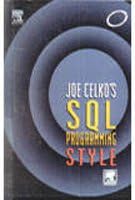
Sql Programming Style
Product ID: 417575209
Buy anything from 5,000+ international stores. One checkout price. No surprise fees. Join 2M+ shoppers on Desertcart.
Desertcart purchases this item on your behalf and handles shipping, customs, and support to Morocco.
Key Features + Help you write Standard SQL without an accent or a dialect that is used in another programming language or a specific flavor of SQL, code that can be maintained and used by other people. + Enable you to give your group a coding standard for internal use, to enable programmers to use a consistent style. + Give you the mental tools to approach a new problem with SQL as your tool, rather than another programming language - one that someone else might not know! Description Are you an SQL programmer that, like many, came to SQL after learning and writing procedural or object-oriented code? Or have switched jobs to where a different brand of SQL is being used, or maybe even been told to learn SQL yourself' If even one answer is yes, then you need this book. A "Manual of Style" for the SQL programmer, this book is a collection of heuristics and rules, tips, and tricks that will help you improve SQL programming style and proficiency, and for formatting and writing portable, readable, maintainable SQL code. Based on many years of experience consulting in SQL shops, and gathering questions and resolving his students' SQL style issues, Joe Celko can help you become an even better SQL programmer. Readership Managers seeking programming standards in their shops, team leaders seeking programming standards in their projects, SQL programmers attempting to set up programming standards in their own work, and newer SQL programmers who want to build good habits from the start. Quotes "Joe Celko, maybe one of the most prominent representatives of the database community these days, has written some of the best books about SQL programming in general. This book, however, is different. "SQL Programming Style" doesn't teach you how to become a better SQL developer with SQL puzzles and brainteasers. Rather, it shows you "how to work in logical and declarative terms"." - SQL-Server-Performance.com, August 17, 2006 Contents Chapter 1. Names and Data Elements; Chapter 2. Fonts, Review: 3.5 stars: Has good stuff but very undercooked - I'll expand on that when I have time; but for now, real quick: PROs: - As usual for Celko's books, you get this feeling of conversing with a knowledgeable and overall very likeable individual with a good sense of humour (he got me laughing on page 2, see his comments on the making of fine furniture). - Good justifications are given for many rules of thumb that, as of now, you're likely to be adhering to on faith. - A number of unobvious, sharp, mind-stretching tidbits (an ever-present feature of Celko books). - Very good bibliography. Celko is not a "narrow specialist": reading pointers he gives are varied and very interesting. Also, links to a lot of net material. Great. - He writes simply. ----------------------- CONTRA, the one and only problem: the book appears to be written in a terrible hurry, which is manifested by the following occurrences (not exhaustively): - Sometimes the author has something to say, but does not say it intelligibly (e.g., section 1.2.7) - Sometimes he doesn't have anything to say, but gibbers on anyway (e.g., section 3.15) - Sometimes he belabours the obvious or maybe even spurious: for example, there's too much of this "unlearn OO to understand SQL". One doesn't need to unlearn what one knows to learn something he doesn't; there's no clear-cut distinction: for example, operating on STL collections is very set-like, quite SQL'ish actually: you provide a predicate and it's then applied internally in a set-scoped operation. Matlab is very similar. BLAS is very similar. Fortran is similar. Iow, thinking in sets is an important thing to point to -- once; but after that it's beating a dead horse; move on already. Especially since it isn't really as black-and-white as the author suggests. (4) The book is very inadequately indexed: index is very small; nothing can be found. What's SQL/PSM? I don't think it's been defined anywhere, but perhaps I missed it; off to index I go... and find nothing there. How nice. I mean, come on -- a five-page index in a technical book? (5) Dropping French. Is it really necessary? "Sistemé International d'units", OK. There's more stuff to talk about, both good and bad; but I've no time to write it up right now. So, finally: is it a worthy book? Well, the book is flawed but not useless by any means. It's not a must read, but if you got a few discretionary bucks and a bit of free time, it's worth reading. I've learned a few interesting things here; ~1/3rd of the reading has been pleasant: in addition to knowing a lot of stuff, DB-related and beyond, Celko's got a real good sense of humour and a gift of gab. Were this book a brochure one-third its current size sold for five bucks, I'd give it five stars. OK, ten bucks. Review: Book - Excellent read
| Best Sellers Rank | #761,391 in Books ( See Top 100 in Books ) #63,853 in Reference (Books) |
| Customer Reviews | 4.3 out of 5 stars 18 Reviews |
J**T
3.5 stars: Has good stuff but very undercooked
I'll expand on that when I have time; but for now, real quick: PROs: - As usual for Celko's books, you get this feeling of conversing with a knowledgeable and overall very likeable individual with a good sense of humour (he got me laughing on page 2, see his comments on the making of fine furniture). - Good justifications are given for many rules of thumb that, as of now, you're likely to be adhering to on faith. - A number of unobvious, sharp, mind-stretching tidbits (an ever-present feature of Celko books). - Very good bibliography. Celko is not a "narrow specialist": reading pointers he gives are varied and very interesting. Also, links to a lot of net material. Great. - He writes simply. ----------------------- CONTRA, the one and only problem: the book appears to be written in a terrible hurry, which is manifested by the following occurrences (not exhaustively): - Sometimes the author has something to say, but does not say it intelligibly (e.g., section 1.2.7) - Sometimes he doesn't have anything to say, but gibbers on anyway (e.g., section 3.15) - Sometimes he belabours the obvious or maybe even spurious: for example, there's too much of this "unlearn OO to understand SQL". One doesn't need to unlearn what one knows to learn something he doesn't; there's no clear-cut distinction: for example, operating on STL collections is very set-like, quite SQL'ish actually: you provide a predicate and it's then applied internally in a set-scoped operation. Matlab is very similar. BLAS is very similar. Fortran is similar. Iow, thinking in sets is an important thing to point to -- once; but after that it's beating a dead horse; move on already. Especially since it isn't really as black-and-white as the author suggests. (4) The book is very inadequately indexed: index is very small; nothing can be found. What's SQL/PSM? I don't think it's been defined anywhere, but perhaps I missed it; off to index I go... and find nothing there. How nice. I mean, come on -- a five-page index in a technical book? (5) Dropping French. Is it really necessary? "Sistemé International d'units", OK. There's more stuff to talk about, both good and bad; but I've no time to write it up right now. So, finally: is it a worthy book? Well, the book is flawed but not useless by any means. It's not a must read, but if you got a few discretionary bucks and a bit of free time, it's worth reading. I've learned a few interesting things here; ~1/3rd of the reading has been pleasant: in addition to knowing a lot of stuff, DB-related and beyond, Celko's got a real good sense of humour and a gift of gab. Were this book a brochure one-third its current size sold for five bucks, I'd give it five stars. OK, ten bucks.
A**L
Book
Excellent read
J**T
Great book.
This is a great book to get you on the path to better coding. I didn't always agree with all the points but overall there ae many good tips in the book.
K**L
If you like Joe's other books, you'll probably like this one
I didn't agree with all of his recommendations, but I didn't really expect to. Not a bad guide for writing readable SQL, but you might get just as much by hanging out on Stack Overflow in the DBA pages. It has a lot of nicely-formatted and well-explained code.
Trustpilot
3 days ago
2 weeks ago