We remain fully operational. Our teams are working around the clock to ensure your deliveries continue safely.

DOWNLOAD THE APP


Copyright © 2025 Desertcart Holdings Limited
DOWNLOAD THE APP
Buy anything from 5,000+ international stores. One checkout price. No surprise fees. Join 2M+ shoppers on Desertcart.
Desertcart purchases this item on your behalf and handles shipping, customs, and support to Morocco.
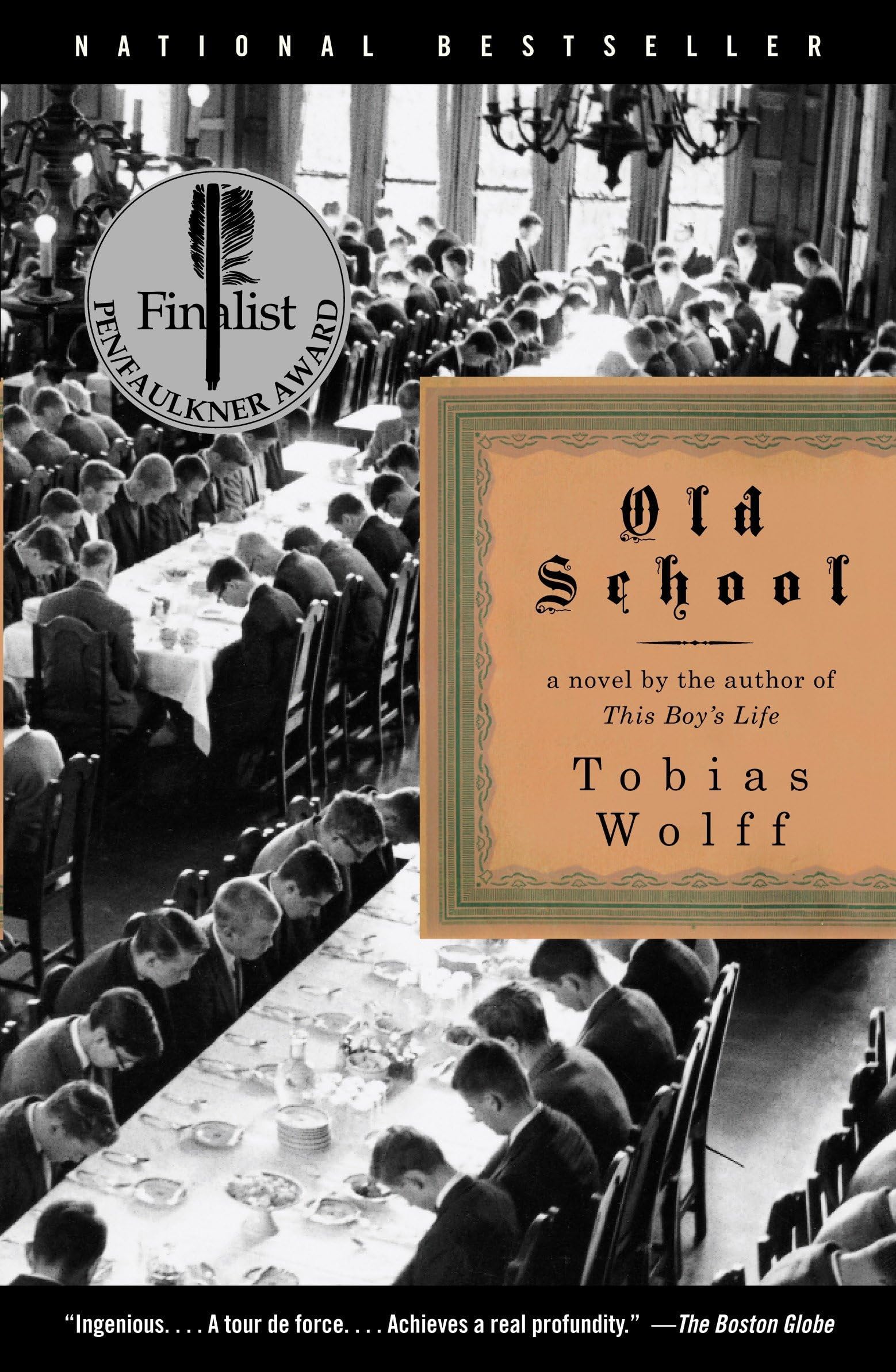
Old School (Vintage Contemporaries) [Wolff, Tobias] on desertcart.com. *FREE* shipping on qualifying offers. Old School (Vintage Contemporaries) Review: IS HE IN THE PHOTO?? - Okay, I liked the book but my curiosity about the cover photo is not satisfied since I still don't know if Wolff himself is one of the boys pictured in the photo? Since he submitted the photo, I am thinking possibly yes.... AND, could he be the boy on the spine of the book? That frustration aside, I bought this book for a couple of reasons: mainly because I really loved THIS BOY'S LIFE and hoped to be as entertained in this book, but also because I am a book-lover and always wished I had attended a prep school, so the setting appealed to me. Call it nostalgia for something I never had. This book is essentially a long short story with a couple of laugh-out-loud moments which are always greatly appreciated. But I couldn't get past the fact that I kept wondering about Wolff's life, the SALON interview notwithstanding. I am curious as to why he is so evasive about the facts of his life beyond the last page of THIS BOY'S LIFE where he seemed to be so brutally no-holds-barred honest and forthright. Did he graduate from Hill School, or did he leave just prior to graduation? The book mentions a father a few times, even rather benignly, but states that his mother was dead at the time of the writing which I believe was not true; so, what is autobiographical and what is not? I couldn't get beyond those curiousities as I read the book. I laughed out loud at Wolff's Ayn Rand diatribe. I read The Fountainhead and Atlas Shrugged in college, too, and my father almost came undone, thought I had turned into a Commie or something, and was really very upset. To me at the age of 18 they were just books. I liked them well enough, but I also loved other authors. In this book I think Wolff introduces enough variance in the books and authors he discusses that we are left to find our own favorites. Okay, I skimmed through all 12 pages of reader reviews here, hoping to find one written by someone who went to school, Hill School, with Wolff so we could get some straight answers, but I didn't see anything.... It's been a lot of years, but maybe he'll open up all the way one of these days and satisfy a lot of curious minds by telling the rest of his story. Directly. Not fictionalized. Good book. I liked THIS BOY'S LIFE better. Not to mention his brother's book DUKE OF DECEPTION which I also loved. PS: I was thrilled to hear directly from Tobias Wolff today, February 20, 2009, and he says the photo on the cover of the book was taken at his school a couple of years prior to his arrival, so he is not in the picture. I'm still mesmerized by the boys in the photo, but now I can stop speculating on which one might be the real Tobias Wolff. Review: Well written novel with a couple flaws that prevent greatness - "Old School" by Tobias Wolf is a well written novel that captures the essence of the experience of a boys' boarding school in the early 1960s. It is a well told story. The characters are very believable and heart felt. While reading I did feel an emotional connection to the main character who also serves in a way as the narrator. The overall plot is that the youth is in his final year of "high school" at a private boarding school. There are guest writers that come to the school and a competition is set up where student submit works, and the winner gets a private audience with the visiting writer. The writers are Robert Frost, Ayn Rand, and Ernest Hemingway. Tobias Wolf does an admirable job of placing the visiting writers into the school setting and allowing those writers to "become real" to the reader. Robert Frost was done well, and led the plot along in an excellent manner. Ayn Rand, was perhaps the best written of the three and she comes off as truly a despicable person (which seems accurate from reading biographies of her). I did find it very humorous and well done that Ayn Rand selected a science fiction story "When the Cows Come Home" as the student winner. Also well weaved into the account was the main character's first impressions of "The Fountainhead" which he seems to gush over for a while until he realizes how unrealistic and substandard is that novel when compared to truly great literature. Ernest Hemingway only makes a brief tangential appearance, but his shadow looms over the plot. The major flaws I found in reading "Old School" were twofold. First is the stylistic form of using no quotation marks. What is with that? Here is an example: Quoting page 154 (hardcover) Without stories one would hardly know what world one was in. But I'm not saying this very well. Mr. Ramsey stared out over the garden. It has to do with self consciousness, he said. Though I'm no believer, I find it interesting that self consciousness is associated with the Fall. Nakedness and shame. Knowledge of ourselves as a thing apart, and bound to die. Exile. We speak of self consciousness as a burden or problem, and so it is- the problem being how to use it to bring ourselves out of exile. Whereas our tendency is to lose ourselves in the distance, wouldn't you say? The squirrel approached within a foot of us and reared up, obviously expecting a handout. Someone had been sneaking him scraps, probably a younger boy, homesick, missing his dog. That squirrel looks about ready to take us down, I said. unquote To me the style of not using quotation marks greatly hindered the flow of the story, and to me, that grammatical irregularities was a major flaw in "Old School." The second flow that prevented me from giving "Old School" five stars was the last section of the book. There is a dramatic switch from the main character to a side character, Dean Makepeace. While that is all interesting, the way the novel ended was just sort of haphazard. I had really connected to the main character, but the last section pretty much abandons him and the focus is on "Arch" previously known as Dean Makepeace. But overall, I do recommend "Old School" for the positives do outweigh the flaws. I believe you will enjoy reading this work by Tobias Wolf. It was my first time reading his work. Thanks for reading my review.


| Best Sellers Rank | #118,404 in Books ( See Top 100 in Books ) #783 in Coming of Age Fiction (Books) #1,164 in Short Stories (Books) #4,346 in Literary Fiction (Books) |
| Customer Reviews | 4.3 out of 5 stars 745 Reviews |
A**R
IS HE IN THE PHOTO??
Okay, I liked the book but my curiosity about the cover photo is not satisfied since I still don't know if Wolff himself is one of the boys pictured in the photo? Since he submitted the photo, I am thinking possibly yes.... AND, could he be the boy on the spine of the book? That frustration aside, I bought this book for a couple of reasons: mainly because I really loved THIS BOY'S LIFE and hoped to be as entertained in this book, but also because I am a book-lover and always wished I had attended a prep school, so the setting appealed to me. Call it nostalgia for something I never had. This book is essentially a long short story with a couple of laugh-out-loud moments which are always greatly appreciated. But I couldn't get past the fact that I kept wondering about Wolff's life, the SALON interview notwithstanding. I am curious as to why he is so evasive about the facts of his life beyond the last page of THIS BOY'S LIFE where he seemed to be so brutally no-holds-barred honest and forthright. Did he graduate from Hill School, or did he leave just prior to graduation? The book mentions a father a few times, even rather benignly, but states that his mother was dead at the time of the writing which I believe was not true; so, what is autobiographical and what is not? I couldn't get beyond those curiousities as I read the book. I laughed out loud at Wolff's Ayn Rand diatribe. I read The Fountainhead and Atlas Shrugged in college, too, and my father almost came undone, thought I had turned into a Commie or something, and was really very upset. To me at the age of 18 they were just books. I liked them well enough, but I also loved other authors. In this book I think Wolff introduces enough variance in the books and authors he discusses that we are left to find our own favorites. Okay, I skimmed through all 12 pages of reader reviews here, hoping to find one written by someone who went to school, Hill School, with Wolff so we could get some straight answers, but I didn't see anything.... It's been a lot of years, but maybe he'll open up all the way one of these days and satisfy a lot of curious minds by telling the rest of his story. Directly. Not fictionalized. Good book. I liked THIS BOY'S LIFE better. Not to mention his brother's book DUKE OF DECEPTION which I also loved. PS: I was thrilled to hear directly from Tobias Wolff today, February 20, 2009, and he says the photo on the cover of the book was taken at his school a couple of years prior to his arrival, so he is not in the picture. I'm still mesmerized by the boys in the photo, but now I can stop speculating on which one might be the real Tobias Wolff.
D**R
Well written novel with a couple flaws that prevent greatness
"Old School" by Tobias Wolf is a well written novel that captures the essence of the experience of a boys' boarding school in the early 1960s. It is a well told story. The characters are very believable and heart felt. While reading I did feel an emotional connection to the main character who also serves in a way as the narrator. The overall plot is that the youth is in his final year of "high school" at a private boarding school. There are guest writers that come to the school and a competition is set up where student submit works, and the winner gets a private audience with the visiting writer. The writers are Robert Frost, Ayn Rand, and Ernest Hemingway. Tobias Wolf does an admirable job of placing the visiting writers into the school setting and allowing those writers to "become real" to the reader. Robert Frost was done well, and led the plot along in an excellent manner. Ayn Rand, was perhaps the best written of the three and she comes off as truly a despicable person (which seems accurate from reading biographies of her). I did find it very humorous and well done that Ayn Rand selected a science fiction story "When the Cows Come Home" as the student winner. Also well weaved into the account was the main character's first impressions of "The Fountainhead" which he seems to gush over for a while until he realizes how unrealistic and substandard is that novel when compared to truly great literature. Ernest Hemingway only makes a brief tangential appearance, but his shadow looms over the plot. The major flaws I found in reading "Old School" were twofold. First is the stylistic form of using no quotation marks. What is with that? Here is an example: Quoting page 154 (hardcover) Without stories one would hardly know what world one was in. But I'm not saying this very well. Mr. Ramsey stared out over the garden. It has to do with self consciousness, he said. Though I'm no believer, I find it interesting that self consciousness is associated with the Fall. Nakedness and shame. Knowledge of ourselves as a thing apart, and bound to die. Exile. We speak of self consciousness as a burden or problem, and so it is- the problem being how to use it to bring ourselves out of exile. Whereas our tendency is to lose ourselves in the distance, wouldn't you say? The squirrel approached within a foot of us and reared up, obviously expecting a handout. Someone had been sneaking him scraps, probably a younger boy, homesick, missing his dog. That squirrel looks about ready to take us down, I said. unquote To me the style of not using quotation marks greatly hindered the flow of the story, and to me, that grammatical irregularities was a major flaw in "Old School." The second flow that prevented me from giving "Old School" five stars was the last section of the book. There is a dramatic switch from the main character to a side character, Dean Makepeace. While that is all interesting, the way the novel ended was just sort of haphazard. I had really connected to the main character, but the last section pretty much abandons him and the focus is on "Arch" previously known as Dean Makepeace. But overall, I do recommend "Old School" for the positives do outweigh the flaws. I believe you will enjoy reading this work by Tobias Wolf. It was my first time reading his work. Thanks for reading my review.
B**A
Where Writers are Rock Stars
Old School is the perfect book for those who truly love literature. The story takes place in an all-boys private school in the early 1960's. This book features appearances by Hemingway and Frost, discusses the philosophies of Ayn Rand, and traces one boy's evolution from impressionable and easily impressed youth to a wizened, free-thinking adolescent. The boy's education comes mainly from the literature he so reveres. I loved seeing his evolution portrayed in the scene where he becomes disillusioned with Ayn Rand. While Wolff obviously has reverence for authors and literature, he also can't help but poke fun at the personas and characters of the authors featured in the book. Robert Frost is portrayed as a pseudo-intellectual; a case of the emperor having no clothes. Wolff raises the question of why "great literature" is considered great. Is it truly great or is it imbued with greatness by what the reader reads into it or assumes was the writer's intent? Wolff's gift for arranging words is a true talent. Each word seems carefully chosen and gives the novel an old-fashioned feel. Wolff's writing is gorgeous. While Old School is a novel about literature and writing, it is also a comentary on class, religion, and social acceptance. Wolff navigates the murky waters of social injustice, class consciousness and anti-semitism with grace. There isn't a book lover alive who would not be enchanted with the idea of living in a place where literature is treated as a religion and writers as gods. There is one unforgettable scene where the headmaster is announcing to the boys that Hemingway will be visiting. In describing the scene, Wolff writes, "The headmaster watched us, enjoying the shock he'd produced. Then someone yelled Bravo! And the room went nuts - whistles, shouts, feet drumming the floor, fists pounding tables." In Old School writers are contemporary rock stars.
G**H
Excellent story, draws you right in
This is an excellent story, it is a excellent book and something the I will stop by the bookshelf, pull out, and read a passage at random. I won't comment on Wolff's writing ability, that is well established, but he does everything that helps bring you into a story and keep you there until the end. I don't know the technical difference between a short story, a novella, or short novel but this book is on the shorter side and you can probably read this through in a couple of hours. It is well worth it. Though I attended boarding school and can relate to the experiencesI have no trouble recommending this to anyone because Wolff brings the color and texture of that era (1960), of boading school, and of the narrator seemlessly. It amazes me that there is no 'Search Inside the Book' feature for this book, the first paragraph itself is just magnificent. The Poison Pen of Aberdeen Prep: A small rebellion against law and good will.
B**R
"Old School" will appeal to English majors, few others
Heralded as a sensitive homage to the struggles of a conflicted teen aspiring to become a writer, Tobias Wolff's "Old School" actually reads as little more than an account of a poor little rich boy who slogs his way through standard teen angst. Wolff's determination to idealize the seemingly insurmountable difficulties a writer must confront and overcome cannot hide the fact that his protagonist doesn't live in the same world as most of us. Ashamed of his semi-pariah status at an isolated, elitist, eastern prep school, ambivalent over his quasi-Jewish identity and alarmed at the level he will stoop to win a literary contest, Wolff's protagonist will appeal to a very limited audience. Both the protagonist and the novel lack authenticity, the real sweat and mess of daily life. Consequently, "Old School" is itself elitist and aloof, appealing only to those who swoon to the oh-so-awful quandaries "real" artists alone understand. There is no disgrace for young men (and make no mistake about it, "Old School" from front cover to last page is a book solely about men) to love literature. Nor is there anything wrong for aspiring writers to compete for a private audience with the leading literary lights of the early 1960s. To speak with Robert Frost, Ayn Rand or Ernest Hemingway is no small prize. However, the button-downed characters who flit their way through the novel lack depth and genuine character. Even the scholarship students are a cut above everyone else; their problems, as serious as they seem to themselves, are, in the large scope of things, frivolous. By the time the protagonist fritters his time away, invariably postponing writing and agonizing about theme, form and worth of each submission, "Old School" loses steam. Wolff could have selected any number of issues to develop: an assimilated Jew's ambivalence over identity, what competition does to decent people, how a small, self-contained culture can both exalt and degrade personality. Instead, just as Shakespeare's Romeo loved being in love more than love itself, Wolff rhapsodizes over what the life of the writer is rather than writing itself. The result is a desiccated sentimentalism, an arid mawkishness. "Old School" does contain several moments of light. Wolff's depiction of Robert Frost humanizes the poet and convinces even the most hard-hearted that poetic form matters. The protagonist's introduction to the complicated nature of adult sexuality and ambition gives wholeness to his teachers. His friend's capitulation to attending chapel instead of holding true to principle reminds us that even the best of the quiet rebels of the early 1960s had feet of clay. Several strong moments do not rescue the novel. Women are either way over the top (Ayn Rand is more caricature than character) or foils to the protagonist's moral evolution. Wolff's nostalgia over prep school life cannot disguise an arrogant elitism and a frightening presumptiveness that this type of education is superior to public education. Above all, "Old School" is a smug book, certain that a writer's sensitivities far transcend all others. This haughty old-school assuredness vitiates all the lessons Tobias Wolff hoped to teach.
T**R
Master of the Milieu: Tobias Wolff
As indicated by all reviewers, you now know the plot, which involves the final year of a senior's endeavors at his private, boys' school as seen by an unnamed narrator in retrospect. More so than the plot, the author's mastery is alive from the first paragraph of the first page. Reading a book is more than deconstructing a plot puzzle. But this is not a plot-based book. This is a milieu, and the events of the narrator are less important than capturing a slice of life involving this school year--in this regard, don't expect a climax or to watch the main character change for the better--or worse. Essentially, you have 200 pages of life that occurred during the narrator's senior year. The boys are literarily inclined, more interested in appearing literary than becoming literary, as the parents' money and family's name will carry most of the young men wherever they end up. Except for the narrator, who hints at his split heritage of ambivalence between Judaism, Christianity, and Hemingway-ism. As all the boys are more interested in literature over politics, Wolff informs us in the first paragraph of the book, we come to see that life's lessons are less significant than eking one's way into social status. For example, the narrator confronts the biggest mistake of his youth, not because he feels sorry, but because he misunderstands its role in his life. He carries guilt for years and when he finally seeks confession to the person he's harmed, she is unsympathetic to his plight, his problem, or who he's has wronged. He may have set his world straight, but it doesn't affect her life, and it will never matter. This isn't the end of the story. In a milieu, the story is not concerned with the dramatic turn but the canvass beneath the painting. When you focus an additional aspect, a separate character, the dean, he too carries the narrator's sense of burdensome guilt. In his final confession years after the fact, no one remembers the incident, and for those who do have a recollection, they don't care. The boys, now successful men, of course, are interested only in fundraising for their alma mater. End of book. This takes nothing away from Wolff as the master storyteller he is. What a pleasure to walk with such a confident author for 200 pages. 4 stars out of 5.
R**A
"Plagiarism is The Sincerest Form Of Flattery "
Tobias Wolff's novel Old School perfectly captures the period in America before innocence was lost in the aftermath of the Kennedy assassination, and the Viet Nam War. Set in a New England school for boys that has traditions in common with English boarding schools, the story follows a group of boys drawn to Literature and aspiring to be writers, emulating and idolizing contemporary writers. The Faculty and Headmaster have some connection to famous writers through past associations including, Robert Frost , Ayn Rand and Hemmingway. The focal point of the Boy's year is the annual visit of one of these famous writers and the writing competition that results in one of the boys getting to have a private audience with the visiting writer. Wolff's book is narrated by one of the students and may be somewhat autobiographical. The narrative is reflective, humorous and atmospheric. This is a coming of age story in one sense but it is set apart by it's literary references and the portrayal of young minds trying to find a voice by emulating their literary heros is uniquely entertaining. Very well done.
C**S
Wonderful!
Wonderful portrait of a time gone by
Trustpilot
3 weeks ago
2 weeks ago