Desert Online General Trading LLC
Dubai, United Arab Emirates
Desert Online General Trading LLC
Dubai, United Arab Emirates

Full description not available
R**A
The perfect introduction to GR
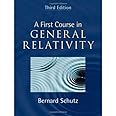
I used this book back at University for the course of General Relativity. I took it while being an undergraduate whilst the course was meant for graduate students! (I did not do very well, but I passed). For that course we used this book, the first edition, now, I own this third edition. I must say that: Most chapters have been expanded. Also, the presentation of the Einstein Equations are now much more clear, it is a great derivation I think! The first chapter is a quick introduction to Special Relativity, with amusing things like the addition velocity law and space-time diagrams. Then follows a chapter of vectors in SR. Then a chapter on Tensors, it is very good introduction about this topic. I must say that the geometric interpretation of a one-form, I think is erroneous, it is just a vector, which happens to be dual to the usual vectors nothing more, not surfaces in space! (But I could be wrong so don't take me too seriously about this) There is a chapter about Christoffel symbols and curvilinear coordinates but still in flat space. Then comes Curvature, with the Riemann Tensor and its contractions and the Bianchi identities. Then comes Curve Manifolds, although it talks about the concept "Manifold" it never gives a proper definition of what a Manifold is. Ah I was forgetting, there is a chapter that describes Dust and Perfect Fluid Energy Momentum Tensors with a little bit of Thermodynamics, this chapter is excellent! Then comes the Chapter of Einstein Field Equations, again this chapter has been re-written and is much better now. There are two very fat and new chapters, one about gravitational waves and its detections and another about gravitational wave astronomy, very, very interesting. The book also presents one chapter about Spherical solutions to Einstein's equations for example for a star with the exterior and interior parts (of the solution), this chapter has been expanded as well and you have one chapter on Black Holes, first the Schwarzchild black hole and then the Kerr black hole. In the exercises which by the way are very good and a lot for each chapter, introduces the Eddington-Filkenstein coordinates which show that the singularity r=2M is just a coordinate singularity and not a real spacetime singularity as is the case of r=0. Material has been added on things like Hawking radiation. Finally the book ends with a chapter on Cosmology. This book is the essential introduction to General Relativity, that you must go through in order to get your first steps into the subject and then take as me, Carroll and then Wald or Weinberg. There is an amusing discussion of the gedanken experiment of Einstein about gravitational redshift also somewhere in the book. Also there is a chapter about weak gravitational fields, Excellent book!
B**N
Excellent introduction
Very well written and more easily understood for self-study than either Carroll or Misner-Thorne-Wheeler. I recommend getting the associated "Student's Manual" by Scott and working the exercises.
P**.
Great book, print on demand binding (hardcover)
I wish there were an option to pay an extra $20 for smith-sewn binding. But the content is great and my understanding is that this edition has substantially new and revised material to justify starting here rather than the 2nd edition. I also ordered a used paperback copy of the 1985 1st edition because it has some solutions to problems, which may help with self-learning. These solutions may also be available on line, but I’m happy to have the paperback for portability and easy holding, while I study the basics in the early chapters (probably not much change between 1st and 3rd editions because the math hasn’t been superseded by research, while the physics, the later chapters, has).
A**R
A textbook of rare clarity
This textbook is ideal for someone who only has a backroung in Special Relativity, since it develops all the tools needed for GR.
A**N
One of the best books on General relativity
Well updated classic text. One of the best in the market.
G**T
Worst intro to GR available.
I had a class based on this book years ago. I should say since then I have seen many introductory books on GR and I consider Shultz to be the worst introduction available. It constantly loses the forest behind the trees, dives into the formalism right away and gives no motivation for it whatsoever. Did I get through what was covered? Yes. Could I have done that with much more comfort using books like Hobson or Nightingale or Hartle? Also yes. My personal favorite is Hobson, I highly recommend that as your first book on GR.
D**Y
Good book
I self learnt GR from this book over the course of a year. I already had the first edition but I bought the third edition because of updated material on cosmology, black holes, neutron stars and gravitational waves. Overall I like this book and recommend it if you have a lot of time. If you are short on time, consider Foster and Nightingale which is also a good book but much more terse than this. This review will be peppered with comparison with Foster and Nightingale. If you want a deeper understanding, get this book. Be aware that first 8 chapters are exactly the same as first edition with minor typo fixes. So if you already have first or second edition, work through that first. If and when you get past chapter 8, you can get the third edition.Pros1. Uses geometrized units. Initially it is weird to measure mass and time in meters but you soon realize the benefits. The equations are not cluttered with various powers of G and c and calculations are less tedious. (This is not the case with Foster and Nightingale which uses SI units so G and c everywhere in that book!).2. The updated chapter on Cosmology is very good and that alone makes it worth getting this new edition.3. Even though this is a GR book, it teaches SR in considerable detail. So if you don't have background in SR and want to do GR, this is a good book to get. In comparison, SR is relegated to an appendix in Foster and Nightingale and is not taught in as detail as in this book. Also, don't use A.P. French for learning SR - it is an old book and does not use 4 vector notation which is essential to GR.4. It teaches tensor calculus in more detail than most other GR books though I strongly recommend supplementing this with Schaum's outline of Tensor Calculus. That is a very good book and without it I would have probably given up on this book. Foster and Nightingale does a poor job of teaching tensor calculus. It ramps up really fast.Cons1. The first edition contains answers to selected problems. The answers were removed in the second edition. I do not know why authors do that. Answer is not the same thing as solution. Fortunately I had bought first edition 20 years ago. It has been tremendously helpful to check my answers. Without the first edition I would have probably given up on this book. Note - Foster and Nightingale has solutions (not just answers) in the back for all problems so in that regard Foster and Nightingale is better.2. Too many problems to solve. Generally I am in favor of more problems at the end of chapters but this book has way too many. Many problems have multiple parts and each part asks you to calculate multiple things. So if a chapter has 35 problems, they are more like 70-80 problems to solve. Author himself acknowledges in Preface that there are too many problems for a student to solve. I am in favor of having large number of problems if they are classified as "Essential" and "Advanced" which this book does not do. As a self learner I am often left wondering if I am wasting my time solving a problem because it is too advanced for my level.3. Chapters on gravitational waves are very long - It is clear that gravitational waves is author's favorite topic. There are two long chapters on them. So if gravitational waves is your thing then this is a great book else it is a slog to work through these chapters. Ironically, in spite of long chapters, the development of traceless transverse gauge is mostly left as an exercise for the reader! I found this odd. I really struggled with TT gauge because it is not derived properly in the book.4. Just after a couple of months of use the binding of the book started to unravel. This is a book that should have been bound to withstand thousands of hours staying open time. Poor binding.5. Form factor - I really miss the form factor of first edition. First edition is paperback and has the form factor of a novel. I can hold it in one hand and read it in bed. This one is hardcover, heavy and large. Need to hold with both hands. However, the typesetting is more spacious so that is nice.6. New typos introduced - while typos in first eight chapters have been fixed, because of new material in subsequent chapters new typos got introduced but they are not too many, so it's mostly OK.7. Less than stellar description of Kerr black holes - There are glaring omissions in the section about Kerr black holes. For some reason, the author ignores one of the two quadratic solutions that lead to the Kerr horizons so fails to mention that Kerr BH actually has two horizons. Absolutely no mention of ring singularity which is a key feature of Kerr BH. A diagram showing ergoregion, both horizons and ring singularity is crucial to understanding Kerr BH but the book has no such diagram. Even a book like Foster and Nightingale which is half the thickness of this book has a better description of Kerr BH.
Trustpilot
1 month ago
3 weeks ago
1 month ago
1 month ago