🔆 Charge Smarter, Live Freer — The Ultimate Solar Controller for the Modern Adventurer
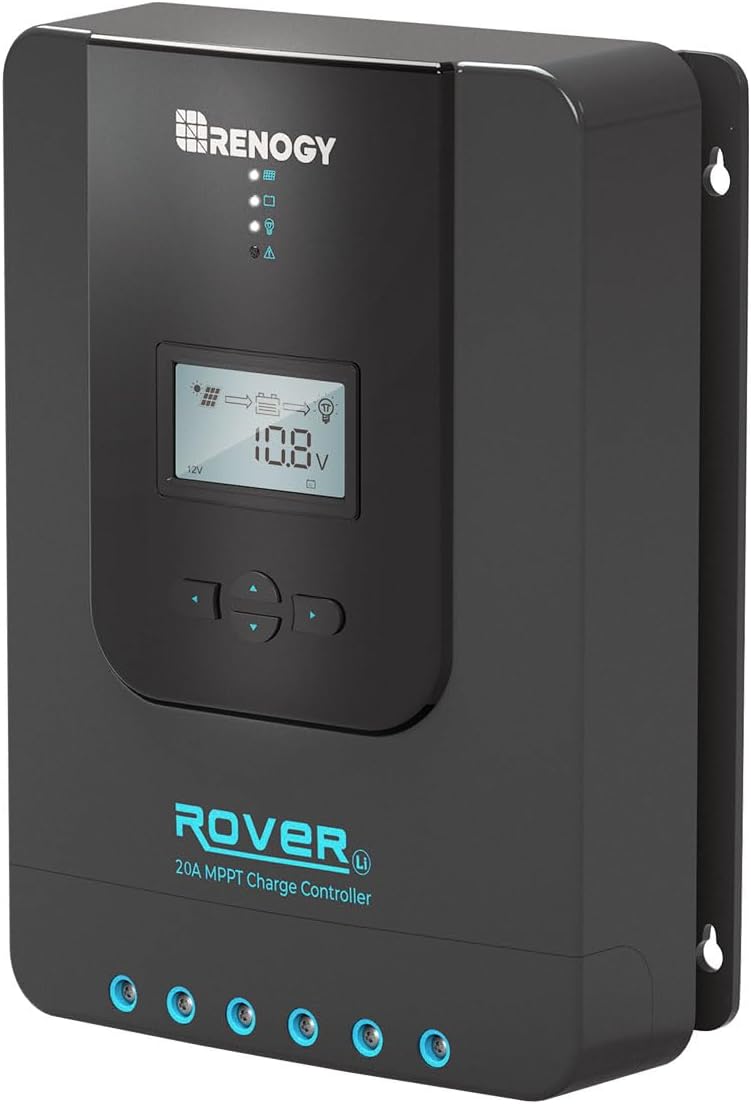
The Renogy Rover 20A MPPT Solar Charge Controller is a high-efficiency, dual-peak 12V/24V controller designed for off-grid, RV, and marine solar systems. Featuring advanced 4-stage charging, temperature compensation from -40°F to 149°F, and robust protections including 6kV lightning and reverse polarity safeguards, it supports multiple battery types including lithium. With an adjustable LCD display, 365-day data logging, and optional Bluetooth monitoring, it empowers professionals to optimize solar energy use and manage DC loads seamlessly.


| ASIN | B01MRWTAB5 |
| Best Sellers Rank | #11,189 in Patio, Lawn & Garden ( See Top 100 in Patio, Lawn & Garden ) #5 in Renewable Energy Controllers |
| Brand | Renogy |
| Brand Name | Renogy |
| Color | black |
| Customer Reviews | 4.4 out of 5 stars 3,790 Reviews |
| Display Type | LCD |
| Global Trade Identification Number | 00816360024644 |
| Included Components | Rover Li 20 Amp MPPT Charge Controller |
| Item Dimensions L x W x H | 8.27"L x 5.94"W x 2.34"H |
| Item Type Name | 20A MPPT Charge Controller 12V/24V Auto DC Input Solar Charge Controller, Parameter Adjustable, LCD Display Solar Panel Regulator, fit for Gel Sealed Flooded and Lithium Battery, Rover 20A |
| Item Weight | 680 Grams |
| Manufacturer | Renogy |
| Material | Plastic |
| Material Type | Plastic |
| Product Dimensions | 8.27"L x 5.94"W x 2.34"H |
| UPC | 816360024644 |
| Unit Count | 1.0 Count |
| Voltage | 24 Volts |
| Warranty Description | 3-year material and workmanship warranty |
L**.
great product
The price you pay seemed high until you set it up and it just works. It took a few minutes to get the setup right but once it's done it does the job very well.
C**R
3 years later, still working great!
I use this a couple times a year for the last 3 years with no complaints. Works great with a pair of 48V panels to charge a 200ah SLA AGM deep cycle battery without any issues. I previously had a smaller controller that the 48v panels fried, but this handles it great and the LED screen is nice too.
G**.
Excellent MPPT Upgrade, Easy Setup, and Better Low-Light Performance
I bought this Renogy 60A MPPT charge controller on April 4, 2025, and after 11 months of use I’m very happy with it. It was a great upgrade from my old Tristar 45 PWM controller and has been noticeably more efficient. My old PWM controller struggled early in the morning, near sunset, and during cloudy weather. This Renogy starts charging much sooner and handles lower-light conditions far better. It keeps my battery voltage right where it should be. I bought the 60A model even though it was more than I needed at the time because I wanted room to expand my solar setup later. No regrets there. Right now I’m using it with a 140Ah 12V LiFePO4 battery and a 350W solar panel. Installation and setup were very easy, and the menus are clear and simple to use. I haven’t used every feature yet, like data logging, but based on my experience so far, this has been an excellent purchase.
D**E
Need to Customize for LiFePO Batteries
This works well to charge LiFePO batteries - but you have to change the settings. The default "Li" (Lithium) setting doesn't do it. I don't know what logic it applies in the "Li" setting, but my LiFePO batteries went dead. Once dead, the controller would not apply any current to recharge them. I had to change the battery type to "USE". The "USE" setting allows you to set the battery charging parameters - Equalizing voltage (which you can't shut off, but doesn't apply to LiFePO batteries), Boost voltage, Floating charging voltage, over-discharge return voltage, Over-discharge voltage - to your LiFePO battery's specs. Once done, they charged very quickly and stayed that way. LiFePO batteries typically have a built-in BMS unlike Lithium Ion batteries. Also, the manual that comes with the unit is nowhere near as detailed as the one that you can download from here (or Renogy's site). What's included in the box is pretty much a quick-start guide that doesn't get into detailed settings.
Z**L
Great efficiency & highly configurable
I replaced an old direct from China PWM converter with a Renogy Rover 20 amp for my camping solar rig. The improvement has been pretty remarkable. I'm really happy with the configuration, efficiency, and safety of this design. The efficiency gain going from PWM to MPPT is noticeable. More importantly for me, the ability to program the charging parameters from a laptop allowed me to use a custom lithium battery pack and get the target voltages exactly where I want them. I camp with a 70 Ah lithium pack built into a "suitcase" with the the Renogy Rover, fuse box, switches, inverter, etc. A big selector switch in the box lets me swap between my internal lithium and an external sealed lead acid batter for those times when the weather doesn't cooperate, and I need a little more juice. The Rover easily switches between "SLA" battery mode and my "USER" mode for the lithium. Best for me, the protection circuitry in the Rover shuts everything down long before voltages get anywhere near damaging my lithium if I forget to switch modes. The only knock I'd give on this controller is that the software to configure it is pretty rough around the edges. I had to reconnect and reboot frequently as it lost sync with the Rover, and the initial setup of the software isn't intuitive. Read the Fine Manual... The software is Windows only as well which is inconvenient for a Linux/Mac user. Still, after a bit of fiddling & testing (with a bench power supply standing in for solar panels over this LONG winter), it configured the Rover to the exact charging parameters I wanted for my lithium. All the settings are remembered when the controller is powered down. I'm ready to camp this summer!
A**A
Gave Renogy a Second Chance and they failed.
Initially, I bought a Rover 30 for my solar panels back in 2022. It failed after 6 months. Renogy would not honor the warranty because they said the charge controller for my wind generator voided it, even though there was nothing in the warranty language that prohibited it. After 1.5 years with an unbranded hybrid MPPT that could take wind, I decided to take the wind offline, add two more panels. The Rover 40 seemed to make sense in that application. I hoped that this time the Renogy, which does well in converting high voltage low amp current from the panels to 24V/high amp charging current, would serve its purpose well. For the first couple weeks, it did very well. But now about once a day, I have to take off, reposition, and re-connect the battery cables. It work fine for a while, and then stop charging. Then I am running straight off the batteries until they run down. Seems the battery cables will not stay connected despite my best efforts. I've noticed in different reviews, others have also had issues with their terminals. One person complained that the screw stripped out, which suggests to me they were trying the get a good, lasting connection. I don't think this problem is unique to me. Since I am still within 30 days and since I had poor experience with their customer service previously, I'm not taking any chances. I've orderd a Vectron to replace this, and as soon as it arrives this thing is going back into the box and back to Amazon. No more Renogy products for me. I'm done with them.
G**H
Well priced Controller - a definite must for small-scale/camping solar applications
Great replacement for the PWM controller that came with our Renogy Solar kit. Initially we had the Renogy PWM 30 AMP controller and it was an entry level controller in all respects. The previous controller was limited to a 12 volt battery source had 2 lead pairs, one for solar panel connection and the other for the battery side connection. Any load connected to the battery array had to be connected directly to the batteries and was not governed by the controller. Also you had to rely on LED indicator lights To determine when the controller was in charge mode versus float mode. Adequate for an entry level controller but not great. Now lets talk about this controller. First, this controller is capable of 12 or 24 volt wiring installations. 24 volt DC is superior to 12 volt DC because it cuts the Amperage draw in half on the DC end. A 1.2 Amp TV running on AC/120 volts will require 12 Amps on the 12v-DC end to meet the same 140 Watt requirement. A 24 volt DC setup will reduce the amperage requirement down to 6 amps on DC, which means your DC wiring gauge doesn’t have to be as robust when supporting a 24 volt application. Secondly, the LCD display is great and is a must for a solar charge controller. It’s not enough to know that the solar cells are charging the battery, you may also want to know how “fast” they are charging the battery and whether or not the panels should be angled to reach optimized charge rate. The LCD screen also provides a percentage estimate of battery remaining in addition to the amps that are being supplied by the panels, along with a running amp-hour accumulation of charge provided the panels over a period of time and current battery voltage. Third, it has a pair of positive/negative load leads that permit connecting appliance loads up to 20 Amps DC. It’s not necessary to use the load leads for connecting the devices that run off the battery, but the added advantage of using them is that your battery array is protected from over-consumption, as the leads shut off usage on the battery once it reaches a certain level of discharge in order to protect the battery array. I’ve only used the new controller once, but the instructions were easy to follow and I made a laminated copy of the LED and Menu options as a quick reference guide that will go along with the kit on camping trips. Currently the array powers my 400 Watt (4x100W) kit and 2 VMAX 125ah batteries wired in parallel, but I am seriously thinking of doubling the panel array and adding 2 more batteries in a series/parallel configuration to take advantage of the 24 volt capabilities of this controller. Quick Note on the 100 Watt Renogy panels: When I measured the charge current of the 4 x 100 watt panels connected in Parallel I noted an 18.5 amp charge rate on the new controller or ~4.6 amps per panel. That seemed low to me given that 400 watts/12v is around 33.3 amps, or 8.33 amps per panel. In discussions with Renogy support I found out that the 100 Watts is calculated at 17.9 volts * 5.7 amps, where they use the maximum charge voltage by each of the panels as basis for the calculation. Just something to be aware of when you are reading sub-5 amps per panel charge rate on your controller. This new controller works as advertised, was relatively inexpensive for what it does, and I may update the review again in 12 months after running it a few more times for a consistency check.
S**U
Perfect for my needs.
Exactly what I wanted, works great.
Trustpilot
2 weeks ago
2 weeks ago