We remain fully operational. Our teams are working around the clock to ensure your deliveries continue safely.

DOWNLOAD THE APP


Customer Services
Copyright © 2025 Desertcart Holdings Limited
DOWNLOAD THE APP


🌟 See the unseen, control the light like a pro!
These 3 premium 7.8x5.9in linear polarizing film sheets deliver over 99.9% polarization efficiency with dual protective layers. Ideal for educational physics experiments, glare reduction in photography, and advanced light manipulation, they offer a versatile, non-adhesive solution to mastering polarized light effects.
| ASIN | B08XWDJ4GM |
| Best Sellers Rank | #62 in Lighting Filters |
| Customer Reviews | 4.2 4.2 out of 5 stars (263) |
| Date First Available | December 2, 2020 |
| Item Weight | 1.76 ounces |
| Item model number | GEL-14 |
| Manufacturer | RENIAN |
| Product Dimensions | 8.27 x 5.91 x 0.1 inches |
T**L
Eliminate reflections from a textured surface
I need to take some images of my son‘s paintings that he does on textured canvas. Using flash or studio lights creates a lot of reflection in the textures. I took one sheet. I put it on horizontally on the right light as the other sheet was put on the left light vertically this eliminated all reflections on the paintings. Sure beat the heck out of Photoshoping those little white dots out of the paintings.
H**I
Great to show mind-blowing STEM science
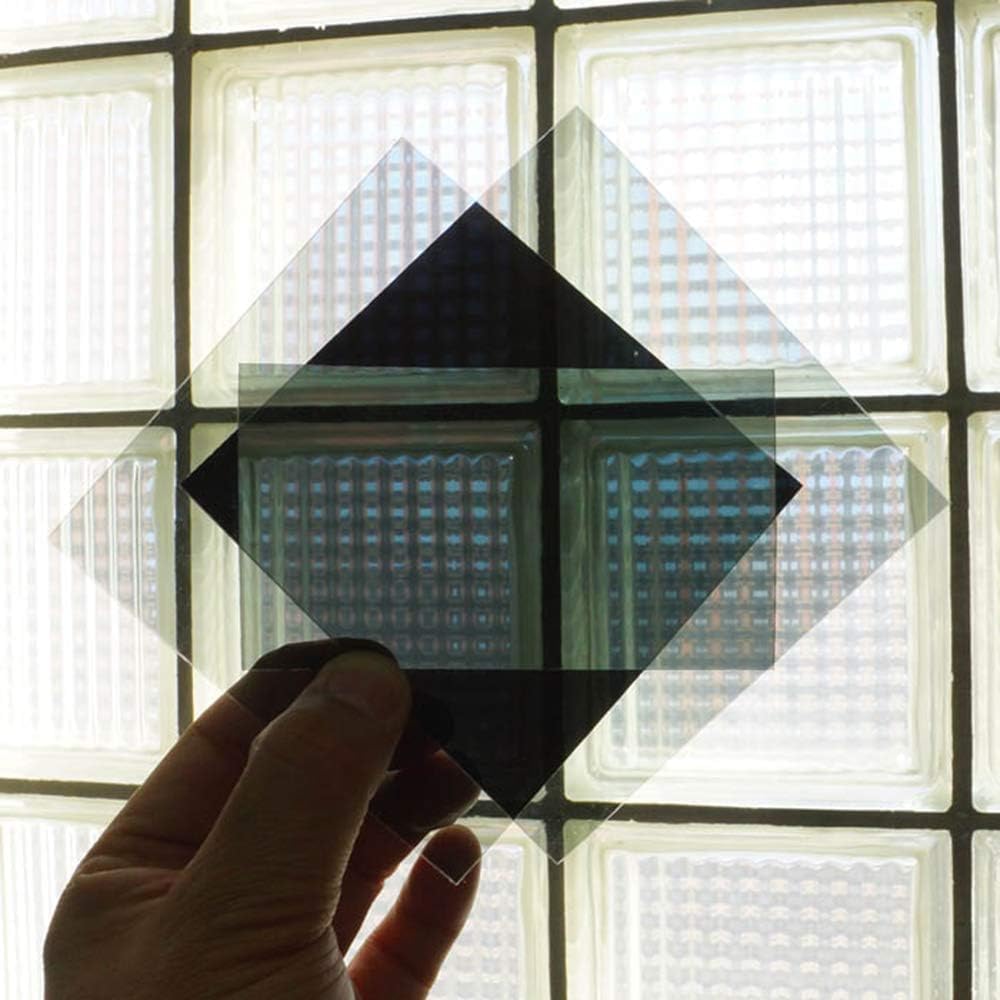
Here's a simple STEM experiment that will defy most folks' predictions. Step 1. Attach first piece of the film to the window with painter's tape (see red rectangle in picture). Discuss how it blocks some of the incoming light, because light acts like a wave, and has an orientation. The film can be thought of as having vertical bars, and thus only the portion of the light that is aligned with those vertical bars makes it through. (For purposes of the experiment, describe the light that passes through as having "vertical" polarization.) Depending on the experimenters, you could draw a unit circle, and explain why ~50% of the light passes through the first sheet. Step 2. Temporarily place the second piece of the film at the same orientation as the first piece. Discuss why it doesn't block much more light. (the light that passed through the first piece was polarized vertically, so a second layer of "vertical bars" won't block much more.) Step 3. Slowly rotate that second piece of the film to the window until it's at a right-angle to the first (see blue rectangle in picture). Discuss why it's now blocking essentially all the light. (Light after first piece is all vertical, so there's no horizontal part to the light ... while the second sheet is now only allowing through the horizontal part, which is zero). Step 4. Tape that second piece as shown in the picture, making an "L" shape with the two pieces. Where the two pieces do not overlap, ~50% of the light will be passing through. Where the two pieces overlap, there will be ~0% light passing through. Step 5. Temporarily place the third piece of film on top of the other two pieces of film, as shown (green in picture). Discuss the amount of light that ends up passing through at each place. A. where 1st+3rd or 2nd+3rd films overlap: ~1/3 of the light is passing through (as expected) B. where 1st+2nd films overlap: ~0 of the light is passing through (as expected) C. where all three films overlap: ~0 of the light is passing through (as expected) So far, so good. Typical stuff that many high school physics classes have shown. This is where it will get WEIRD, and VERY non-intuitive results will occur. Step 6: Ask what folks to write down what they think will happen if, instead of the third film being layered on top, it was placed ***BETWEEN*** the first two films. Specifically, would the amount of light passing through anywhere change much vs. it being layered on top? Step 7: Slide the third film so it goes between ... and enjoy the expressions of bewilderment, curiosity, and disbelief! That's just AWESOME ... it's like a magic trick that takes no practice. It boggles the mind! Enjoy!
R**A
It does what I supposed to.
I use it for polarizing light coming out of lamps for photography. They work. Not the best quality you could expect, but for the money, they're decent. The polarizing effect is as expected.
H**S
muy buenas
K**T
The work, are affordable
These do work, but they let off an odd odor that also lingers on your hands after you touch them.
A**E
Packaging allows the Polaroid filters to be damaged
I disliked that the warehouse or packaging personnel do not understand that damaged filter are not of use. The damage is nearly in the middle of the filters (all 3 damaged). Polaroid filter is very thin.
R**L
Impossible to uncurl
Their filtering property works well, but they arrived with an extreme tendency to curl up (as though they had been stored curled in a tube), and it was impossible to flatten them, even after leaving them pressed by lots of weight over days. This made them near-impossible to use for scientific demonstrations.
G**D
They work well
These sheets work well for crossed polarization with my microscopes but they are not flat. They have a natural curl in them which is quite difficult to straighten
K**N
Perfect
P**W
Timely delivery
C**Y
The polarization of the light is excellent 2 sheets on top of the other will block all light at a certain angle. Also through a single sheet some reflections on various objects disappear, making it a good tool to take a photo through glass or to enhance the sky when partially cloudy.
N**S
Ich verwende es, um Fotos von meiner Arbeit (Tattoos) zu machen, und es passt sich meinen Bedürfnissen sehr gut an, aber mir wurde klar, dass ich zum Ausgleich ein sehr starkes Licht brauche.
J**O
Me pareció al principio un producto caro por las dimensiones pero en cuanto llegó lo probé y me gustó porque las hojas son lo suficientemente gruesas para acortarlas a las superficies correspondientes y además ambos lados son útiles. Se consiguen negros más sólidos y nitidoz para fotografía de tatuaje (para lo que ocupada el filtro) y en general. Muy buen producto 👌🏼
Trustpilot
2 weeks ago
1 month ago