

Siddhartha
Product ID: 276888101
Buy anything from 5,000+ international stores. One checkout price. No surprise fees. Join 2M+ shoppers on Desertcart.
Desertcart purchases this item on your behalf and handles shipping, customs, and support to Morocco.
Siddhartha is a novel by Hermann Hesse that deals with the spiritual journey of a boy known as Siddhartha from the Indian subcontinent during the time of Lord Buddha. In a very simple prose, Hesse has conveyed a very profound message for all seekers. A brahmin boy follows his heart and goes through various lives to finally understand what it means to be enlightened. He experiences life as a pious brahmin, a Samana, a rich merchant, a lover, and an ordinary ferryman, to a father. Neither a practitioner nor a devotee, neither meditating nor reciting, Siddhartha comes to blend in with the world, resonating with the rhythms of nature, bending the reader’s ear down to hear answers from the river... Review: Amazing book - Classic. Must read Review: As this story tells us, wisdom cannot be taught. - "Siddhartha" means "one who achieved his goals" or "every wish has been satisfied". The name of Buddha, before his renunciation, was Prince Siddhartha Gautama, later after attaining enlightenment he came to be called as Gautama Buddha. The literal meaning of Buddha is one who has attained Bodhi; and bodhi is meant wisdom, so Buddha means “the enlighten one”— the knower. I had wanted to read Siddhartha by Hermann Hesse for a long time. I am not very fond of spiritual literature, and even shun it many times, but still something in this book caught my attention. I had heard enough good things about this author to understand that giving Siddhartha a chance was worth it. So I started it, driven more by impulse than by something painstakingly deliberate and planned. So I bought this book in around 2018 and read the first two chapters in two weeks. This may not speak highly of the literary or spiritual content of Siddhartha, but I actually feel that I failed to advance at an adequate speed because at that time I had not "opened up" to what Hesse could tell me. However, in 2020 during the lockdown, I gave him a chance again and tried to embark on reading in a different way, perhaps more private or personal; and, as you will see, I have already finished it. And I must accept that it was an extraordinary journey, through which I traveled with the Sramana Siddhartha in his search for supreme wisdom and peace of the soul in a voyeuristic but no less authentic way. When it comes to Hesse, there is no need to talk about how well written his novel is, about the perfect approach he makes to nature, about the poetry that jumps off the pages when he talks about man and his tribulations. When it comes to Hesse all this is inherent, it is preferable, I think now, to speak of sensations. Siddhartha, speaks to us about many things, is very spiritual and deep in the sense of self, being and soul. It is a book that can be read quickly, in two days if you have time, but I think you have to take it gently, in order to understand it, at least try to understand it and I think that I had to read it often, to be able to give it meaning of words, although some are clearer than water. The many teachings that the book has is a mystery, because there are several, the philosophical sense, the venerable, cultured interior answer, depth of knowledge and knowledge. The plot is narrated from the perspective of Siddhartha, son of Brahmans (priestly caste of India), who cannot find through regulated religiosity a way to satisfy his thirst for knowledge, his desire to find the first cause of things. Therefore, he decides to leave and go his own way in search of the ultimate truth of life. In my view it is precisely the words of Hesse that make this novel such a delicacy. Its symbolism, its universality and the delicate simplicity when expressing Siddhartha's reflections, his fears and concerns, the questions inherent to the human condition. Making an interpretation of the work from its universal philosophical intentionality, I praise the quality of Hesse and I prefer what, for me, is the main message of the work; each one must trace his own path, we must be our own guide. In Siddhartha's words: “I will no longer allow Siddhartha to escape me! I will no longer occupy my thoughts and my life in the search for the Atman or with inquiries about the suffering of the world. I am not going to kill myself again and fragment myself to search for a mystery behind the ruins. I will no longer be instructed by the "Yoga-Veda", the "Atharva-Veda", the ascetics or any other doctrine. I want to learn about myself, be my own disciple, know myself and penetrate this enigma called Siddhartha " Words of Wisdom “Once you hear this phrase: you are wise when it is useless. He believed that only time and perseverance teach us.” “Premature knowledge is just a mere illusion of true knowledge that only arises in the middle of the years and the different experiences of life.” “I have needed time to learn, and I still have not managed to understand that nothing can be learned! How true!” “Words are harmful to the secret meaning of things; everything changes slightly when we express it, it seems a bit distorted, a bit silly ... " “The human does not know how to live and does not know what he lives for, he has erroneous dreams and vain goals, we despise what we should love and we love what we should hate. Little by little we move away from our humanity and meaning, but we do not get to see the ambiguous paths that we choose, we do not see the paths that society itself has implanted for us to follow.” Concluding thoughts As this story tells us, wisdom cannot be taught. Decomposing information into language may become feasible, but it is not so with experience. Wisdom is achieved through the inner being, from the outside to the inside, and it is highly personal. Similarly, Siddhartha, somewhat contradictorily, can make many ideas clear, some somewhat controversial and others revealing. It is a reading that I highly recommend, as long as it is read with an open mind. I cannot say more since this path must be traveled by oneself and discovered in private. So here you go, go ahead and let yourself go.


| Best Sellers Rank | #1,530 in Books ( See Top 100 in Books ) #55 in Classic Literature & Fiction #221 in Literary Fiction #296 in Genre Fiction |
| Customer Reviews | 4.5 out of 5 stars 4,249 Reviews |
A**R
Amazing book
Classic. Must read
R**H
As this story tells us, wisdom cannot be taught.
"Siddhartha" means "one who achieved his goals" or "every wish has been satisfied". The name of Buddha, before his renunciation, was Prince Siddhartha Gautama, later after attaining enlightenment he came to be called as Gautama Buddha. The literal meaning of Buddha is one who has attained Bodhi; and bodhi is meant wisdom, so Buddha means “the enlighten one”— the knower. I had wanted to read Siddhartha by Hermann Hesse for a long time. I am not very fond of spiritual literature, and even shun it many times, but still something in this book caught my attention. I had heard enough good things about this author to understand that giving Siddhartha a chance was worth it. So I started it, driven more by impulse than by something painstakingly deliberate and planned. So I bought this book in around 2018 and read the first two chapters in two weeks. This may not speak highly of the literary or spiritual content of Siddhartha, but I actually feel that I failed to advance at an adequate speed because at that time I had not "opened up" to what Hesse could tell me. However, in 2020 during the lockdown, I gave him a chance again and tried to embark on reading in a different way, perhaps more private or personal; and, as you will see, I have already finished it. And I must accept that it was an extraordinary journey, through which I traveled with the Sramana Siddhartha in his search for supreme wisdom and peace of the soul in a voyeuristic but no less authentic way. When it comes to Hesse, there is no need to talk about how well written his novel is, about the perfect approach he makes to nature, about the poetry that jumps off the pages when he talks about man and his tribulations. When it comes to Hesse all this is inherent, it is preferable, I think now, to speak of sensations. Siddhartha, speaks to us about many things, is very spiritual and deep in the sense of self, being and soul. It is a book that can be read quickly, in two days if you have time, but I think you have to take it gently, in order to understand it, at least try to understand it and I think that I had to read it often, to be able to give it meaning of words, although some are clearer than water. The many teachings that the book has is a mystery, because there are several, the philosophical sense, the venerable, cultured interior answer, depth of knowledge and knowledge. The plot is narrated from the perspective of Siddhartha, son of Brahmans (priestly caste of India), who cannot find through regulated religiosity a way to satisfy his thirst for knowledge, his desire to find the first cause of things. Therefore, he decides to leave and go his own way in search of the ultimate truth of life. In my view it is precisely the words of Hesse that make this novel such a delicacy. Its symbolism, its universality and the delicate simplicity when expressing Siddhartha's reflections, his fears and concerns, the questions inherent to the human condition. Making an interpretation of the work from its universal philosophical intentionality, I praise the quality of Hesse and I prefer what, for me, is the main message of the work; each one must trace his own path, we must be our own guide. In Siddhartha's words: “I will no longer allow Siddhartha to escape me! I will no longer occupy my thoughts and my life in the search for the Atman or with inquiries about the suffering of the world. I am not going to kill myself again and fragment myself to search for a mystery behind the ruins. I will no longer be instructed by the "Yoga-Veda", the "Atharva-Veda", the ascetics or any other doctrine. I want to learn about myself, be my own disciple, know myself and penetrate this enigma called Siddhartha " Words of Wisdom “Once you hear this phrase: you are wise when it is useless. He believed that only time and perseverance teach us.” “Premature knowledge is just a mere illusion of true knowledge that only arises in the middle of the years and the different experiences of life.” “I have needed time to learn, and I still have not managed to understand that nothing can be learned! How true!” “Words are harmful to the secret meaning of things; everything changes slightly when we express it, it seems a bit distorted, a bit silly ... " “The human does not know how to live and does not know what he lives for, he has erroneous dreams and vain goals, we despise what we should love and we love what we should hate. Little by little we move away from our humanity and meaning, but we do not get to see the ambiguous paths that we choose, we do not see the paths that society itself has implanted for us to follow.” Concluding thoughts As this story tells us, wisdom cannot be taught. Decomposing information into language may become feasible, but it is not so with experience. Wisdom is achieved through the inner being, from the outside to the inside, and it is highly personal. Similarly, Siddhartha, somewhat contradictorily, can make many ideas clear, some somewhat controversial and others revealing. It is a reading that I highly recommend, as long as it is read with an open mind. I cannot say more since this path must be traveled by oneself and discovered in private. So here you go, go ahead and let yourself go.
T**K
Great book to read again!
I love this book. I read it years ago in college and reading it again. it's a very wonderful to see him go through all the stages to come to. appreciate the present moment.
A**L
Its not about Gautam Buddha
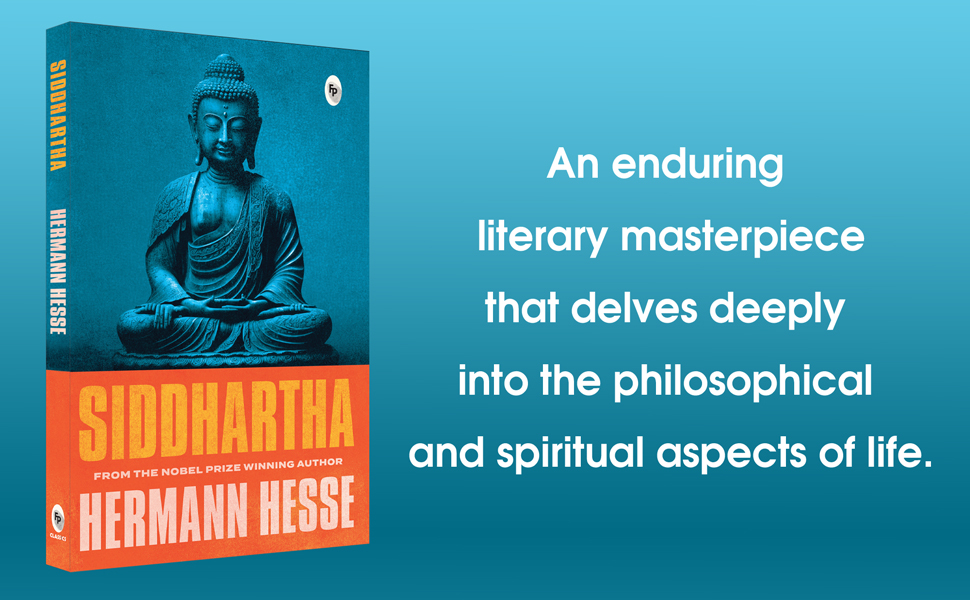
The book is good but this low star is just to draw the attention of those who can give try to this book only they may think this is about Gautam Buddha because of its cover and the name Sidhartha but its not about Gautam Buddha, the cover of this book can be misleading, before buying read about it
L**N
Good price for a good copy
Compared with other Hesse’s book I bought the other day, this book is unbelievably cheap. Not a very thick book, nor too difficult to keep reading. Print is good and I don’t find why this book is this cheap. Maybe Siddartha is a lot easier to acquire? I like reading Hesse so have no complaint. Thank you.
S**A
teaches us many valuable lessons about living an awakened, conscious, and spiritual existence.
The highly influential and infamously popular book Siddharth by Hermann Hesse is a remarkable text that every spiritual seeker needs to read. It depicts the story of a young man named Siddhartha who is on a quest for knowledge and a deeper understanding of himself. Here’s a Brief Plot Synopsis of Siddhartha The context of Hesse’s novel begins with the life of Siddhartha. He is born into a prominent Indian-Brahman (priest caste in India) family where his childhood was surrounded by religious texts, spiritual teachings, and devotion. From the beginning, the young Siddhartha is wise beyond his years. He adheres to a lifestyle of meditation and simplicity. Siddhartha has everything he needs but chooses to leave it all in search for his life’s purpose. An excerpt from the book highlights this: “Within Siddhartha there slowly grew and ripened the knowledge of what wisdom really was and the goal of his long seeking. It was nothing but a preparation of the soul, a capacity, a secret art of thinking, feeling and breathing thoughts of unity at every moment of life.” Siddhartha is an avid truth-seeker, and his ascetic nature at a young age propels him to leave home and live with monks known as Samanas. His childhood friend Govinda accompanies him on this journey. Here they both learn to live with no attachments, minimal food, and live the life as nomads. We Can Learn Something From Every Moment Along the journey, Siddhartha becomes part of a sacred tribe and learns the value of stillness, breath, and fasting. The Samana way teaches Siddhartha a deeper connection with all living beings and creatures – feeling at peace with the process of birth and death, just like the cycle of life. A pivotal moment in Hermann Hesse’s novel is encountering a character by the name of the Ferryman (Vasudeva). Siddhartha, as a young man, learns the language of the river and nature from the Ferryman: “Have you also learned that secret from the river; that there is no such thing as time? That the river is everywhere at the same time, at the source and at the mouth, at the waterfall, at the ferry, at the current, in the ocean and in the mountains, everywhere and that the present only exists for it, not the shadow of the past nor the shadow of the future.” Every interaction Siddhartha has within the novel shapes his soul in a profound way. Siddhartha does not realize until later, however, that the spiritual path is within his soul – always present within his entire existence and in alignment with his purpose. At the end of the text, Siddhartha is reunited with his friend Govinda. While they’re speaking, Siddhartha asks his dear friend to gently press against his forehead. At that moment, you see that Siddhartha illuminates a magnetic force within himself and he is connected to everything. Every sage, ancestor, lineages were felt by Govinda. Siddhartha finally realized that the source was always within him in his older age. The seeking finally came to an end. Here Are 7 Life-Changing Lessons You’ll Learn from Siddhartha: There are many valuable life lessons presented in this narrative – lessons that are worth reviewing if you’ve already read Siddhartha and lessons that are worth cracking the book open if you haven’t: 1. You are your own guru Respect and learn from others, but don’t hold anyone’s power or wisdom above your own. 2. Your journey is not like anyone else’s Embrace your unique path and avoid playing the comparison game. 3. In life, there will always be challenges Embrace life’s challenges as necessary for your evolution – they’re here to teach you! 4. Release the impulse to constantly seek the next big thing Replace this impulse with an ability to remain open, aware, and humble. Ultimately this is how we grow. 5. Presence is key to evolution Like the river’s journey in the story, we learn that our actions of today are what define us. 6. You must live by – and trust – your life purpose We each have a unique gift and purpose to share with the world. Find yours and live by that compass. 7. Change is the only constant By trusting yourself and the Universe, you can begin to flow with the waves of change, rather than resist them. Indeed, Siddhartha teaches us many valuable lessons about living an awakened, conscious, and spiritual existence. when you finish the last page and let the wisdom and inspiration wash over you like a transcendent wave.
Trustpilot
1 day ago
3 weeks ago