⚡ Clamp it, measure it, master it — power up your precision!
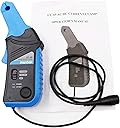
The Hantek CC-65 is a robust AC/DC current clamp meter transducer designed for digital multimeters and oscilloscopes. It measures currents from 20mA up to 65A DC with high accuracy and supports frequencies up to 20 kHz. Featuring a BNC connector for easy oscilloscope integration and a user-friendly clamp design, it delivers reliable, continuous readings without auto shutoff interruptions—ideal for professionals demanding precision and convenience.


| ASIN | B08KZMS4Z2 |
| Best Sellers Rank | #35,616 in Industrial & Scientific ( See Top 100 in Industrial & Scientific ) #27 in Clamp Meters |
| Brand | Hantek |
| Color | Blue |
| Date First Available | October 10, 2020 |
| Item Weight | 8.8 ounces |
| Item dimensions L x W x H | 3.94 x 8.27 x 1.97 inches |
| Item model number | CC-65 |
| Manufacturer | Hantek |
| Measurement Type | Multimeter |
| Power Source | Battery Powered |
| Product Dimensions | 3.94 x 8.27 x 1.97 inches |
| Style | Digital |
| UPC | 611550889924 |
| Upper Temperature Rating | 70 Degrees Celsius |
F**S
Solid performance and accurate
for no critical test it's pretty accurate less than 0.2a off. Here's a video testing three meters a hantek cc-65 a kaiweets ht206d and f-nirsi dcm100 Good price and for most people accurate enough, both a pro and a con it has no auto shutoff. Auto shutoff always seems to kick in when I don't want it to, but on this device I forget to turn it off and come back to dead battery.
J**N
Seems accurate
I got this to try with me new oscilloscope and it seems to work fairly well. Build quality could be better, the zero button tends to get stuck easily, bit is also easy to fix. Comparing to my USB meter as well as my power supply meter it seems to be pretty accurate even <1A. I haven't tried it yet at higher current. The signal is pretty noisy, bit from what I've seen that seems to be expected with these.
P**R
4 stars because it works as described and expected, plus 1 star for value!
I was not expecting a high precision current probe at this price and this is as good as it claims! The accuracy is reasonable, though zeroing is a bit finicky (as described in the instructions ;-)). Zeroing is, of course, most important at the low end of its current range but even there, measurements are repeatable making it fine for relative measurement and comparisons. Though it will detect signals below 20mA (it's rated low end) it is pretty noisy so of limited use. I tested it across its frequency range but not the high end of its current range. It is pretty linear with some distortion appearing as its response starts to roll off near the high end of its frequency range. It works fine with my bench DMM and oscilloscope, though my intended use is primarily with the latter. Definitely a good value. Unless and until I need higher accuracy or range, I would buy another if it fails. If you are even looking at this you know that to get a clip on current probe significantly better would cost much fine gold. Believe the specs and if you think it might work for you, go for it. It probably will and it won't break the bank.
V**R
View DC current transients on your oscilloscope with Clamp-on DC Current Probe.
This inexpensive clamp-on DC current probe works with your oscilloscope to view transient DC currents. We used it to diagnose a video camera that pulled a high surge current from a DC source. In the photo attached, we had a current pulse of about 12A for about 800 usec. We could not have found this without this product.
E**E
A reasonable instrument given the limitations listed below.
What's good: Pretty accurate (within a few percent at low frequencies, although zero drifts a bit) except at low currents. Low price for a current probe. What's not: Clunky design. Probe won't fit in tight spots. On/off/range switch and zero setting control are poor quality I haven't had time to use this very much. However, I did a quick set of tests using a square wave current of 1 ampere at various frequencies. The rise and fall times of the current probe signal were both about 10 microseconds, which corresponds to a bandwidth of about 30 or 40 kHz. (The rise and fall times for the current signal I generated were both 1.2 microseconds, an order of magnitude shorter than those of the probe.) I also tested it briefly at much lower currents. Down to about 100 mA it's pretty good, although the signal is quite noisy. As currents drop below this level, I would have less confidence in the readings because of uncertainty about the zero setting and the noise in the signal. The noise produces a trace that is about 3mV thick, which corresponds to a current of about 30 mA.
L**3
more accurate than I thought it would be
Having owned a Fluke Y8100 for years I was skeptical at this price. But I can report that after making many measurements and comparing with a Fluke meter connected in series with the circuit, the Hanktek is quite accurate (at least up to the 10 amp capability of the Fluke 77) and surprisingly, more accurate than the high dollar Fluke. If you need one you could do worse than this one.
J**C
Check out a YouTube video if you loose the instructions
Watch the YouTube video to see how it works with a VOM meter. You'll need to use BNC to banana plug adapter. It didn't ome with one. Got to remember to set the VOM to the DC volts scale because the clamp converts the current to a DC voltage. Separate the wires in the power cable and clamp the sensor onto one single wire of the power cord , not to all 3 or 2 wires or to the ground wire.
I**A
Works exceptionally well. Measured accurately at uS speeds.
Even at micro-Second (uS) speeds the measurements seemed to be accurate, even for DC voltages. Doesn’t auto-power on or off, so you need to remember to use the switch. Requires 9V battery (not included).
Trustpilot
5 days ago
2 months ago