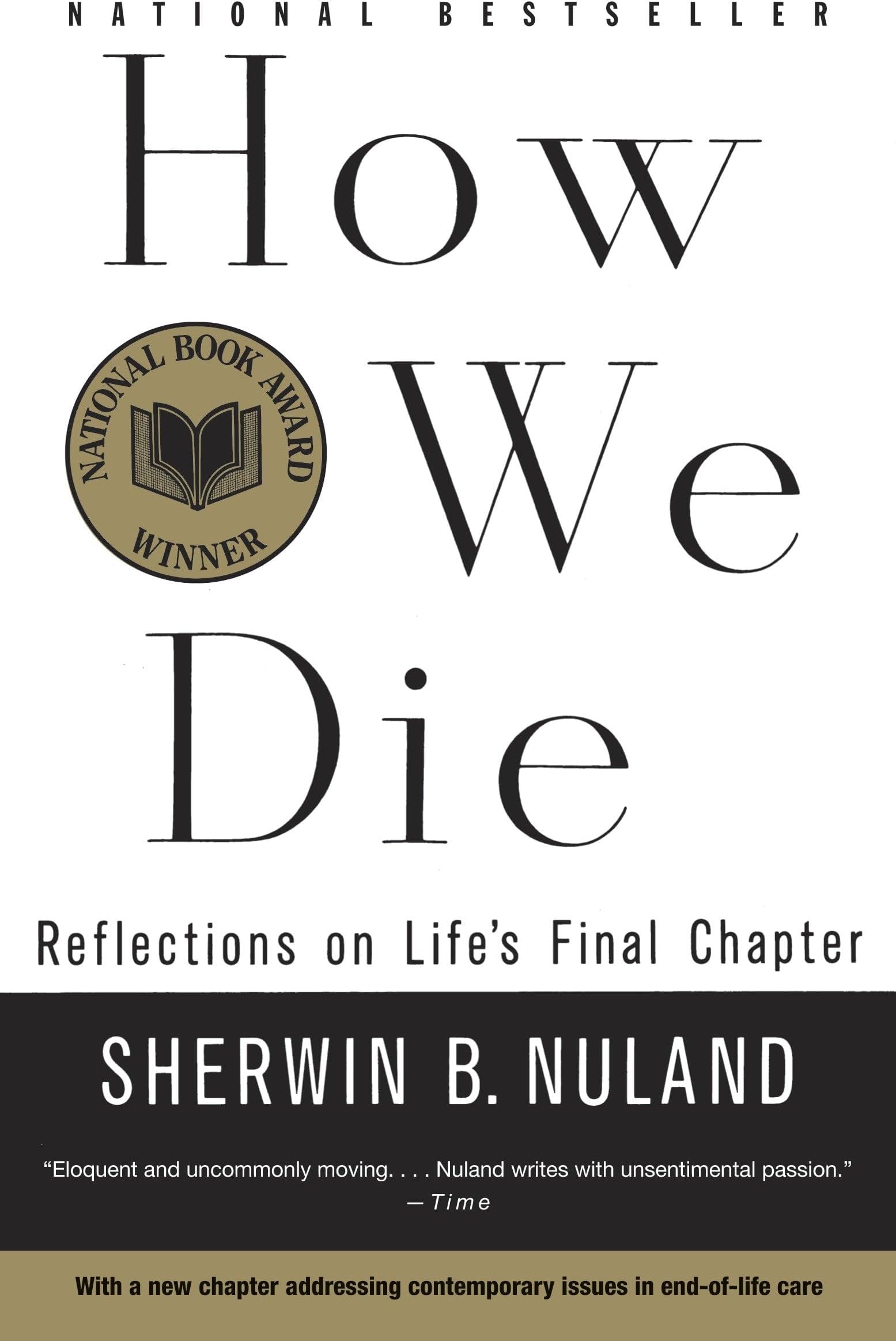

desertcart.com: How We Die: Reflections on Life's Final Chapter, New Edition (National Book Award Winner): 9780679742449: Nuland, Sherwin B.: Books Review: A Guide To Dylng, For Those We Love and For Ourselves - This book is an invaluable guide to deciding on how to care for we love as they approach death, and to thinking about (and planning for) our own deaths. I first read it back in the 1980's, and found it both fascinating and frightening. Dr. Nuland illustrated very clearly that most of us are unlikely to go gentle into that good night, and discussed very movingly how that fact conditions the choices we will have to make . At the time, however, this did not seem terribly relevant to me -- I was, after all, just moving into middle age. . Now, however, I am over 70, and it is an extraordinarily relevant book. Last month, I reread it in the revised edition, as a dear friend for whom I have been responsible came to the end of her life. I only wish that I had read it earlier in this process. What Dr. Nuland said in the 1980's, and again in the 1990's, is still true. All too often, the American medical system still doesn't recognize that some illnesses cannot be cured. A dying patient may be subjected to procedure after procedure, and treatment after treatment, in a vain effort to avoid the inevitable. Hospice may not be called in until the very end, because the doctors and the patient and the patient's family are still focussed on treating the illness rather than the patient. The result is pain, discomfort and disorientation that might have been avoided. Had I realized just how entrenched this bias still is, I would have insisted that chemotherapy be cut off sooner than it was, and that my friend go on hospice sooner than she did. For the future, this book -- and my recent experience -- convince me that if I am diagnosed with a cancer that is likely to kill me, I will enlist a palliative care doctor on my medical team from the start. I only hope that I will find one with a fraction of Dr. Nuland's empathy and understanding. Review: Great read; very interesting and thought provoking - The language is superb! Dr. Nuland writes about the scientific medical truths in such an artistic and beautiful language. I like the way he starts off a serious subject with such drama and fiction (so it seems); but then tapers it to the serious facts of life. He draws us from a fiction to nonfiction with interest and enthusiasm. He makes the facts of death so real and natural that it takes the fear of death out of us; it becomes quite acceptable. His language really is beautiful. The way death consumes each and every one of us, whether we are healthy or sick, is so fascinatingly put. He has explained how he saw his grandmother pass away; this has shed a lot of light on the facts about death for me. The analogy with which he described the cancer cell to young unruly adolescent has a touch of humor and at the same time describes the truth about the malignant cells. It is so beautifully written. For someone who is not a doctor or someone who is more a dreamer in the fiction world, this book (which is a nonfiction-medicine) is never boring from beginning to the end. He has caught my attention from the beginning to the end. His language captivated my attention; I have never read a nonfiction book with such enthusiasm and interest before. I am able to face the facts of death more logically now. This book was an excellent read. I would recommend this book to anyone who wants to accept death as a natural phenomenon and to make peace with yourself and with your loved ones at the time of death.


| Best Sellers Rank | #35,514 in Books ( See Top 100 in Books ) #38 in Death #74 in Anatomy (Books) #88 in Grief & Bereavement |
| Customer Reviews | 4.4 out of 5 stars 1,569 Reviews |
A**S
A Guide To Dylng, For Those We Love and For Ourselves
This book is an invaluable guide to deciding on how to care for we love as they approach death, and to thinking about (and planning for) our own deaths. I first read it back in the 1980's, and found it both fascinating and frightening. Dr. Nuland illustrated very clearly that most of us are unlikely to go gentle into that good night, and discussed very movingly how that fact conditions the choices we will have to make . At the time, however, this did not seem terribly relevant to me -- I was, after all, just moving into middle age. . Now, however, I am over 70, and it is an extraordinarily relevant book. Last month, I reread it in the revised edition, as a dear friend for whom I have been responsible came to the end of her life. I only wish that I had read it earlier in this process. What Dr. Nuland said in the 1980's, and again in the 1990's, is still true. All too often, the American medical system still doesn't recognize that some illnesses cannot be cured. A dying patient may be subjected to procedure after procedure, and treatment after treatment, in a vain effort to avoid the inevitable. Hospice may not be called in until the very end, because the doctors and the patient and the patient's family are still focussed on treating the illness rather than the patient. The result is pain, discomfort and disorientation that might have been avoided. Had I realized just how entrenched this bias still is, I would have insisted that chemotherapy be cut off sooner than it was, and that my friend go on hospice sooner than she did. For the future, this book -- and my recent experience -- convince me that if I am diagnosed with a cancer that is likely to kill me, I will enlist a palliative care doctor on my medical team from the start. I only hope that I will find one with a fraction of Dr. Nuland's empathy and understanding.
S**H
Great read; very interesting and thought provoking
The language is superb! Dr. Nuland writes about the scientific medical truths in such an artistic and beautiful language. I like the way he starts off a serious subject with such drama and fiction (so it seems); but then tapers it to the serious facts of life. He draws us from a fiction to nonfiction with interest and enthusiasm. He makes the facts of death so real and natural that it takes the fear of death out of us; it becomes quite acceptable. His language really is beautiful. The way death consumes each and every one of us, whether we are healthy or sick, is so fascinatingly put. He has explained how he saw his grandmother pass away; this has shed a lot of light on the facts about death for me. The analogy with which he described the cancer cell to young unruly adolescent has a touch of humor and at the same time describes the truth about the malignant cells. It is so beautifully written. For someone who is not a doctor or someone who is more a dreamer in the fiction world, this book (which is a nonfiction-medicine) is never boring from beginning to the end. He has caught my attention from the beginning to the end. His language captivated my attention; I have never read a nonfiction book with such enthusiasm and interest before. I am able to face the facts of death more logically now. This book was an excellent read. I would recommend this book to anyone who wants to accept death as a natural phenomenon and to make peace with yourself and with your loved ones at the time of death.
L**D
Very Good Book
"How We Die" comprises individual stories taken from a physician's close looks at and through the dying process. Especially enjoyable is that it described the illnesses and pathologies in layman but partly technical language. Much of the book's value was in the frank descriptions of the diseases. In an early chapter Dr. Nuland is still a third-year medical student taking a patient's history, when the patient suffers a severe cardiac event. The thriller begins -- Nuland steps through rapid-fire, inexperienced, yet probably good decisions, and immediately cuts through the breastbone. Holding the man's defibrillated heart in his hands, he tries to massage it back into sync. Nuland explains how a phone call from the patient's spoiled, college-age daughter had set off an effect on his constricted arteries, which, combined with his life-style choices (exercise, diet, substance-intake) genetics, and age, caused a breaking off of plaque, creating a blood clot (ischemia) and finally the heart's starvation of the blood's oxygen-carrying hemoglobin. Perhaps an unintended result was that I learned, in a socio-economic context, how 18th Century English society routinely allowed young, poor, meagerly-paid boys to be hired to climb inside of chimneys to clean them -- and about the horrific scrotum cancers and visceral diseases they contracted. The section on Alzheimer's Disease covers its physiological impact, level-by-level, and was an eye-opener for me. Nuland has been deeply touched by his experiences and conveys this well. This is an amazing look inside a physician's head, the sort of detached, frank, professionalism that lurks there, and the full panoply of empathy and human feeling. One chapter is on an AIDS patient's downward spiraling journey, mixed with a sort of chronology or history of HIV. This is a seven-page history of the discovery of AIDS, and related pharmacology and forensics. Reading San Francisco newspapers my whole life has kept me informed of this insidious disease's past so I would have actually appreciated an even more detailed accounting. Missing is a detailed accounting of the fascinating race in isolating the AIDS retrovirus between the CDC and Pasteur Institute in Paris. Along with his experiences, Nuland also expresses opinions and a philosophy revolving around his work, which also gives this book value. He presents both sides of the euthanasia issue, only going as far as to criticize a particularly questionable case. He talks about the value of the family doctor, death with dignity, death by "old age" (though a doctor never can write this on the death certificate, says Nuland), suicide, and euthanasia. It is on death itself where Nuland may be his most eloquent. This book is excellent as a gift to someone who's lost a loved one to the ravages of long-enduring, punishing, terminal diseases. Someone gave me a copy of this book after I'd lost my close grandfather to a debilitating suite of diseases. It was very soothing to read Nuland's book after his death. I plan to buy several more copies. Had this book been longer and more detailed I would have given it 4-1/2 or 5 stars, instead of 4.
B**N
Understanding death to understand life.
As a cancer patient that may be beyond repair, I am looking to understand death and understand life, and make sense of the situation in a way that I can live my life happily and know how to make the most of a time that will most likely be far less than I expected. This book has helped. It has brought some of the wisdom I was seeking and I am happy to have bought it. I am leading my life in a way that I’m not very concerned about death and I am happy living my life, having the comfort that it is a meaningful life and one I am happy to be living. Some run into religions, but to me a religion isn’t a solution, it’s more like an ostrich putting its head into a hole to avoid seeing the lion running to eat it. Religions promise eternal life and people believe it even though it makes absolutely no sense at all. Said this, the author does not have a problem with religion. I do! I recommend the book, you don’t have to be close to dying to make good use of these ideas, they’re good for anybody, as we all are mortals and it’s always good to stay ahead of death and not regret that we didn’t say or do something if we or a loved one dies. I used to be anxious and fearful before cancer returned. Now that it came back I am relaxed and not very, very worried.
R**E
Could be trimmed down by 1/2 and still get all the points across
The author does deliver in detailing some of the ways most people tend to die, which is good information for anyone unaware of what actually is likely to happen. Being a retired RN of almost 4 decades and having spent much time in both ICU and home hospice work, I agree with the author that death is very rarely what we hope it will be. It is however much better the further you stay away from conventional medicine and remain close to comfort care only. Staying away from the last ditch techno efforts is a great decision in virtually every case. What I didn't appreciate was the extensive use of unnecessary words to make his point and the overuse of words not typical in most people's conversations. This gave the impression of some snobbishness. He also tends to see himself as above or special in humanity due to his profession as a surgeon. Yes, it gives him a unique perspective (all of us have a unique perspective), but it doesn't make him better morally or ethically. He does seem to have trouble connecting his ideals and his behavior. The book is worth the read, although it is sometimes difficult to tolerate the excessive word usage.
V**S
An Important Book With Lasting Value
An excellent book... I wish I could thank the author for writing it, but he himself passed away from prostate cancer. I found the book very helpful as I try to heal from the death of my mother. From Nuland's detailed descriptions, I realized that it was not possible to treat her with medication, and that it would not have been possible to save her life.
A**R
Excellent Book
An excellent book, well written and researched. a classic. Book arrived well packaged and on time. Very pleased with the product and seller,
G**S
depressing but informative
Nuland's _How We Die_ communicates to a general audience that death will be unpleasant; there most likely will be pain, suffering, and loss of dignity. He illustrates with descriptions of the dying process from the major causes. Nuland’s second theme, which seems to address peers in the medical industry, is that modern physicians can be overly consumed with solving what he calls “The Riddle” – the technical challenge of defeating a disease – and overlook whether the treatment negatively affects the remaining quality of life and is in the best interest of the patient. After my own career in information technology, I can readily identify. _How We Die_ was originally published in 1994 and this updated version in 2010, so it is obviously a dated text given that healthcare is a very fast-moving technology-driven field. Yet it does not feel antiquated to this reader. Nuland has an advanced vocabulary and is an eloquent and engaging writer; however, when he dives into medical concepts his prose is often too technical for the layperson. While slightly frustrating, it does not prevent me from strongly recommending _How We Die_ and wanting to read his other works.
Trustpilot
3 weeks ago
3 days ago