
Desertcart purchases this item on your behalf and handles shipping, customs, and support to Morocco.
📖 Unlock the timeless power of Latin—start your linguistic legacy today!
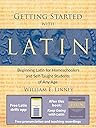
Getting Started with Latin is a beginner-friendly, homeschooler-approved guide that breaks down Latin grammar into manageable lessons. It includes fun exercises, an answer key for self-assessment, and free downloadable audio to perfect pronunciation. With a 4.7-star rating from over 1,800 reviews, this book makes learning Latin accessible and enjoyable for all ages.
| Best Sellers Rank | #28,249 in Books ( See Top 100 in Books ) #92 in Homeschooling (Books) |
| Customer Reviews | 4.7 out of 5 stars 1,869 Reviews |
J**G
I can not find a better way to start learning a language
Great job Mr Linney English is not my first language so I can feel how it looks like to start learning a new language, MOTIVATION And the way to motivate me? Telling me something interesting. I don't want to start with apple or tree. Well, Getting started with Latin starts with nauta, stella, maybe some of the most beautiful words in the world to me. Don't let me guess like Rosetta Stone, that's not my way of learning, why just show me words and sentences in endless repetition rather than just letting me know the answer, the meaning of the word and the grammar used? I can handle these things right now since I'm not a child anymore. (I say this because I still remember how I was frustrated by some simple English grammar rules when I was a child, now I can memorize the first and second declension in a much natural way, so ,just tell me) Not too basic for too long. Well, this is so great about this book, I finished it in 2.5 week with daily effort(I mean understand every word in every sentence in this book), that's really a balance between the time you spent and the content you learnt. There's much more. One great feature in this book is the Latin Expression, which introduces many interesting Latin usage in modern world, the author does not explain a lot on that except the meaning and historic background. How can I say this is part of a motivation. Because some of them can not be explained using what you have learnt in this book. And I'm just happy to continue my Latin study in order to, say, find the Latin background behind them. Another thing I need to mention is the free audio commentary from My Linney, which is a very helpful companion to the book, or say, it is an essential part for the learning, it's just like somebody is really teaching you something and Mr Linney explained a lot of details that you might be at first confused when reading the book (I actually have a feeling here, if you are no longer a child, a teacher who can explain to you is extremely important, yes of course, if you can figure out something that would be wonderful, but even that, a teacher is indispensable for learning, I can safely say the audio commentary from Mr Linney makes this book worth every penny for a Latin starter, not because he teaches you something more, but because he saved your precious time and lead you the way you should learn the knowledge.) All in all, Getting started with Latin is a very good introductory book for Latin. I never think that I can get any fluency in Latin after finishing this book, but I think Mr Linney just succeeded in bringing the beauty of Latin to me, say, with the words and the grammar(I can really feel the beauty of the Latin Grammar now, when I was learning French, since the grammar is not very different from English, so many times I just get bored) I highly recommend this book to anyone want to study Latin as a complete beginner.(even you say you are a serious learner and want a more formal and academic book. it just takes you 2 weeks, and it will boost your enthusiasm, that's the two week definitely worth taking)
R**N
The books lives up to its title...great for YOUNG homeschoolers
I have almost eight years of formal Latin study, and of all the textbooks I've encountered, I can say with confidence that this is the best for young beginner Latin students. I know because this has proven to be the case with my 9-year-old, who started on this book about a year ago and is about to finish it up. Let me preface this by saying that as an 8-year-old (in third grade), her English reading skills were not stellar. But when I felt she was old enough to sound out the Latin words (we use ecclesiastical pronunciation), we started on this book and I've been continuously astounded at how well my daughter retains the lessons learned here. The book is structured very prudently. It doesn't slam you with tough grammar lessons one-after-another, as is common with many first year Latin books. It builds slowly and incrementally, giving 10 sentences to translate at the end of every lesson in order to strengthen the lesson just learned and to review past lessons. How quickly you want to go through the lessons will obviously depend on the student. My daughter is a bit of a slow learner, so we typically do two to three lessons per week. We'll start by quickly reviewing the last five lessons or so (which takes less than five minutes), and maybe do a quick review of conjugations/declensions. Then we move on to the new lesson, read over the new concept or vocabulary, and then translate the sentences. Sometimes we translate all 10, but if I feel that she's being overwhelmed or is just mentally fatigued, we'll do five sentences and then the rest later. To translate, I have her first read the Latin sentence aloud, and I'll ask her to try to think about the meaning of each word as she reads. The book recommends that the student first identify the main verb of the sentence before attempting to do anything with the nouns, and I agree with this translation strategy. My daughter has gotten to the point where she will read the sentence in Latin and then translate it in her head before giving me her translation. Everything we do is oral. We hardly ever do written work. The beauty of this book is that it builds up the confidence of the student, because the ten review sentences every lesson are not very difficult, yet they still give the student enough of a challenge that they feel a real sense of accomplishment when they get it right. I would recommend this book to anyone who wants to teach Latin to a child of elementary school age. While we started my daughter at age 8, I think this could be started much younger as long as the student has strong reading skills. UPDATE: The author has made several updates to his website, which can be used both as a supplement to this book as well as a continuation, as he has a follow-up course that takes on more advanced elements of Latin. http://www.linneyslatinclass.com/index.php
B**N
Satisfaction in Learning Latin
First when I started to learn Latin from this book I was judgmental of its format. Many pages were filled in with what appeared to be minimal information. Actually, it was only a short while before I realized the value of the book’s teaching format. One can focus easily on a single concept and be satisfied with a relatively easy achievement after completing the lecture. I considered Wheelock’s and Henle’s books for learning, but they are more demanding condensed with their terse requirement for memorizing grammar. Furthermore, once their exercises are completed one has to go to extra length to verify the correctness of the exercises. That is not the way with Linney’s book! The answers are right at the end of the lecture. My way of learning was probably different from that of other people. I typed the Latin sentence into a column of a spreadsheet, and then I typed my English translation in the adjacent column. I did not check the answers until I had completed the translation of all ten sentences. It worked very well. One problem took me a long time solve. Typing the macrons designating long vowels can be done several ways, but many of them require too many keystrokes. After some research and elementary programming I can reproduce all long vowels by holding down an auxiliary key and the relevant vowel. This way it is less time consuming to represent those characters. The Latin Expressions segments are very useful additions to one’s English language knowledge. I would have enjoyed more than book presents. Some memory grinding was needed, but overall they were more enjoyable and easier than the other sources I considered. Linney made my Latin learning easier with his book and the free audio accompaniment. It deserves five stars.
J**F
Great, but Limited, Resource for Latin Learners
Bad news first: As others have stated this book can be finished quickly--not in half an hour as one reviewer put it, but a week is enough time for a serrious adult student to master the material in this course. At the end of the book you will have encountered basic declensions, a smattering of verbs and around 100 words . This approximates the amount of material covered by the first 40 pages of Wheelock's Latin. After completing this book, students continuing their study of Latin will need to use another introductory text. Now for the good news: This is the best format for learning Latin I've seen! Each lesson clearly introduces one word or grammatical concept in two paragraphs or less, followed by ten example sentences that cover the lesson topic and review past lessons. Best of all, the sentences include only vocabulary covered in the book! This is the exact opposite of other Latin books that rely on dense grammatical explanations without many useful examples. Following this method the learner never feels overwhelmed, after learning a few nouns and verbs, one can quickly and naturally move on to correctly produce simple sentences. This is no small feat considering the fact that Latin nouns change based on case. Although the author's voice reminds one more of a cowboy than a consul, the fact that he provides free MP3 recordings for each lesson in both ecclesiastical and classical pronounciation on his website is fantastic. This is the only Latin textbook I've found that offers so much audio material for free online. This book needs a sequel or better yet two--ASAP!
G**G
An Ideal Starting Point
In David McCullough’s biography of John Adams, he shares a story about John Adams and his son, John Quincy Adams. The two had a layover and were awaiting the arrival of a ship to board, leaving them with time to spare. They passed the time by translating a classical Latin work. Times have certainly changed. At one time, for the relatively small percentage of Americans who attended college, knowledge of Latin was assumed, not for graduation but for admission. As higher education came to focus on business, social science, and scientific and technical knowledge, the study of Latin was de-emphasized, if not omitted altogether from curricula. However, in recent years, there has been a renewed interest in classical education and in Latin, especially among homeschool students. William Linney’s book, Getting Started With Latin, is perhaps evidence of this trend. The book offers an ideal introduction to Latin for those who are (no kidding) truly new to the subject. Linney presents a unique, learn-by-translation approach to language study. Beginning with simple two-word sentences, each lesson progresses to ten Latin sentences for the student to translate to English. Words are repeated, thereby reinforcing learning. The book includes basic Latin vocabulary, present tense verb endings, conjunctions, prepositions, infinitives, noun endings, direct and indirect objects, and adjectives. By itself, the book will not make one a Latin scholar. However, the book is a good starting point before formal study of Latin or before pursuing more advanced informal study using a more academic text, such as Wheelock’s Latin. Additionally, Linney has written a follow-on Latin text, Keep Going With Latin. Linney’s book can not be recommended more highly. Unlike many self-study books, this book genuinely delivers on its title.
H**I
Deceptively Effective.
I mentioned this book on a homeschooling message board to a mother asking what curriculum others were using for Latin. After I explained that I planned to use this for the upcoming year, I decided to check it out again since I had not done much with it in the time since I purchased it. I opened it and read the initial suggestions and such. There is a site that is mentioned in the beginning that gives files for the various lessons of the book. These have audio files and such. There is a brief explaination in the beginning as to various ways that you can use the lessons. Then we get to the lessons. At a glance, they seem way too light. The first few introduce a single word. However, I think the author was very clever in his approach. By lesson 5 (or somewhere in the area) he has the kids translating something like 8 or 9 sentences. These sentences essentially say the same thing, but are worded differently. It is introducing the concept of word placement in Latin versus English. I read through this in a few minutes while the kids were working on an indepedent project and in five minutes highlighted the whole of the first four lessons to the kids. They were initially skeptical themselves about learning only one word or thought a day. Then I wrote the sentences for translation on the white board I had sitting beside me and they successfully translated every one of them. My daughter who was fighting me the hardest on learning Latin told me later that she liked Latin. That she thought that she could enjoy learning it. The author very blatantly states that it is definitely only one step of the language learning process and not all that is needed to learn all there is to learn about the Latin language, but that his hopes are that the student will learn gently and have interest after completing the book enough to pursue the subject further. I know that it is not the most intensive curriculum that could be used, but I think the excitement and effectiveness that my kids used it in just the few minutes we played with it yesterday is enough to tell me that I made the best decision for us.
C**R
Great Beginner/Refresher Latin Book!
I’m not quite a “beginner” with Latin since I took it for three years during high school. That set me up for great success in being able to excel at medical and scientific terminology in college and my subsequent careers. How this book came to be in my life…learning is a hobby for me and I realized Latin was something I’ve always loved, but had dropped the ball on over the course of my life. I remembered the “old school” Wheelock’s textbooks and wasn’t quite ready for that level of learning again and came across this lovely book. I figured it would be a great refresher for me and it was! For adults: It’s easy to follow along with and you really don’t need outside clarification (like, you’re not going to have to google what words mean, etc.) It’s time efficient—no endless hours spent translating various declensions of the same word. I personally aim for one lesson a day, sometimes I’ll do two. I finished this book in about 3 months. I’m now moving on to the second book by this author before I pick up Wheelock’s again. If you’re a complete beginner…start with this book! It will save you loads of frustration. Once you get through this book and the second, you’ll be well set up for moving on to the harder textbooks. For kids: As a mom, I was analyzing this book for my own kids if they showed an interest in it. I think it would be a great introductory book for them (aged 16, 11, and 5.) The older two could definitely do these exercises and understand the concepts on their own. The younger one would need help for sure, but I think even she could learn the basic vocabulary with assistance. The author has utilized a well thought out learning format that builds upon itself. It’s easy to figure out “what went wrong” if someone is struggling with a particular translation. Overall, excellent book! Looking back on my high school years, I wish this book had been available then and utilized in our first year. I’ve started the second book and I suspect I’ll love it too. If these books had been available in our first year, I think Latin would’ve held more interest for most students. It would’ve been a fantastic way to “ease” into Latin as teenager instead of just doing rote memorization. No regrets on buying this. You won’t regret it either!
H**S
Great for children and adults who need a gentle approach
I bought this to begin learning Latin alongside my homeschooled children (ages 7, 6, 4, 2, and infant). Linney provides such a gentle approach that even my 2 year old can follow along. My 7, 6, and 4 year olds complete the lessons with ease. I make my oldest two write every new word, meaning, and exercise–along with translations–so that I can use this as their handwriting practice as well (the writing is the only part that they despise because they simply do not like to write). Recently, I have been pulling the book aside at night in order to complete it more quickly on my own, so that I can move on to some of the more challenging recommendations in these reviews and on the Latin subreddit. However, I wholeheartedly appreciate the ease of this little book. My only previous experience with Latin is a university course for which I registered when I was younger and that I promptly dropped after the first few classes because I was simply too intimidated and overwhelmed by the speed and complexity of the language right from the start. Maybe I'm just overly sensitive, but I tend to quit when a subject immediately and completely stumps and drowns me. I can understand why someone with more time on their hands and strength of will to overcome challenging material would find this to be too simple, but it is a wonderful introduction to Latin for me and my family.
D**N
Excellent for adult learners at home
I changed school when 14 and was due to start Latin but that was too late in my second school. In my 40s I thought I'd give it a go, as I always regretted not learning Latin. I got the Oxford book but the first lesson in that just had far too many words in it and was totally daunting. This one introduces a word at a time and explains it in great detail so you feel you are progressing rapidly. You get a good grounding in one case before moving on to another and the book is excellent at exlaining why you use a particular case, and if a noun has the same ending in different cases how you choose which one it is. The website for the books has all the lessons explained and the examples are worked through. The downloadable classical and ecclesiastical pronunciation guides are excellent, although you do learn latin with an American accent. Now halfway through the book I'm starting to work through the Oxford book as well, but this book helped the Oxford book make sense.
S**W
Great for beginners and homeschoolers
This book was made primarily for homeschoolers and for self-study. Linney does a great job at keeping things simple and proceeds logically and methodically throughout the book. He also provides free sound files online to help guide pronunciation, thus helping self-studiers gain an ear for the language. If you have never tried to learn an language before, and if you have no idea what the nominative, accusative, dative, or genitive cases are, then this is the right book for you. If you've already had some Latin, then this book will probably be too simple unless you really suck at grammar.
S**N
A self study guide with good audio
Like any new language skills it is important to get the basics right. Also to get pronunciation guides through access to the audio lessons and other guides I found very helpful. I would recommend this book as a good place to start exploring Latin as a language.
G**Y
Fenomenal
El método es fantástico, puedes hacer cada unidad en 5-10 min e irte con la sensación de haber avanzado sin tener en ningún momento la de haberte roto la cabeza. Yo hacía 2 ó 3 al día antes de dormirme (y otras días un pequeño repaso en su lugar), usando la función marcapáginas del Kindle con las cosas fundamentales para poder reencontrarlas fácilmente. ¡Y antes de darme cuenta habia llegado al final! Eso sí, las explicaciones y frases a traducir son en inglés, pero no son muy técnicas y los nombres de las declinaciones son casi iguales que en castellano, ¡ya que proceden todos del propio latín! Y las palabras introducidas son básicas (hombre, mujer, ciudad, orilla, tener, poder, dar...). Por cierto la que escribe esto es una persona de mediana edad, no una joven, con lo cual creo que este libro vale para todas las edades 😉
P**5
Latin conecta languages with conjugation and declination in the syntax analysis in its five cases
William E. Linney is a Genius with didactic he knows how to convert complex things into something easy to understand and makes the brain of the autodidact student operate like a computer relactiong not only the English with the Latin, but making the student have an understanding of the matter that is far superior to the understanding that app DUOLINGO can make, and I used both, so I can make this statement. It's hard to find a linguist and a teacher gifted like this author. I did not completed yet the book, I am with 59% completed, but I am anxious to complete and start the continuation in the other book. I have a real pleasure to learn with this author. My advice is to learn all languages he teaches, that are the Latin, Greek, French, German and Spanish. All I knew from syntax analysis were a misconception and William E, Linney clarified in a perfect and indelible way. I wish I could thanks personally the author, because he is the language teacher for autodidact students.
Trustpilot
3 weeks ago
2 days ago