We remain fully operational. Our teams are working around the clock to ensure your deliveries continue safely.

DOWNLOAD THE APP


Customer Services
Copyright © 2025 Desertcart Holdings Limited
DOWNLOAD THE APP

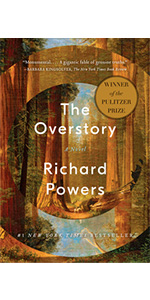
The Overstory: A Novel [Powers, Richard] on desertcart.com. *FREE* shipping on qualifying offers. The Overstory: A Novel Review: This Novel will Change how you view Trees and Life - The main characters in this epic story Nicholas Hoel (Watchman), Olivia Vandergriff (Maidenhair), Mimi Ma (Mulberry), Douglas Pavlicek (Doug-fir), Adam Appich (Maple), Dr. Patricia Westerford, Neelay Mehta, Dorothy Cazaly Brinkman, and Ray Brinkman, all have interesting and sometimes tragic life stories that somehow connects them to trees. Their life stories are told in a captivating but fast paced manner that sometimes seemed compressed but for a good reason. The book did not just tell us about the current personalities of the characters without giving the history. Our personalities are partially formed by our parents, grandparents, great grandparents, cultures far away from where we live, by nature and by trees. In some cases, the history of several generations was covered in a couple of pages. I am a curious person, and I found this kind of novel character development powerful and very entertaining. In a fashion that reminded me of Stephen King’s the stand, the life events of the characters and their family history bring them together in the defense of old growth redwood forest in Oregon. There are also hints of paranormal phenomena. In Oregon, things get very wild and even violent and it became difficult for me to put the book down. It felt very real and very tense and mistakes were made, bad mistakes. The book is certainly a page turner. The Overstory asks whether humans are the only ones that matter by challenging human-centered perspectives and exploring the lives, consciousness, and value of trees. The book shows that other beings have their own valuable and interesting experiences, and presents scientific ideas that trees have a form of communication and intelligence. I learned that trees communicate with each other through a network of fungi in the soil. By looking up the facts about this I found out that this was not fiction made up by the author. There is an entire new science on this topic called mycorrhizal ecology or biocommunication, sometimes referred to as the “Wood Wide Web”. Dr. Patricia Westerford is based on a real person, Dr. Suzanne Simard of the University of British Columbia. The book also points out that we humans do not understand the amount of destruction that we are causing to the world’s forests. This is a book that speaks for the trees, but in addition, the trees speak for us. This is one of the most fascinating novels that I’ve read. It has an important message that some of us will understand but that some of us may not grasp. In any case, I can certainly understand the books popularity. I highly recommend it. Review: This book has forever changed my brain on many ideas, worthy ideas, best ideas! A must read! - Overstory was a book club recommendation. I've already read Lab Girl and the Hidden Life of Trees so when I read Overstory, I felt I was in a familiar forest walking with old friends on the trail. Richard Powers, the author, is a poet, a literary writer and delivers a poignant message in a delicious style. Both of the mentioned books are embued inside Power's story and melded into characters with passion, grit, love and unstoppable influence - felt then or later - in the storyline and especially in the reader/witness. I loved the writing and then I loved the story/stories. I hadn't read any reviews and so when I started out with the character sketches as chapters i though how clever to have a book written in all "overstories" - the way a writer or artist makes preliminary and brief notes on a protagonist. but, I was soon to find out that the overstory was about the trees, the magnificent trees and my heart opened, my eyes, opened and my world point of view enlarged such that I'll never be the same. This book changes the structure of mind and future in all the best ways. a beautifully written book and a must read for all of our futures. Trees and connections and merchandising and monetizing our world for a few short years of pleasure are toppling our planet and, hey we're on the planet. I've shared this book with 8 - 10 friends now and always include that this is one of those books that is a classic and is a must-read. i'll be reading it again after our book club meeting and it will be one of those books that i will not recycle. i need this one with me. I still give a 5 star because of the effect it has had on me, but for the meat of the story, I wanted more development from some of the characters and at the end, I got lost often in the names; in the metaphors that seemed to be more author-writerly than for the movement of the plot. Powers lost literary steam, or maybe his editors did at the end and it sort of wound down into a slow coasting rather than a summarizing climax. I told my friends that maybe this how trees actually are - strong for a long time (the book could be edited to be shorter) and then they fall. That being said, I still loved it, wanted to read more Powers and have bought several more of his many novels. Loved his science through characters and nature. STRONG points in the 5 star.


| Best Sellers Rank | #7,127 in Books ( See Top 100 in Books ) #7 in Political Fiction (Books) #176 in American Literature (Books) #191 in Literary Fiction (Books) |
| Customer Reviews | 4.4 out of 5 stars 41,228 Reviews |
T**N
This Novel will Change how you view Trees and Life
The main characters in this epic story Nicholas Hoel (Watchman), Olivia Vandergriff (Maidenhair), Mimi Ma (Mulberry), Douglas Pavlicek (Doug-fir), Adam Appich (Maple), Dr. Patricia Westerford, Neelay Mehta, Dorothy Cazaly Brinkman, and Ray Brinkman, all have interesting and sometimes tragic life stories that somehow connects them to trees. Their life stories are told in a captivating but fast paced manner that sometimes seemed compressed but for a good reason. The book did not just tell us about the current personalities of the characters without giving the history. Our personalities are partially formed by our parents, grandparents, great grandparents, cultures far away from where we live, by nature and by trees. In some cases, the history of several generations was covered in a couple of pages. I am a curious person, and I found this kind of novel character development powerful and very entertaining. In a fashion that reminded me of Stephen King’s the stand, the life events of the characters and their family history bring them together in the defense of old growth redwood forest in Oregon. There are also hints of paranormal phenomena. In Oregon, things get very wild and even violent and it became difficult for me to put the book down. It felt very real and very tense and mistakes were made, bad mistakes. The book is certainly a page turner. The Overstory asks whether humans are the only ones that matter by challenging human-centered perspectives and exploring the lives, consciousness, and value of trees. The book shows that other beings have their own valuable and interesting experiences, and presents scientific ideas that trees have a form of communication and intelligence. I learned that trees communicate with each other through a network of fungi in the soil. By looking up the facts about this I found out that this was not fiction made up by the author. There is an entire new science on this topic called mycorrhizal ecology or biocommunication, sometimes referred to as the “Wood Wide Web”. Dr. Patricia Westerford is based on a real person, Dr. Suzanne Simard of the University of British Columbia. The book also points out that we humans do not understand the amount of destruction that we are causing to the world’s forests. This is a book that speaks for the trees, but in addition, the trees speak for us. This is one of the most fascinating novels that I’ve read. It has an important message that some of us will understand but that some of us may not grasp. In any case, I can certainly understand the books popularity. I highly recommend it.
J**R
This book has forever changed my brain on many ideas, worthy ideas, best ideas! A must read!
Overstory was a book club recommendation. I've already read Lab Girl and the Hidden Life of Trees so when I read Overstory, I felt I was in a familiar forest walking with old friends on the trail. Richard Powers, the author, is a poet, a literary writer and delivers a poignant message in a delicious style. Both of the mentioned books are embued inside Power's story and melded into characters with passion, grit, love and unstoppable influence - felt then or later - in the storyline and especially in the reader/witness. I loved the writing and then I loved the story/stories. I hadn't read any reviews and so when I started out with the character sketches as chapters i though how clever to have a book written in all "overstories" - the way a writer or artist makes preliminary and brief notes on a protagonist. but, I was soon to find out that the overstory was about the trees, the magnificent trees and my heart opened, my eyes, opened and my world point of view enlarged such that I'll never be the same. This book changes the structure of mind and future in all the best ways. a beautifully written book and a must read for all of our futures. Trees and connections and merchandising and monetizing our world for a few short years of pleasure are toppling our planet and, hey we're on the planet. I've shared this book with 8 - 10 friends now and always include that this is one of those books that is a classic and is a must-read. i'll be reading it again after our book club meeting and it will be one of those books that i will not recycle. i need this one with me. I still give a 5 star because of the effect it has had on me, but for the meat of the story, I wanted more development from some of the characters and at the end, I got lost often in the names; in the metaphors that seemed to be more author-writerly than for the movement of the plot. Powers lost literary steam, or maybe his editors did at the end and it sort of wound down into a slow coasting rather than a summarizing climax. I told my friends that maybe this how trees actually are - strong for a long time (the book could be edited to be shorter) and then they fall. That being said, I still loved it, wanted to read more Powers and have bought several more of his many novels. Loved his science through characters and nature. STRONG points in the 5 star.
E**K
Because 'Tree' & 'Truth' Share the Same Root
In this Pulitzer Prize winning novel, The Overstory, one of the characters offered some profound advice to his students. “You can’t see what you don’t understand. But what you think you already understand, you’ll fail to notice.” Before we bought our current family home, we visited. With most of the furniture moved out and life hidden from view, the rooms were staged for a buyer. All except the young boy with autism, who could not be subdued during our tour of the home for sale. He sat on the couch and jumped up to pace, groans for words, his hands thrown against his stomach in uncomfortable, unpredictable bursts. His mother, long in patience and able to see what most could not, interpreted his enthusiasm for us and for our young children. His mother saw what we could not, knew everything was fine. In her son’s honor and in his name, a young tree had been planted years prior in the backyard of the house that we wanted to buy, because the boy’s parents understood. They saw. They did not fail to notice. Yes, we bought the home and our children played for hours in that backyard. We did not see the boy’s tree, just as we didn’t see the boy. The author of this book has caused me to see that tree, and others, much differently. Other trees including the ones no longer there. The author screams his warning to see their disappearance, page aftrr page. Our children chose instead to live in the wild little forest growing on the edge of our property line, beneath the boy's tree. Here, they buried their childhood. Deceptively dense on a postage stamp of swamp, this little forest was rife with potato vines, knee-high undergrowth and thin trunks that bent in the wind to shake off little white flowers. It sheltered courage within the walls of a young boy’s fort; it sprouted imagination in a backlot to short films on a young girl's handheld camera. Those leaves and vines covered hope and shame and anger and joy and love and peace. Then, just as our children all entered their teens, our little town outgrew itself. Progress sent machines to tear down our forest and build a mandatory retention pond. Every vine, every stump, every little white flower was erased from the yard and forever from the planet, so that our neighbors could use more water and so that the water would have some place to go other than out onto our dirt roads. Against our will, the machines tore away everything but the autistic boy’s tree. Quietly, this had grown tall, with a trunk too wide to hug. Today, that tree is the lone survivor of our backyard forest. This beautiful, magnificent tower of memory tells the stories of my three kids’ childhood. I just finished reading The Overstory by Richard Powers. I read it because I love trees (not just the one in my backyard), and because I want to read good writing. This book offers both. Powers tells the stories of 9 characters whose lives all profoundly intersect with trees. And what do all stories do, one of those characters asks in the book? “[Good stories] kill you a little. They turn you into something you weren’t” (page 412). Is that why I read? To become something I wasn’t? To grow? Or to put it another way, to die just a little? Is it death? The author wants us to think about the environment like we’ve not thought about it before. He doesn’t serve up a green brochure or a scientific journal article disguised as a flimsy four-part play. He introduces us to people and pulls them together in ways that surprise and distress and move and frighten his reader. After all, propaganda about the destruction of trees would not make us think differently. We would just see what we think we see without understanding, without knowing. “The best arguments in the world won’t change a person’s mind,” says one of the characters in this book. “The only thing that can do that is a good story.” He got me thinking anyway. Powers ends his novel on the second to last page with a reminder that “the word ‘tree’ and the word ‘truth’ come from the same root” (page 500). Because of his story, I see trees with new eyes. But Powers begs his readers to do more than just listen and nod. He storytells his heart out and, in return, begs me to die a little.
M**E
A Pulitzer Prize-Winning Epic That Connects Humanity and Nature
**"The Overstory": A Pulitzer Prize-Winning Epic That Connects Humanity and Nature.** **"The Overstory"** by Richard Powers is a profoundly moving novel that explores the intricate relationships between humans and the natural world, ultimately delivering a powerful message about environmental activism and the interconnectedness of all living things. Winner of the Pulitzer Prize in Fiction and shortlisted for the Man Booker Prize, this sweeping narrative weaves together the lives of nine diverse characters, each linked by their own encounters with trees. From a Vietnam War veteran saved by a banyan tree to an artist grappling with the legacy of a dying chestnut, Powers masterfully captures their individual stories and the broader themes that underscore humanity’s relationship with nature. The novel spans a vast timeline, highlighting the conflicts and struggles faced throughout American history, including the late twentieth-century Timber Wars. As the characters converge in a desperate fight to preserve the last remnants of ancient forests, Powers invites readers to reflect on the silence of trees and the urgent need to reconnect with the environment around us. **"The Overstory"** is a stunning evocation of nature and a call to action for readers who wish for a deeper understanding of their role in the world. With its intricate narrative and lyrical prose, this book resonates as both a celebration of the natural world and a poignant reminder of the consequences of humanity's choices, making it an unforgettable read for anyone who cares about the planet's future.
J**E
The Overstory Stories to pass ponder while passing time.
Received a copy of this book as a gift. It was such an interesting read I decided to gift one to someone else. This was bought for someone who has everything but likes to read. A book is always a good gift.
M**S
Beautifully written -at first. But then turns into a rant.
Richard Powers environmental novel, The Overstory, (New York: W.W. Norton, 2018), won this year’s Pulitzer Prize for fiction. I was curious, ordered it immediately, and read it ahead of the stack of French-African novels piled by my bed. This novel is a dramatic and epic tale about trees. It’s structured as a series of stories about nine characters. The novel begins with elegantly written portraits of families and their bonds to trees. The first chapter is masterful: it’s about an American Chestnut, planted in the black earth of an Iowa farm from a chestnut in the pocket of a Norwegian migrant pioneer. Patiently, the tree unfolds its branches over the plains, over multiple generations, standing strong, an expression of the family’s endurance, of its life force. Powers follows with charmed chapters on a Chinese family’s devotion to a mulberry tree, and on a paraplegic Indian-American child’s creation of an electronic fantasy world, inspired by an exotic tree. In subsequent chapters, Powers portrays the old-growth forest as a character of intrinsic value and dignity. His forest is a healthy community, almost a single being, compromised by logging. Patricia Westerford is a key human character because she reveals the active and communal character of the forest through what are, in effect, science lessons encased within a fiction story-line. Westerford seems inspired by real-life ecologist Suzanne Simard, of the University of British Columbia, who discovered that trees communicate. They signal each other by releasing gasses and transfer nutrients through lattices of fungi that connect roots. Powers’ story-telling feeds my intuition for trees as a vital life form, with a capacity to act in response to signals, and therefore possessing a quality close to consciousness. They are not so far from us as we imagine. Powers tells us over and over that we share half our genes with trees. Next, Powers moves on to his central story about five of the characters who join to defend the forest. They live-out a series of confrontations, adventures, and ultimately, flight from the Law. Here, the novel loses much of its charm as it turns into a political rant against logging companies, clear-cutting, and the destruction of ancient trees. I share his intuition about the intrinsic value of trees, admire his passion for the remains of the great Northwestern forest, and agree with his concern about Global Warming. But his anger is over-the-top and I wonder about his sympathies for his fictional Earth first radicals in their non-violent and then violent fight for the forest. Powers’ theme is the superlative moral and spiritual value of the forests. This comes at it wrong –at least to me. I prefer post-war French author Roman Gary’s approach in Les Racines du Ciel (The Roots of Heaven), one of the first ecological novels. Gary wrote about the great herds of elephants that wandered the Chadian Sahel for centuries, before they were shot down by ivory hunters in small airplanes. His theme is that the presence of the wandering herds of elephants forms part of our dignity as human beings. The same holds for the great forest. Without the natural environment from which we emerged, we will never become intact and know our own humanity. Whether we are more or less than the trees is besides the point. There is something pointless about Powers’ rant. Environmentalists won’t win this fight without broad public support. The evidence from the election of Trump and from the yellow vest movement in France is that ordinary people don’t want to pay for preservation of our climate. It will take more dramatic natural disasters than we’ve seen so far to mobilize public support for serious conservation.
B**E
Profundity, Thy Name is 'The Overstory'. A Future Classic!
I’ve previously railed against the abysmal choice made for 2018’s Pulitzer Prize winner for fiction. I’m still salty about that decision, but oh how deliciously, and fortuitously 2019’s Pulitzer Prize for fiction winner, ‘The Overstory’, redeems the Pulitzer committee's previous year’s nonsensical choice. Richard Powers’ ‘The Overstory’ is a premier example of work that defines exceptional contemporary literature. Where the writing is not only of the highest caliber, but carries an urgent message for our times. I finished it two months ago and in the time since, I've simply been letting it marinate and seep into my senses before finalizing my thoughts. 'The Overstory' is not a flash in the pan, it is not a gimmick. It is what I believe will be considered a literary classic in the future, one which academics and thinkers of the age will refer to. This is a book that is both a teacher as well as a friend. It is a parent and it is spiritual guide. It is a force as monumental as the oceans, yet as humble as a mustard seed. What elevates this novel to this degree of profundity, an attribute that was a source of major delight of the book, is the sophistication to Powers’ writing style. A writing style that I like a lot. It’s scholarly without being affected, dense without being overwrought or preachy. Powers' prose is sumptuous and orchestral, leaving a textured cloud of complexity that hovers throughout the entire novel. Powers’ writing is also deeply enthralling, affording me the knowledge and appreciation for trees and foliage that goes beyond the greenery we see everyday. He displays beautifully and deftly, the symbiotic relationship between humans and trees - nature, to an extent; plus the necessary brotherly connection that must exist between these two entities. If you're paying attention to current events occurring domestically and abroad - the Amazon is on fire, the importance of combating climate change - you'll understand how timely and necessary a book such as this is. For every act we do to trees, to our surroundings, and to the earth at large - be it wilful malice, altruistic, or inadvertently - there is a consequence. The question then becomes: in the face of these consequences, what is humanity's role, duty, and responsibility in the grand scheme of things. Powers, without cajoling the reader to feel one way or the other, presents several possibilities. Truth be told though, amidst all this lush prose and didactic earth toned lessons, there is also a layer of inaccessibility, a fogginess to the writing that demands the reader’s attention at all times. By this I mean, 'The Overstory' does not spoon feed, nor does it coddle the reader. Rather, it challenges the reader to be alert, to pay attention as the stories unfold. The section labeled "Trunk" is a prime example, one which I deduce some readers are likely to find to be long winded and laborious. To be clear, the novel is not a difficult read, but it has a level of difficulty that though circuitous and busy, I think ends up being one of the book’s rewards. I plan to read ‘The Overstory’ again, the second time around more so to pick up the bits and pieces of treasures I may have missed the first time. There are plenty, each with a profound message for humanity, a message for the sustainability of the planet itself. Highly, highly recommended read, but take your time with it. Read some, let it marinate, read more, let that marinate, and so on. Make this a slow and steady read to get the most out of it. The literary rewards as well as the human rewards, are ripe and overarching. This is fruit with flavor that resonates and lingers long after completing it. Deserving of the Pulitzer Prize? ABSOLUTELY, without any doubt! 4.75 stars out of 5.
T**R
Astonishing Linguistic Skill
This book is pretty amazing. It’s not surprising it won a Pulitzer Prize. The author has impressive writing skills— as an aspiring writer myself, I kept thinking “wow, there’s no way I could write this well.“ His use of metaphor, and his vivid descriptions, are fantastic. I think you could make an argument that this author is perhaps the best writer of our generation. That being said, I did have some frustrations with the book. First, he introduces all the characters in a series of chapters at the beginning. When he gets back to those characters later, I often struggled to remember exactly who they were and what their histories were. I read about 10 or 15 pages a day, and so for some of these characters their backgrounds were a few weeks prior. I would also say that I wasn’t crazy about his characters. They were complex generally, but they were damaged and very depressing. There was not a character in this book that I really came to admire or care about. Dr. Patricia Westerford was perhaps the one that I felt the most affection for. The environmental message of this book is extremely important. This is perhaps the most articulate and artistic plea for environmental awareness that I know of. I loved trees and forests before reading this, and now I love them even more. The book is a major milestone for all environmental causes. For that, I applaud and thank the author. I was very disappointed by the ending. The new generation of video game design by the tech character, and the artistic project in the forest, both seemed vague and confusing to me. I’m not sure exactly what the word “STILL” signifies. Still time? Still hope? I’m not sure. And I’m not really sure what he meant by the reference to “lookers.” Space aliens? Internet algorithms? I couldn’t figure it out to any degree of certainty. I went back and reread those sections several times and I have no exact idea what he intended. Overall, this is a book worth reading. This is an important book. This is a major artistic accomplishment. If you are an aspiring writer like me, you want to read this just so you can see gold-standard use of the English language. Countless times I was stunned by the descriptions and expression of fascinating new ideas. I will have to go back and re-read the book and highlight all the sentences that I found captivating. There will be several hundred of them.
Trustpilot
1 month ago
3 weeks ago