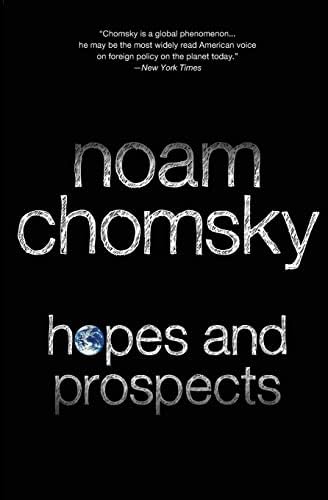
Hopes and Prospects
Product ID: 8837952
Desertcart purchases this item on your behalf and handles shipping, customs, and support to Morocco.
Full description not available
G**R
What is democracy?
This collection of essays is timely given the amount of heated debate going on about the state of Western democracy, particularly in the US. Chomsky’s perspective - my interpretation: What democracy?It is true that democracy is a word thrown around with little regard for what it means. Is it a system of election or an ideal?Either way, of course, the US has never been a pure democracy. When the country was founded only white men who owned property could vote and there was no one who suggested that the government existed to act on behalf of the average citizen.Today, of course, we have the Electoral College, allowing the presidential candidate receiving the least popular votes to actually win election. And the fact that the least populous state has the same Senate representation as the most populous state. If you live in South Dakota, therefore, you have far more theoretical power over the government than a resident of California or Texas.And it doesn’t stop there. The US Senate, arguably the more powerful of the two houses, is run by committees, and the committee chairperson, usually chosen by seniority within their party, wield outsized power because they single-handedly control which bills actually make it to the floor for debate and a vote. Most of these chairman and chairwoman, as it turns out, hail from those same least populous states that already enjoy an inflated amount of Senatorial power. The chairman of the Senate Appropriations Committee, for example, arguably the most powerful committee in the Senate, represents Vermont, the second-least-populous state, home to less than two-tenths of one percent of Americans. (This distortion occurs for a lot of obvious reasons including social homogeneity, less competition for the job, etc.)The strongest point Chomsky alludes to is that the ideal of democracy is not really a function of how you structure elections. It’s about having politicians who are carrying out the will of the citizens. And it is in this regard that virtually all modern democracies score the lowest.In part, of course, that is because not all citizens are the same. And the citizens who count the most in today’s political world are the citizens who hold the capital. They are the ones who determine which politicians wield power because their money allows them to control elections, and it is, therefore, their interests that the politicians care most about.Which is why our elected politicians in Washington refuse to take positions supported by an overwhelming majority of Americans. They don’t care. Unless you can afford to contribute a gazillion dollars to their next re-election, your opinion doesn’t really count.When it comes to American foreign policy, therefore, Chomsky makes an irrefutable argument that despite all the talk about promoting democracy and protecting the oppressed, the overwhelming objective of our foreign policy is to protect and promote the financial interests of our banks, hedge funds, and corporations. We have actually overthrown democratically elected governments, Chomsky notes, for the simple reason that they refused to do the bidding of our investor class.Chomsky has one of the most insightful minds putting thought to paper today. The book is extremely well written and thoroughly researched. If you recoil at his basic premise you owe it to yourself to read it.
C**G
Impressive and Convincing
I'm not usually a huge fan of Chomsky but his new collection of essays Hopes and Prospects is really good. The first part of the book deals with Latin America. Chomsky outlines the colonial past and present of Latin American countries and their valiant efforts to rid themselves of neo-imperialist domination by the United States. He states correctly that today's struggles of Latin American countries (Bolivia, Argentina, Venezuela) to oppose the depredations of the US-inspired version of globalization offer hope for the rest of the world. He is also absolutely right in pointing out that "Latin America is not merely the victim of foreign forces. The region is notorious for the rapacity of its wealthy classes and their freedom from social responsibility." Here, Chomsky echoes Eduardo Galeano's classic work Open Veins of Latin America: Five Centuries of the Pillage of a Continent that decades ago offered a brilliant analysis of how Latin American power elites sold out their own countries to the predatory forces of the US neo-liberalism. Today, Chomsky points out "Latin America has real choices, for the first time in its history." And this is great news for the entire planet.In the second part of the book, Chomsky analyzes the influence that the imperialist mentality in the US exercises over the discussions of the US military presence in Iraq. I was particularly pleased to see that Chomsky decided not to follow in the footsteps of most liberal commentators in their refusal to see that Russian imperialism is in no way "better" or more justified than the US imperialism. Chomsky qualifies Putin's actions in Chechnya as "murderous", which they most definitely are. I only wish that more progressive analysts dared to depart from the tendency to praise everybody who opposes the US regardless of the atrocities they perpetrate. It is definitely right that the US imperialism and Russian imperialism should be discussed together since there are glaring similarities between them.Chomsky then segues into what I consider the weakest part of the book: the discussion of the Israeli-Palestinian conflict. As usual, Chomsky's analysis of the issue is one-sided and biased. Israelis are all villainous nationalists and religious fanatics, while the Palestinians are without an exception languishing and tolerant victims. While Chomsky is right in suggesting that the Israelis do everything they can to make sure the conflict continues, he forgets to say that so do the Palestinians. When he describes the Israeli "information campaigns to instruct the world on its errors and misunderstanding, arrogant self-righteousness, circling the wagons, defiance . . . and paranoia," he avoids mentioning that this exactly the pattern adopted by every single nation-state with a very weak and diluted national identity (Russia is a great example of precisely this kind of paranoid nation building. Closer to home, so is the US.)Starting from Chapter 9 of Part II, Chomsky offers a brilliant analysis of the 2008 presidential elections and the job Obama's presidency has done since then. He points out correctly that both Democrats and Republicans are considerably to the right of the American population on many major issues, both international and domestic. Hence, it is not surprising that Obama's tepid efforts to defend his intentions to introduce some kind of change don't convince Americans any longer. Chomsky talks about how the American people have been brilliantly manipulated into being suspicious of public welfare programs that would be of invaluable use to themselves while supporting the "nanny state for the rich."The fact that the two main candidates in the 2008 Democratic primary were a woman and an African American were a welcome sign, Chomsky acknowledges, that the country has managed to get at least somewhat civilized. Still, we cannot expect the joy from this reality to keep us perennially blind to the numerous ways in which Obama has not been living up to his promise. Chomsky reminds us that "Obama's message of 'hope' and 'change' offered a virtual blank slate on which supporters could write their wishes." And write we did, only to be disappointed in most of our expectations.The book is composed of a series of essays and as a result is very repetitive in places. It could have done with a lot of editing because many sentences are simply repeated over and over. This lack of editing is the main reason for the four-star rating I give to the book.
L**D
About Hopes and Prospects
This book is a compilation of essays that Chomsky also updated just before its release here in May 2010. Each essay has a topic of focus; Chomsky weaves in and out of different subject material throughout each, highlighting moral principles and hypocrisies of the United States, and the West in general. The issues are grotesque and in need of addressing by us - the public.Contents:PREFACE ..... VIIPART I: LATIN AMERICA01. Year 514: Globalization for Whom? ..... 302. Latin America and US Foreign Policy ..... 3903. Democracy and Development: Their Enemies, Their Hopes ..... 7504. Latin America and Caribbean Unity ..... 103PART II: NORTH AMERICA05. "Good News," Iraq and Beyond ..... 12106. Free Elections, Good News and Bad ..... 14307. Century's Challenges ..... 16508. Turning Point? ..... 17709. Elections 2008: Hope Confronts the Real World ..... 20710. Obama on Israel-Palestine ..... 25111. The Torture Memos ..... 25912. 1989 and Beyond ..... 269Notes ..... 281Index ..... 315
T**T
Opens The Mind
If you're wanting to leave the cave from Plato's allegory, read this.It is so refreshing to read the words of a man as articulate and direct as Chomsky.This book has been eye opening and addictive, highly recommended.
J**R
Five Stars
Fantastic attention
B**Y
Five Stars
genius
Z**.
the usual Chomsky
As his readers are already used to, in "Hopes and prospects" Chomsky heavily criticizes modern (mostly US) politics, starting from the collonial times and ending with the struggle of the third world to set itself free of the rich centres' of power deadly grip. Although the book does not offer much new material for readers already familiar with Chomsky, I would have given it four stars if it had a clear concept and order. However, it is actually a collection of several lectures Chomsky had given in Chile (as he himself says in the perface), arranged for a printed edition, with only loosely bounded chapters. Further, although as always very sharp and insightful in his comments, Chomsky quite often just wonders off a topic, or the opposite, stays too long on one. Nevertheless, the essence is more than clear, clearly argued and presented, and I can recommend the book to everybody interested in a critical view of the time we live in, and different from the one usually presented.
J**L
Yes we can...
It doesn't seem to matter who is the US President it's just more of the same, or sometimes worse. By chance I happened to see a recording of David Icke giving a speech a the Oxford Union before Barack Obama was elected. There, he warns of the dangers of electing Obama saying he will just escalate wars, due in part to being supported by Zbigniew Brzezinski, who had admitted luring the Russians to invade Afghanistan over thirty years ago while President Carter's advisor. And we all know what happened to Afghanistan.What's this got to do with Chomsky's book? Well it's just exposing the truth that is really shocking to the readers who have not yet worked out how the world order and power operate in "democratic societies".Just to return to Obama, the man who embodied the hopes of millions of US citizens for a fairer society, what is his war record?- Started a covert, drone war in Yemen- Started a war in Libya without congressional approval- Escalated the war in Afghanistan- Sharply increased drone attacks in Pakistan- Continued the occupation of Iraq, in spite of saying otherwise- Escalated the proxy war in Somalia by launching drone strikes- Sold $60 billion worth of weapons to Saudi Arabia- Secretly deployed US special forces to 75 countries- Signed an agreement for 7 military bases in Colombia- Touted nuclear power, even after the disaster in Japan- Opened up deepwater oil drilling, even after the BP disaster- Did a TV commercial promoting "clean coal"- Defended body scans and pat-downs at airports- Signed the Patriot Act extension into law- Continued Bush's rendition programIf this subject interests you then buy it, but if you prefer not to know then there are plenty of books to keep you occupied.
Trustpilot
1 day ago
2 months ago