
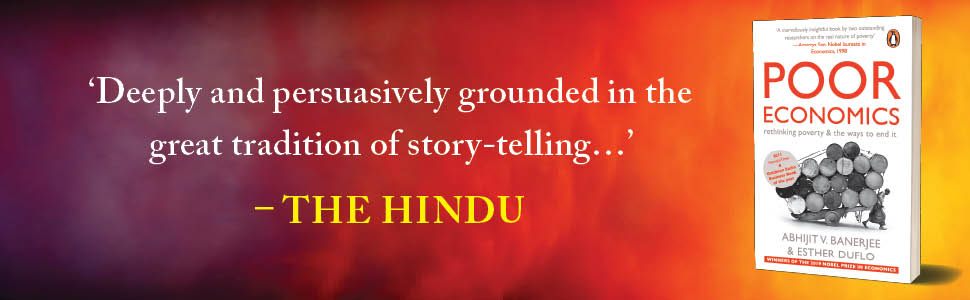
Poor Economics-Bpb : BANERJEE ABHIJIT V.: desertcart.in: Books Review: A very relevant read. - The book debunks certain popular myths about the poor and the global poverty trap. It presents both as less overwhelming and practically solvable if their issues are dealt with, one at a time. The book is a product of the previous decade based on Duflo and Banerjee's extensive research and collaborative trials in 18 developing countries. It holds poverty as an unnatural phenomenon largely in place due to unfair public distribution systems. The book talks of a population that lives below 99 cents per day and how their economic lives are a site of wonder. It delves into the choices made by the poor with regard to nutrition, preventive health care, education, fertility, savings, micro-credit, entrepreneurship, public institutions, politics etc, the circumstances in which these choices are made and how these affect the larger picture. It holds the poor in an empathetic light and doesnt addresses them as an alien category. The language is simple and it doesn't impose an ideology but cites various instances where with little common sense and a practical foresight, the lives of the poor have been bettered. The book discourages convenient assumptions and prophecies , we tend to make about poor people and their needs. Review: Must Read - The reading experience of the book will dip you into the sea of many,where they are floating without any aids that we take for granted.It will give us insight how poor really run their economy,mostly contrary to our tradition wisdom. Authors succinctly put their knowledge,earned through their own experience,experience of Poverty Action Group founded by them,outcomes of Randomised Control Tests(RCT) and many more learnings.They went into the lives of below 99 Cent people to understand how poor make decision wrt core issues of hunger,health,education and family planning etc.Those decision found to be complex and unique from individual to individual rather than generalised as we assume. They further get into understanding of macro and micro institutes which affect economy of these people wrt saving,lending, entrepreneurship and politics pattern.The book forces us to contemplate that why we are failing to keep them afloat despite all of our good intentioned intervention even to the extent of putting decentralised policy as ' of the poor,for the poor and by the poor'. The clear and unambiguous message sounded is that we need to think , think again while studing poor economics,we really need to understand how these poor people takes decisions.Understanding their perspective will bring better decision at our end.We should be ready to harness the potential of these enterprising yet fallen souls.Overall it's an excellent read and recommended to all.



| ASIN | 8184002807 |
| Best Sellers Rank | #7,484 in Books ( See Top 100 in Books ) #120 in Economics Books #144 in Society & Culture (Books) #393 in Biographies, Diaries & True Accounts |
| Country of Origin | India |
| Customer Reviews | 4.6 4.6 out of 5 stars (4,433) |
| Dimensions | 19.8 x 12.9 x 2.75 cm |
| ISBN-10 | 9788184002805 |
| ISBN-13 | 978-8184002805 |
| Importer | Penguin Random House India Pvt Ltd |
| Item Weight | 320 g |
| Language | English |
| Net Quantity | 500.00 Grams |
| Packer | Penguin Random House India Pvt Ltd |
| Paperback | 464 pages |
| Publisher | Penguin Books (1 January 2013) |
P**I
A very relevant read.
The book debunks certain popular myths about the poor and the global poverty trap. It presents both as less overwhelming and practically solvable if their issues are dealt with, one at a time. The book is a product of the previous decade based on Duflo and Banerjee's extensive research and collaborative trials in 18 developing countries. It holds poverty as an unnatural phenomenon largely in place due to unfair public distribution systems. The book talks of a population that lives below 99 cents per day and how their economic lives are a site of wonder. It delves into the choices made by the poor with regard to nutrition, preventive health care, education, fertility, savings, micro-credit, entrepreneurship, public institutions, politics etc, the circumstances in which these choices are made and how these affect the larger picture. It holds the poor in an empathetic light and doesnt addresses them as an alien category. The language is simple and it doesn't impose an ideology but cites various instances where with little common sense and a practical foresight, the lives of the poor have been bettered. The book discourages convenient assumptions and prophecies , we tend to make about poor people and their needs.
A**H
Must Read
The reading experience of the book will dip you into the sea of many,where they are floating without any aids that we take for granted.It will give us insight how poor really run their economy,mostly contrary to our tradition wisdom. Authors succinctly put their knowledge,earned through their own experience,experience of Poverty Action Group founded by them,outcomes of Randomised Control Tests(RCT) and many more learnings.They went into the lives of below 99 Cent people to understand how poor make decision wrt core issues of hunger,health,education and family planning etc.Those decision found to be complex and unique from individual to individual rather than generalised as we assume. They further get into understanding of macro and micro institutes which affect economy of these people wrt saving,lending, entrepreneurship and politics pattern.The book forces us to contemplate that why we are failing to keep them afloat despite all of our good intentioned intervention even to the extent of putting decentralised policy as ' of the poor,for the poor and by the poor'. The clear and unambiguous message sounded is that we need to think , think again while studing poor economics,we really need to understand how these poor people takes decisions.Understanding their perspective will bring better decision at our end.We should be ready to harness the potential of these enterprising yet fallen souls.Overall it's an excellent read and recommended to all.
R**K
An intellectual read with practical insights
A wonderful read with lots of insight about the real situation and problem of our society.. This books will guide you to adress the real and deep problem of our society which is poverty...
V**N
Understanding Poverty - In a better way
Poverty as a subject has been of interest to many. Aim of every one is to identify the cause of it. But there are very few who have understood it and helped in understanding it to others. Authors Abhijit and Esther agrees that there is no one answer to understand poverty. As a reader, I thoroughly enjoyed the journey undertaken by authors from Kolkatta to various places to explain which are the factors that are responsible for poverty. Authors have managed to understand what is the factors that envelops an individual into poverty. This book should be read to understand: 1. How politicians are responsible and if diligent they can help society in pushing people out of poverty 2. How some times lack of information causes people to get struck in a situation 3. How uncontrolled conditions like non availability of basic requirement of life and to struggle to obtain it makes people to struggle harder 4. How flaw in the design of public policies does more harm than serving its purpose of dissolving poverty Some of the statements by authors are so profound that they actually touch the main concern areas. How minor changes, if introduced can cause immense leverage in alleviating poverty from human society. Authors have taken lot of trouble to ensure that message is very crisp and easy to digest. l think Poor Economics should be read to know many unknown facets of poverty as it seems we have not given a very clear thought about why poverty is there in first place. Enjoyed reading and will highly recommend for reading. Thanks Abhijit and Esther.
T**S
Made me a more generous person
After reading that people living below the poverty line in India live on Rs 16 per day, I've cut down on my unnecessary daily expenses and donate the money I save to the poor. In this insightful book, Banerjee and Duflo maintain that the difference between the rich and the poor is NOT just that the rich have more money—the rich also have more access to information, healthcare, education, and banking services. As a result, there is a fundamental difference in the way the rich and the poor plan for the future. If only the poor had more money to start with, they would be able to escape "poverty traps", a concept explained in detail in the book.
D**L
Dans ce livre, les auteurs traitent des spécificités des économies des pays en développement. Ils présentent idées et hypothèses et les comparent aux résultats d'expériences et de campagnes très concrètes menées sur le terrain. Ce faisant, ils remettent en question pas mal d'idées reçues et démontrent que la bonne volonté seule ne suffit pas à faire avancer les choses. Au travers d'un livre très agréable à lire, ils nous encouragent à essayer de voir les choses au travers des yeux des plus pauvres, en nous demandant 'quels choix feriez-vous si vous deviez vivre avec moins de 1.9$ par jour'?
A**N
Bom livro, traz um bom aparato sobre trabalhos da Duflo e Banerjee do que funciona ou não para reduzir a pobreza extrema. Avisando que esse livro é a versão "poor" de encadernação, com uma capa que pode sujar facilmente e parecendo ser bem frágil, se quiser algo melhor acabado, compre a versão de capa dura. Entretanto, o conteúdo compensa essas falhas.
P**.
An excellent book; lays out the authors' case in a clear well formed fashion. Well researched. Quite informative and inspiring.
Y**S
This book is fantastic for every human being, but specially for those of us who want to tackle the problem of human poberty one way or another. It just doesn't explain why things are the way they are, but it also offers solutions. And not just theoretical ones, but solutions that have actually worked in some parts of the world. Besides, the authors focus on each part of the problem in every chapter (hunger, education, health, etc.) which makes it even easier to understand and grasp the whole picture. Highly recommended book for everyone!
E**D
Ich finde dieses Buch wirklich großartig. Es ist einfach geschrieben und gibt gleichzeitig Einblicke in neueste wissenschaftliche Erkenntnisse. So ist es sowohl für mich als Ökonomin interessant, als auch für nicht-Ökonomen gut verständlich. Ich war immer wieder überrascht und beeindruckt von den Ergebnissen die die Autoren zu Tage gefördert haben. Dabei habe ich mich oft ertappt gefühlt dabei, wie einfach ich mir Entwicklungsökonomie vorstelle und wievielen Irrtümern ich aufsitze, wenn ich denk dieses oder jenes müsste man mehr machen, dann könnte man so viel erreichen. Klare Kaufempfehlung!
ترست بايلوت
منذ يومين
منذ شهر


