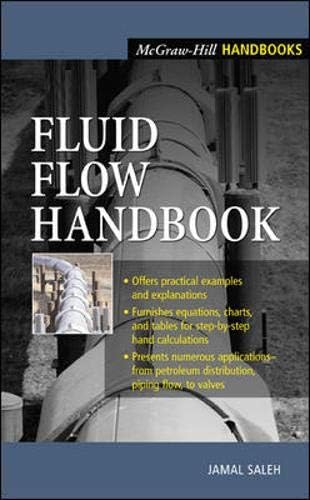
Fluid Flow Handbook
Product ID: 70582043
Desertcart purchases this item on your behalf and handles shipping, customs, and support to Morocco.
Fluid Flow Handbook [Saleh, Jamal] on desertcart.com. *FREE* shipping on qualifying offers. Fluid Flow Handbook Review: Valuable Fluids Handbook - As a practicing aerospace engineer, I find this handbook to be quite useful. It’s like a shorter version of Johnson, or a more textbook-like treatment than Blevins, and a good companion to the earlier “Fluid Flow Source Book” from the same (reputable) publisher. There are some great descriptive sections, but also quite a lot of useful data. There is definitely a focus on “industrial” applications (pipes and ducts, flow meters and control and assurance, fluid machines and networks, corrosion, chemical processing, ...). However, and more to my interest, there are really interesting and useful sections on external aerodynamics, turbulent flow, CFD, and molecular flow (that section, at least, was written by somebody who I know is widely regarded to be a world-class expert). It’s a good addition to any professional fluid mechanics collection, and would be useful for students as well. Review: Errata - I only referred to Section 18 but found this to be very poorly written and full of errors. The flow solution for the three branch network is wrong. In Eq. 18.9, the conversion factor for pressures is not properly accounted for, so the units are inconsistent. Not only are the symbolic Jacobian factors incorrect in Eq. 18.11 but so are the numerical derivatives (0.999 or 0.9999 instead of 1, which is clear from inspection of the system of equations and the inaccurate terms only serve to confuse the reader). The iterative solution derived is essentially a mass balance and the equations were explicit in the first place and did not require this Jacobian approach. The example spans over many pages but could have been more effectively derived and explained in one or two and it felt like the authors were trying to fill pages. Flow networks as opposed to branches are not treated. I was expecting much more to be said about two phase flow networks (which was how I arrived at this book in the first place).
| Best Sellers Rank | #10,875,434 in Books ( See Top 100 in Books ) #1,510 in Hydraulics (Books) #4,283 in Chemical Engineering (Books) #7,966 in Mechanical Engineering (Books) |
| Customer Reviews | 4.3 4.3 out of 5 stars (3) |
| Dimensions | 6.3 x 2.03 x 9.1 inches |
| Edition | 1st |
| ISBN-10 | 0071363726 |
| ISBN-13 | 978-0071363723 |
| Item Weight | 2.95 pounds |
| Language | English |
| Print length | 1000 pages |
| Publication date | March 26, 2002 |
| Publisher | McGraw-Hill Professional |
B**C
Valuable Fluids Handbook
As a practicing aerospace engineer, I find this handbook to be quite useful. It’s like a shorter version of Johnson, or a more textbook-like treatment than Blevins, and a good companion to the earlier “Fluid Flow Source Book” from the same (reputable) publisher. There are some great descriptive sections, but also quite a lot of useful data. There is definitely a focus on “industrial” applications (pipes and ducts, flow meters and control and assurance, fluid machines and networks, corrosion, chemical processing, ...). However, and more to my interest, there are really interesting and useful sections on external aerodynamics, turbulent flow, CFD, and molecular flow (that section, at least, was written by somebody who I know is widely regarded to be a world-class expert). It’s a good addition to any professional fluid mechanics collection, and would be useful for students as well.
A**K
Errata
I only referred to Section 18 but found this to be very poorly written and full of errors. The flow solution for the three branch network is wrong. In Eq. 18.9, the conversion factor for pressures is not properly accounted for, so the units are inconsistent. Not only are the symbolic Jacobian factors incorrect in Eq. 18.11 but so are the numerical derivatives (0.999 or 0.9999 instead of 1, which is clear from inspection of the system of equations and the inaccurate terms only serve to confuse the reader). The iterative solution derived is essentially a mass balance and the equations were explicit in the first place and did not require this Jacobian approach. The example spans over many pages but could have been more effectively derived and explained in one or two and it felt like the authors were trying to fill pages. Flow networks as opposed to branches are not treated. I was expecting much more to be said about two phase flow networks (which was how I arrived at this book in the first place).
Trustpilot
2 weeks ago
1 week ago