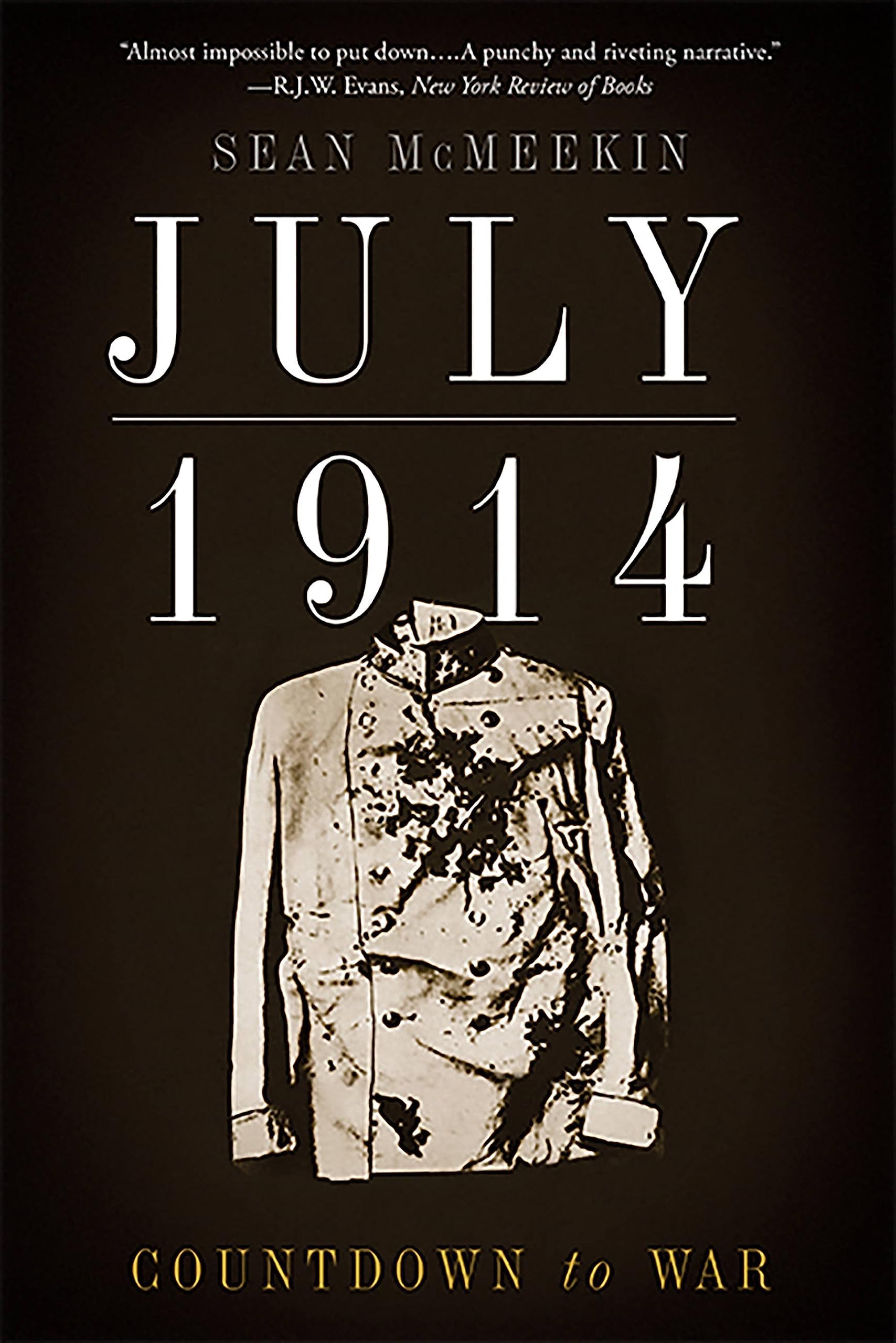
July 1914
Product ID: 6886155
Desertcart purchases this item on your behalf and handles shipping, customs, and support to Morocco.
The definitive account of the month after Franz Ferdinand’s assassination, revealing how reckless statesmen directly led to World War I. “Almost impossible to put down ... A punchy and riveting narrative.” — New York Review of Books When a Serbian-backed assassin gunned down Archduke Franz Ferdinand in late June 1914, no one could have imagined the shocking bloodshed that would soon follow. Indeed, as acclaimed historian Sean McMeekin reveals in July 1914 , World War I might have been avoided entirely had it not been for the actions of a small group of statesmen in the month after the assassination. Whether they plotted for war or rode the whirlwind nearly blind—from Austrian Foreign Minster Leopold von Berchtold and German Chancellor Bethmann Hollweg to Russian Foreign Minister Sergei Sazonov and French President Raymond Poincaré—each sought to capitalize on the fallout from Ferdinand’s murder, unwittingly leading Europe toward the greatest cataclysm it had ever seen. A revolutionary account of the genesis of World War I, July 1914 draws on troves of new evidence to show how a single month—and a handful of men—changed the course of the twentieth century. Review: This is a real contribution.... - McMeekin mentions in his introduction that there are more than 25,000 books on WW1, many of them dealing with the question of "cause" and "responsibility." McMeekin's new book is an important new contribution, which is rare; especially for those of us who do not read foreign languages and are not professional historians. Why is this book better than most of the others that have come out recently (centenary approaching, publishers salivating....)? (1) McMeekin appears to have limited his account to contemporary archival and first-hand sources -- there is none of the annoying (though entertaining) reliance on postwar self-justifying memoirs that so many professional and journalistic historians of the period rely on. (2) McMeekin proceeds by taking the reader through a careful, detailed, almost moment-by-moment chronology; the beginning of wisdom. Following the trail of evidence in 6 or more capital over 40 days is difficult, but it is the beginning of wisdom. (3) McMeekin has a sensible approach to the "Who were the deciders?" question in each capital; he shows you what people did and said, and from that record there emerges a sense as to how events were shaped. To give a few examples -- neither Wilhelm II nor Nicholas II were really "deciders", in the sense, say, of US Presidents today, but they were important; nevertheless, McMeekin recognizes the primacy of the chancellors, ministers and others just below the "sovereign"/head-of-state level. (4) McMeekin recognizes that despite the crowned heads and ostrich plumes on the surface, the great European powers in 1914 were close to modern democratic states in which public opinion mattered -- sometimes for real, sometimes as a screen. (5) Importantly, McMeekin has a finely judged sense of contingency -- yes, there were "deep forces" at work; but some totally contingent events played a large part in how events developed. His discussion of counterfactuals is lively and provocative, but also appropriately restrained and illuminating. (6) There is a brief chapter at the end in which McMeekin offers a kind of summing-up of the "sins" -- he uses that word -- of the Great Powers. This is a tour de force -- persuasive by its very Olympian detachment ("None shall 'scape whipping", was my personal reaction.) ....... And here is perhaps the central aim of McMeekin, to balance out the inevitable hindsight effect of Hitler and World War II. It is easy now, in retrospect, to assume the German government in 1914 was as lawless, aggressive and arrogant as in 1939. But such was not the case. The "German war guilt" thesis does not hold up. It may be that McMeekin slightly overweights Russia's appetite for war. But it must be said, his evidence is there and the "case" he makes that the French egged the Russians on is both somewhat new in popular history (most Anglophone historians are rather pro-French) and convincing. All right, how about the negatives? I can think of only one -- McMeekin is not an especially gifted writer; he is clear (a difficult feat given his task), he has an eye for the telling detail, but his prose is rather flat. Here and there his publisher, perhaps, has encouraged him to engage in popularisms that fall somewhat flat (entitling a chapter "The Last Chance Saloon", for example). That's it. This was a much more satisfying book than Christopher Clark's Sleepwalkers (although the two historians share the same general Germany-isnt'to-blame-for-everything view). (Coda: So what did cause WW1? In a nutshell, I would summarize McMeekin (or what I took from McMeekin) as follows: After years of humiliations, Austria felt she must respond to the Sarajevo outrage; she contemplated a short, local response -- perhaps a brief occupation of Belgrade; she asked Germany whether Germany would support this, and Germany, giving too little thought to consequences but probably with the idea that Austria's move would be localized and contained, gave her only ally support -- unfortunately, support in the form of the famous "blank check"; once Austria sent a humiliating ultimatum to Serbia, Russia seized the opportunity -- or recognized a necessity -- of standing behind her Slav compatriots; France then seized the opportunity of engaging Russia in a two-front war against Germany; Germany diplomacy and strategic thinking was incapable of wiggling out of the resulting situation, as Britain was incapable of wiggling out of its prior soft assurances to France; and so, by the first week in August, Germany, Britain and even Austria (by this time) went into a war none of them wanted, only France and Russia really being happy about the outcome. Of course, no one knew how bad it would be. But McMeekin quotes some evidence suggesting that German leaders -- Wilhelm, Moltke and others -- had the same premonition Yamamoto had at the time of Pearl Harbor; i.e., that whatever the start of the war looked like, they were doomed to defeat. And all along, the story is one of successful deceit (all's fair, etc., but the French and Russians were much better at this than the Germans or British); bluster and war-lust alternating with reality checks and the fear of regime-destruction: and, most of all, unutterably depressing ignorance and incompetence on the part of all the players -- ignorance of what was actually happening (this was a world reliant on the telegram) and incompetence in judging realities, formulating strategic aims and then following through. I will leave to others the obvious parallels to our own time.) (Further coda: McMeekin generously credits Barbara Tuchman, a non-academic historian, as piquing his initial interest in WW! and its causes (although he is not shy in pointing out her mis-dating of an important event). I have always thought we all owe out present lives, literally, in some part to the fact that JFK was (with all his faults on other issues) in charge during the Cuban missile crisis and that he had recently read Tuchman's Guns of August, which argues a crude-but-effective version of the "railroad timetable" theory of WW1 causation; along with his anger at being misled over the Bay of Pigs, this helped teach him to question the rigidities of advice about military matters (I can almost imagine him repeating to the Joint Chiefs the point Wilhelm II made to Moltke when the Kaiser believed that re-directing Germany's attack tothe East rather than to France would keep Britain out of the war, and Moltke mumbled that operational and supply considerations would not permit the change.) McMeekin does not follow a crude version of the railway timetable approach, but gives appropriate weight to the key geopolitical consideration that was perhaps the largest determinant of the war's inevitabilty once the diplomats had made their blunders -- the fact that Russia, due to her enormous size, had to mobilize earlier than anyone else, and that once Russia mobilized, Germany had to, and then..... Review: Informative,detailed and diligent,first class narrative,controversial conclusions - The title informs clearly the potential reader what he/she is about to read.As there are thousands of books on the origins of the First WW,the first question is why select this one. The answer is ,in my opinion,because it is one of the better ones in describing the events and because it is very well written,with literary skill in modern but elegant prose.Also because it is bound to be controversial.The book is a blow by blow account of how,within one month,Europe went from peace and prosperity to a 20 million dead war that became global and turned the rest of the 20th century into the biggest war century of all times.It is also very scholarly with a clear text. The reader should be cautioned that the author is judgmental.He does not consider that the responsibility for starting the war,normally assigned to A-H and Germany by many historians,is an open and shut case.He points the responsibility for this strongly to Russia and France and,I consider,he tilts more than fair to that side.Yet,I consider that,in challenging the prevailing opinion on responsibility for the war,he provides a lot of arguments and food for thought,as certainly the responsibility for this war is not s clear cut case and there are a lot of responsible states,differing only by their degree of guilt. The three main causes of War ,Militarism,Nationalism and Imperialism should taint all European Nations involved,because they transformed by their adoption the 20th century into a powder keg waiting for the spark.The only innocent Nations were Belgium and Luxembourg. I do not expand on this because I stated my views in my review of The Sleepwalkers and this review is about this book.The three profound causes that I mentioned are not adequately covered ,but they are not the stated subject of the book either. The reason,I believe,that the author shifted so much the blame on Russia and France ,is that Russia encouraged through her Representative in Serbia a panslavic confrontational attitude against Austria and indirectly Serbian State terrorism and France because she aligned with Russia for anti German reasons.Also because they prepared both war by timetable like everybody else but Russia mobilized first. This however is not the whole story. Granted that they could equally well abstain on the basis that Serbia was not worth 20 million dead but they were not the cause of the spark.The primary responsibility for the spark is with Serbia,Austria and Germany. The author treats the Kaiser in a softer way than most historians ,putting on the dock instead Bethmann,Berchtold and Conrad as Principals responsible for the war on the Triple Alliance side and underlines the belligerence and inflexibility of Samsonov and Pointcare,absolving to an extend the Tsar and Viviani on the Entente side The incompetence of the Statesmen, their political myopia and inability to foresee the consequences of their act to the point of imbecility and their willingness to use brinkmanship to the limit to obtain insignificant aims are excellently and persuasively described. I consider useful to go away from the cliche that all responsibility for this war is on Austria and Germany and be critical about it,but I feel that the author in his effort to do so charges the other side with more responsibility than they deserve. In any case the readers of this sort of books are all thoughtful people and can draw their own conclusions. The debate is endless and over simplifications should be avoided.Already clubs are formed assigning the responsibility to this or that Nation.You can join any of them or start your own. The important matter is that the study of the origins of this war by responsible and intelligent Statesmen saved us a few times from a Nuclear Armageddon during the Cold War. This is the real contribution of books like this one. DVK P.S. To facilitate those who start reading about this war's origins below is a not exhaustive list of some significant works on the subject -The guns of August by Barbara Tuchman (Impressionistic style ,excellent prose,easy to understand) -The origins of the war of 1914 by Luigi Albertini (The Classic ) -Political Philosophy and the Great War by G P Crean IV (Broad analysis) -The origins of the First World War by Stephen Van Evera,MIT Political Science Dept (Lists all points of view on responsibility,Neutral) -The Sleepwalkers by C.Clark (An excellent, very deep and profound analysis of the causes and the actors,exceedingly well written,avoids assigning responsibility) -Europe's Last Summer by David Fromkin (Very good Primer for the American Public,Classic conclusions) -The origins of the First World War by William Mulligan(Broad and deep with thematic essays and a new approach as to the inevitability of the war) -The Origins of ww1 edited by R Hamilton and H Herwig (The most recent product of serious Scholarship.It goes as far back as 1815.Ten American and one British author examine the Nations behavior and conclude.No European author)




| Best Sellers Rank | #462,126 in Books ( See Top 100 in Books ) #19 in Australian & Oceanian Politics #36 in Canadian Politics #39 in Canadian Military History |
| Customer Reviews | 4.5 out of 5 stars 481 Reviews |
D**E
This is a real contribution....
McMeekin mentions in his introduction that there are more than 25,000 books on WW1, many of them dealing with the question of "cause" and "responsibility." McMeekin's new book is an important new contribution, which is rare; especially for those of us who do not read foreign languages and are not professional historians. Why is this book better than most of the others that have come out recently (centenary approaching, publishers salivating....)? (1) McMeekin appears to have limited his account to contemporary archival and first-hand sources -- there is none of the annoying (though entertaining) reliance on postwar self-justifying memoirs that so many professional and journalistic historians of the period rely on. (2) McMeekin proceeds by taking the reader through a careful, detailed, almost moment-by-moment chronology; the beginning of wisdom. Following the trail of evidence in 6 or more capital over 40 days is difficult, but it is the beginning of wisdom. (3) McMeekin has a sensible approach to the "Who were the deciders?" question in each capital; he shows you what people did and said, and from that record there emerges a sense as to how events were shaped. To give a few examples -- neither Wilhelm II nor Nicholas II were really "deciders", in the sense, say, of US Presidents today, but they were important; nevertheless, McMeekin recognizes the primacy of the chancellors, ministers and others just below the "sovereign"/head-of-state level. (4) McMeekin recognizes that despite the crowned heads and ostrich plumes on the surface, the great European powers in 1914 were close to modern democratic states in which public opinion mattered -- sometimes for real, sometimes as a screen. (5) Importantly, McMeekin has a finely judged sense of contingency -- yes, there were "deep forces" at work; but some totally contingent events played a large part in how events developed. His discussion of counterfactuals is lively and provocative, but also appropriately restrained and illuminating. (6) There is a brief chapter at the end in which McMeekin offers a kind of summing-up of the "sins" -- he uses that word -- of the Great Powers. This is a tour de force -- persuasive by its very Olympian detachment ("None shall 'scape whipping", was my personal reaction.) ....... And here is perhaps the central aim of McMeekin, to balance out the inevitable hindsight effect of Hitler and World War II. It is easy now, in retrospect, to assume the German government in 1914 was as lawless, aggressive and arrogant as in 1939. But such was not the case. The "German war guilt" thesis does not hold up. It may be that McMeekin slightly overweights Russia's appetite for war. But it must be said, his evidence is there and the "case" he makes that the French egged the Russians on is both somewhat new in popular history (most Anglophone historians are rather pro-French) and convincing. All right, how about the negatives? I can think of only one -- McMeekin is not an especially gifted writer; he is clear (a difficult feat given his task), he has an eye for the telling detail, but his prose is rather flat. Here and there his publisher, perhaps, has encouraged him to engage in popularisms that fall somewhat flat (entitling a chapter "The Last Chance Saloon", for example). That's it. This was a much more satisfying book than Christopher Clark's Sleepwalkers (although the two historians share the same general Germany-isnt'to-blame-for-everything view). (Coda: So what did cause WW1? In a nutshell, I would summarize McMeekin (or what I took from McMeekin) as follows: After years of humiliations, Austria felt she must respond to the Sarajevo outrage; she contemplated a short, local response -- perhaps a brief occupation of Belgrade; she asked Germany whether Germany would support this, and Germany, giving too little thought to consequences but probably with the idea that Austria's move would be localized and contained, gave her only ally support -- unfortunately, support in the form of the famous "blank check"; once Austria sent a humiliating ultimatum to Serbia, Russia seized the opportunity -- or recognized a necessity -- of standing behind her Slav compatriots; France then seized the opportunity of engaging Russia in a two-front war against Germany; Germany diplomacy and strategic thinking was incapable of wiggling out of the resulting situation, as Britain was incapable of wiggling out of its prior soft assurances to France; and so, by the first week in August, Germany, Britain and even Austria (by this time) went into a war none of them wanted, only France and Russia really being happy about the outcome. Of course, no one knew how bad it would be. But McMeekin quotes some evidence suggesting that German leaders -- Wilhelm, Moltke and others -- had the same premonition Yamamoto had at the time of Pearl Harbor; i.e., that whatever the start of the war looked like, they were doomed to defeat. And all along, the story is one of successful deceit (all's fair, etc., but the French and Russians were much better at this than the Germans or British); bluster and war-lust alternating with reality checks and the fear of regime-destruction: and, most of all, unutterably depressing ignorance and incompetence on the part of all the players -- ignorance of what was actually happening (this was a world reliant on the telegram) and incompetence in judging realities, formulating strategic aims and then following through. I will leave to others the obvious parallels to our own time.) (Further coda: McMeekin generously credits Barbara Tuchman, a non-academic historian, as piquing his initial interest in WW! and its causes (although he is not shy in pointing out her mis-dating of an important event). I have always thought we all owe out present lives, literally, in some part to the fact that JFK was (with all his faults on other issues) in charge during the Cuban missile crisis and that he had recently read Tuchman's Guns of August, which argues a crude-but-effective version of the "railroad timetable" theory of WW1 causation; along with his anger at being misled over the Bay of Pigs, this helped teach him to question the rigidities of advice about military matters (I can almost imagine him repeating to the Joint Chiefs the point Wilhelm II made to Moltke when the Kaiser believed that re-directing Germany's attack tothe East rather than to France would keep Britain out of the war, and Moltke mumbled that operational and supply considerations would not permit the change.) McMeekin does not follow a crude version of the railway timetable approach, but gives appropriate weight to the key geopolitical consideration that was perhaps the largest determinant of the war's inevitabilty once the diplomats had made their blunders -- the fact that Russia, due to her enormous size, had to mobilize earlier than anyone else, and that once Russia mobilized, Germany had to, and then.....
D**S
Informative,detailed and diligent,first class narrative,controversial conclusions
The title informs clearly the potential reader what he/she is about to read.As there are thousands of books on the origins of the First WW,the first question is why select this one. The answer is ,in my opinion,because it is one of the better ones in describing the events and because it is very well written,with literary skill in modern but elegant prose.Also because it is bound to be controversial.The book is a blow by blow account of how,within one month,Europe went from peace and prosperity to a 20 million dead war that became global and turned the rest of the 20th century into the biggest war century of all times.It is also very scholarly with a clear text. The reader should be cautioned that the author is judgmental.He does not consider that the responsibility for starting the war,normally assigned to A-H and Germany by many historians,is an open and shut case.He points the responsibility for this strongly to Russia and France and,I consider,he tilts more than fair to that side.Yet,I consider that,in challenging the prevailing opinion on responsibility for the war,he provides a lot of arguments and food for thought,as certainly the responsibility for this war is not s clear cut case and there are a lot of responsible states,differing only by their degree of guilt. The three main causes of War ,Militarism,Nationalism and Imperialism should taint all European Nations involved,because they transformed by their adoption the 20th century into a powder keg waiting for the spark.The only innocent Nations were Belgium and Luxembourg. I do not expand on this because I stated my views in my review of The Sleepwalkers and this review is about this book.The three profound causes that I mentioned are not adequately covered ,but they are not the stated subject of the book either. The reason,I believe,that the author shifted so much the blame on Russia and France ,is that Russia encouraged through her Representative in Serbia a panslavic confrontational attitude against Austria and indirectly Serbian State terrorism and France because she aligned with Russia for anti German reasons.Also because they prepared both war by timetable like everybody else but Russia mobilized first. This however is not the whole story. Granted that they could equally well abstain on the basis that Serbia was not worth 20 million dead but they were not the cause of the spark.The primary responsibility for the spark is with Serbia,Austria and Germany. The author treats the Kaiser in a softer way than most historians ,putting on the dock instead Bethmann,Berchtold and Conrad as Principals responsible for the war on the Triple Alliance side and underlines the belligerence and inflexibility of Samsonov and Pointcare,absolving to an extend the Tsar and Viviani on the Entente side The incompetence of the Statesmen, their political myopia and inability to foresee the consequences of their act to the point of imbecility and their willingness to use brinkmanship to the limit to obtain insignificant aims are excellently and persuasively described. I consider useful to go away from the cliche that all responsibility for this war is on Austria and Germany and be critical about it,but I feel that the author in his effort to do so charges the other side with more responsibility than they deserve. In any case the readers of this sort of books are all thoughtful people and can draw their own conclusions. The debate is endless and over simplifications should be avoided.Already clubs are formed assigning the responsibility to this or that Nation.You can join any of them or start your own. The important matter is that the study of the origins of this war by responsible and intelligent Statesmen saved us a few times from a Nuclear Armageddon during the Cold War. This is the real contribution of books like this one. DVK P.S. To facilitate those who start reading about this war's origins below is a not exhaustive list of some significant works on the subject -The guns of August by Barbara Tuchman (Impressionistic style ,excellent prose,easy to understand) -The origins of the war of 1914 by Luigi Albertini (The Classic ) -Political Philosophy and the Great War by G P Crean IV (Broad analysis) -The origins of the First World War by Stephen Van Evera,MIT Political Science Dept (Lists all points of view on responsibility,Neutral) -The Sleepwalkers by C.Clark (An excellent, very deep and profound analysis of the causes and the actors,exceedingly well written,avoids assigning responsibility) -Europe's Last Summer by David Fromkin (Very good Primer for the American Public,Classic conclusions) -The origins of the First World War by William Mulligan(Broad and deep with thematic essays and a new approach as to the inevitability of the war) -The Origins of ww1 edited by R Hamilton and H Herwig (The most recent product of serious Scholarship.It goes as far back as 1815.Ten American and one British author examine the Nations behavior and conclude.No European author)
B**J
Diplomacy on a roller coaster and an author who can make sense of it
With the start of WWI exactly 100 years ago this summer, there is no shortage of books on the subject, but so far, "July 1914: Countdown to War" is my favorite. Sean McMeekin has researched the events between the June assassination of Archduke Franz Ferdinand and the August outbreak of open hostilities to the minute. The book is a breathless account of the month, focusing not on the military maneuvers, but the diplomatic side of the story. There are times his writing feels almost climactic, but then he will switch countries to show what their leaders were doing at the same moment, which is the total opposite. Due to communication delays and political niceties, not to mention no one really wanting to actually start a war that obviously would destroy Europe (if not more), it takes nearly an entire month for war to break out. The Russians are militarizing while denying it. The Germans are ready, but pushing the Austrian Empire into war first, Serbia is being held accountable but doesn't even have an army and takes her time answering Austria's official posts. The French are bound by a treaty with Russia to declare war on Germany should she invade Russia (and France mobilizes the fastest) and just when it all seems to be at an impasse, England is forced to choose sides. All of this in stately government palaces, where George V, Kaiser Wilhelm II and Tsar Nicholas II are relatively minor characters, merely signing off on decisions (though Kaiser Wilhelm, at once aloof and shrewd, has a better handle on it all than his cousins). It's the politicians, at one minute warmongers and the next fearful. This is not WWII, where the aggressors openly announced what they were doing and the rest of the world openly mobilized. This is a thrilling story, minute-by-minute, of the dazzling and dizzying decisions going on behind the scenes in London, Paris, Berlin, Vienna (to a smaller degree) and St. Petersburg. McMeekin has poured over every available diplomatic shred of evidence and timed his facts to the minute. It's truly an astounding piece of research, written very much in the polite-but-firm style of the period's diplomatic writings. It's not about villains and it's not about heroes, though it becomes obvious in the story that some men (and there are only men in this story, not a woman to be found after the Archduke's wife is gunned down, that's how tight the story focuses on just what was happening in the main halls of power) were more responsible for the war than others. It's a thrill-ride tied to an event that seems like mothball history. I would suspect that Europeans, far better educated in this part of early 20th Century history than Americans (I can't speak for anyone else), would most likely be surprised at what a nail-biter the countdown to war was. It could have been stopped (or at least delayed) at any time during July, 1914.
A**L
Important Book for Everyone
Sean McMeekin's July 1914, Countdown to War, is an excellent book detailing the various events in the major European capitals leading up to the disaster of World War I. I have read many books on the Great War. In my opinion Dreadnaught by Massy Dreadnought is the best book on the buildup to the war, but it covers decades of time as well as people, systems, and ideologies. Keegan's, The First World War The First World War also covers the build up to the in an excellent fashion; however, he does not match the detail of McMeekly's work because he is covering the entire war including the fighting and its aftermath. Another good book on the Great War is, A Short History of the First World War by Stokesbury A Short History of World War I , but it is a short history. I think July 1914 has earned a special place because of its very detailed handling of the diplomatic entanglements that led to war after the assassination of the Archduke. The killing of this important person did not make headlines in Paris or London because other events, some of them rather silly, pushed it off the front page. The diplomatic maneuvering after the funeral also failed to make the papers because it was secret and because lesser stories seemed more important. They were not. The failure of diplomacy coupled with knuckleheaded policy resulted in a slaughter that ended a very good world. The West was never the same after the Great War. In the late 1890s and early 1900s in Europe and America the world was progressing very nicely. Products of every nature were becoming widely available at bargain prices, populations were increasing because of the mechanization of agriculture, medicine was curing disease at an accelerating rate, and jobs were abundant. Unfortunately, this industrialization also allowed for machines of mass destruction on the battlefield and the unification of mass populations for war. The failure of diplomacy has seldom been more abysmal. Many historians see WWI as the end of the peak of Western Civilization and the start of its decline into nothingness. Thus the importance of McMeekln's book. After reading it and understanding that Russia lied its way into the war that destroyed its monarchy along with millions of its citizens, Austria invited the war that destroyed it as a society, Serbia cooperated with its own execution, Germany blundered its way into a war it knew it could not win, France seemed eager to embrace death's hand, and England was too clever by half in disguising its intentions until it was too late, makes the reader wonder if anything has really changed since 1914. Are diplomats today this stupid? Do people in subordinate positions still have control over policy to the extent that they can start wars? One has a gut feeling that what was true in 1914 is true now. Governments are still secret and have secret understandings, people in government are no smarter than they were in 1914 (in fact they might be dumber), and leaders are just as fickle then as now. In short, it could easily happen again. This makes the book significant. It is also a very good read. AD2
P**F
A great book, but . . .
A great book, but . . . There is much that Sean McMeekin gets right. He writes: "The decision for European war was made by Russia on the night of 29 July 1914 , when Tsar Nicholas II, advised unanimously by his advisers, signed the order for general mobilization. General mobilization-- as he knew, as Sazonov knew, as Schilling knew; as Krivoshein, Rodzianko, and Duma leaders knew; as Sukhomlinov, Yanushkevitch, and Dobrorolskii knew-- meant war. So clearly did the tsar know this that, on being moved by a telegram from Kaiser Wilhelm II, he changed his mind. "I will not be responsible for a monstrous slaughter " is the key line of the entire July crisis, for it shows that the tsar, for all his simplicity-- or expressly because of his guileless, unaffected simplicity-- knew exactly what he was doing when he did it. He knew exactly what he was doing when he did it again, sixteen hours later, after agonizing all day about it. Sazonov knew it, which is why he told Yanushkevitch to "smash his telephone" so that the tsar could not change his mind again." General mobilization did indeed mean war. This makes all the more important the crucial question of why Sir Edward Grey did nothing in the face of the Russian general mobilization - especially as his own ambassador, George Buchanan, had given specific warning to Sasonov that general mobilization would "likely" trigger a German declaration of war. McMeekin properly faults Grey for his policy of ambiguity which left the opposing coalitions to interpret the British attitude in accordance with their own preferences, but he denies that Grey intended a European war without addressing questions such as: -Why did Edward Grey continue and intensify the Anglo-French military "conversations" inaugurated by Lansdowne? -Why did Edward Grey keep these "conversations" secret from the Cabinet and Parliament - even after having promised in 1912 to keep the Cabinet informed? -Why did Edward Grey oppose attempts at rapprochement with Germany after the 1904 Entente Cordiale? -Why did Edward Grey adopt the advice offered by Eyre Crowe on July 25? To wit: "The moment has passed when it might have been possible to enlist French support in an effort to hold back Russia. It is clear that France and Russia are decided to accept the challenge thrown out to them. What ever we may think of the merits of the Austrian charges against Servia, France and Russia consider that these are the pretexts, and that the bigger cause of Triple Alliance versus Triple Entente is definitely engaged. I think it would be impolitic, not to say dangerous, for England to attempt to controvert this opinion, or to endeavor to obscure the plain issue, by any representation at St. Petersburg and Paris . . . Our interests are tied up with those of France and Russia in this struggle, which is not for the possession of Serbia, but one between Germany aiming at a political dictatorship in Europe and the Powers who desire to retain individual freedom." (B.D., 10) -How do we account for Grey's Germanophobia as documented by Ferguson? And how do we explain his biographer's (Hermann Lutz) claim that "This was the man who in the last resort held in his hand during the crisis of July, 1914, the decision between war and peace . . ." McMeekin makes much of the German "mistake" of crossing Belgium. But with strong Franco-Russian forces poised on both her eastern and western frontiers, what choice did Germany have? Both the British and French General Staffs understood and expected that any war involving France and Germany would start with an invasion of Belgium. My hope is that Sean McMeekin will focus his considerable talents on these issues in a future book. Meanwhile, his Countdown to War is an excellent start and highly recommended.
S**I
Excellent research and writing
This is an excellent book and the only reason for 4 stars is to alert the reader that the book has a particular focus on the subject that might not be evident from the title or descriptions, but for quality I give it all five stars. The topic of initiation of WWI is a matter of intense interest and one covered by many writers especially because of the manner in which a relatively peaceful and prosperous Europe collapsed into a horrendous war with millions of deaths and a direct pathway to a second world war of even greater destruction. What Sean McMeekin accomplished was to show day by day (hence the title Countdown) how a small number of individuals and some consequential but otherwise minor circumstances (leaders being away on their vacations, troops having time off at the wrong time for these events) set off a cataclysmic trench warfare via the mobilization plans for the armies, which in the early 20th Century involved maneuvering millions of men into war readiness. The focal point of which I speak is really the diplomatic aspect of how this came about. McKeekin tracked down just about every meeting, every word said, every transmitted communication, showing how deceit, miss-matched intentions, and weakness changed a relatively balanced relationship between nations into a fight that was not among the leaders but among the diplomats, army chiefs, and others who were able to manipulate planning behind their backs. Generally, Germany has historically, and to this day, had the odium of initiating WWI, and this is largely because of the utilization of the Schlieffen Plan of mobilization, in which to prevent a two front war (France, Russia), troop mobilization and initiation of a one front war were linked. The plan had German troops cut through Belgium so as to race to Paris with one flank protected by the sea. But, as is evident from this account (and others have reached similar conclusions), Russia had a large part of the responsibility, by mobilizing its vast army opposite Germany (rather than aiming toward Serbia, where Germany and Austria-Hungary were planning a limited attack) earlier than was necessitated by any of the other actions. This Russian mobilization in timing, size, and troop location forced Germany's mobilization, and the Schlieffen Plan then triggered the rest. The point of the book, though, was not to shift responsibility from Germany to Russia, this is just an evident conclusion the reader may draw from this countdown. The time from the assassination of Archduke Ferdinand and his wife (June 28) by a Serbian team of assassins (one of which fired the fatal shots) to the German invasion of Belgium and France on August 4 was just a few short weeks. This is a gripping story of a sort of palace intrigue that changed the world.
P**L
Exhaustive Study But Pushes the Envelope
This work by historian Sean McMeekin shows in detail the one month leading up to the Great War after the murder of Archduke Franz Ferdinand of Austria while on a visit to Sarajevo, Bosnia. The author does a great job of taking the reader through the process day by day as foreign ministers and heads of state reacted to the event and formulated the responses that eventually led to world war by early August. This book attempts to blame Russia and France as the primary culprits responsible for the war. I have to admit that I read in detail and enjoyed his 2011 work The Russian Origins of the First World War which also placed the blame on the Russians and French. Rather than all of this being a "tragedy of miscalculation" as other historians have claimed, or totally the fault of Germany and Austria (losers do not get to write history), McMeekin in this work lays it squarely on, primarily Russia, claiming that her need for a warm water port and the need to access to the Mediterranean was vital to her economic well-being, and the need to bring allies like France and England was critical for her survival and progress ahead. And it is a major revisionist theory but one I found interesting, while others claimed he cherry picked documents. I don't know enough to make that call. The same theory translates into this book, although the author does not hit on it as hard (and so far the reviews have not hit on the author as some on the previous work)and he is going into much detail on who did what and when during the critical month before the firing began. It is fascinating reading of how so much went wrong in so short a period and a simple chronology of just over a page is prepared to summarize a very complex time, but with that being said, the book showed me that a handful of people who should have known better, bungled their way through this with the result that England, France, and Russia (until her revolution) essentially killed and were killed by Germans, Austrians and Hungarians. From a lay history point of view it was obvious to me that the people that mattered did not have their eye on the ball and this whole thing was avoidable. It sounds cold, but it seems to be had Austria Hungary simply invaded and occupied Belgrade quickly, as requested by Germany, drawn their quart of blood, and obtained concessions the whole thing would have been a regional issue, and over with before major powers could become involved, but the dual monarchy bungled it, and the book shows clearly how they all were allowed to sleepwalk into a world war. Now anyone can show duplicity in foreign affairs. The Russians are good at it, but do not hold a patent. After all, diplomacy is the art of saying enough but at times leaving your audience unclear of what you did say, or even more simply to evade the truth, or plain out lie about it. It is all here on several stages, but in the end it was Austria-Hungary mishandling this thing. and pulling in Germany that resulted in the war. There is blame to be placed everywhere, but this was a progression of errors and incompetence in diplomacy which far overweighted deception in this progess of tragic events. So, the book is interesting and well written, and worthy of reading, but for me, it did not convince me entirely of the author's premise.
W**O
An Exhaustive View into a Month on the Brink of War
Lately I've been captivated by Dan Carlin's "Blueprint to Armageddon" podcast series about WWI. As a result, I've begun reading some of the books he uses as research/source material for his podcast. One of the books is "July 1914" and what better place to start then a well-research book about the month between the assassination of Archduke Ferdinand in Sarajevo on June 28, 1914 and outbreak of war in early August 1914. This is a brilliant, yet challenging book to digest. I say challenging because there are so many players that play a pivotal role in this drama. While some of them are well-recognized by most everyone, others are notable to WWI buffs, but not much beyond. Depending on your level of knowledge, it can be a bit of challenge to keep track of all of them, especially as you acclimate to the story unfolding. Once you do that, McMeekin's exhaustive research and utilization of primary diplomatic documents creates a vivid and detailed chronology of the month's events. It is fascinating to witness the decisions (or lack of decisiveness) of the major players and see all the various missteps, blunders, assumptions and perceptions that contributed to the eventual outbreak of war. History is written by the victors and as a result, the Germans and Austro-Hungarians have been assigned the bulk of blame for WWI's outbreak. They surely share accountability for how events transpire, but it is clear that the other major players, France, Russia and Britain also played more important roles than casual observers (and quite of few historians) have assigned. There certainly was a war hungry faction among the German military and political establishment, but the Kaiser had rebuffed them frequently from aggressive action well before the Archduke's assassination. Throughout the month of July 1914, one is able to see the conflict within the German leadership and attempts by the pro-war camp to manipulate the pro-diplomacy camp. In addition to apportioning the fair share of "blame" across all players, the book leaves you shaking your head at either the blunders or outright bad decisions made across the board. One has a hard time looking at most of the facts and finding players who acting with the kind of statesmen like skill and foresight to resolve a crisis that they all evidently could see unfolding in front of them. WWI is certainly one of the greatest calamities and undoubtedly preventable despite the large tensions that existed before June 28th of that year and even after Ferdinand's assassination. McMeekin masterfully weaves together the story that should be rewarding for WWI buffs as well as anyone else casually interested in the topic.
D**F
scintillating
This book is the result of painstaking and meticulous research. The author must have spent countless hours tracking memos, notes, telegrams and general despatches between the Great Powers during the month of July 1914. What emerges is a fascinating insight into the events that led to war beginning with the assassination of Archduke Ferdinand and ending with the various declarations of war. But who was responsible and why? Before reading this book, I had taken the view that Germany was mostly responsible for the outbreak of war. However, upon reading this book, I think that the shoulder of blame actually lies with the actions of Austria Hungary but read the book and come to your own conclusion. It is a truly great read.
J**P
Als in Europa die Lichter ausgingen
Zum Gedenken an den Ausbruch des Ersten Weltkrieges erschienen in den Jahren 2013 und 2014 eine ganze Reihe von Sach- und Fachbüchern, die den historischen Anlass ausführlich und differenziert betrachteten. Neben Arbeiten, welche sich in traditionellen Bahnen bewegten, die also den Fokus auf die Mittelmächte und insbesondere auf Deutschland richteten, gab es auch höchst interessante Beiträge, die sich kritisch mit der Entente beschäftigten. Zu diesen revisionistischen Publikationen gehört auch die hervorragende Analyse des amerikanischen Historikers Sean McMeekin, der sich auf erfrischende Weise mit der Julikrise auseinandersetzt. Sein ereignis- und diplomatiegeschichtlicher Ansatz rückt die außen- und sicherheitspolitischen Entscheidungsträger der fünf Großmächte in den Mittelpunkt des Geschehens; schließlich waren sie es, die für den Erhalt des Friedens bzw. für den Ausbruch des Krieges die primäre Verantwortung trugen. Strukturelle oder systemische Faktoren können nämlich nicht hinreichend erklären, warum es ausgerechnet in jenen schicksalhaften Sommertagen des Jahres 1914 zum völligen Zusammenbruch der europäischen Ordnung kam. Um diese Frage möglichst umfassend beantworten zu können, untersucht der Autor den genauen Ablauf der Krise, die sich im Anschluss an die Ermordung des Thronfolgerpaares aus Österreich-Ungarn entfaltete. In den europäischen Hauptstädten lösten die Todesschüsse von Sarajevo ein unterschiedliches Echo aus. Kaiser Wilhelm II. war der einzige Monarch, der sich über den tragischen Verlust des mit ihm befreundeten Ehepaares schockiert zeigte. In Wien hielt sich die Bestürzung dagegen in sehr engen Grenzen. Die politische Elite der Donaumonarchie zeigte sich unschlüssig, wie man auf den Gewaltakt reagieren sollte. Außenminister Berchtold und Generalstabschef Franz Conrad von Hötzendorf sprachen sich für eine militärische Strafaktion gegen Serbien aus, während sich der ungarische Ministerpräsident Tisza für eine diplomatische Lösung einsetzte. Allen Beteiligten war jedoch klar, dass man ohne Rückendeckung aus Deutschland kaum handlungsfähig sein würde. In Berlin war man durchaus an einer schnellen und entschlossenen Antwort seines schwächelnden Verbündeten interessiert. Der Konflikt sollte aber möglichst auf die Balkanregion beschränkt bleiben, weshalb die anderen Großmächte vor vollendete Tatsachen gestellt werden mussten. Demgegenüber strebte Russland eine Ausweitung der Krise an. Vor allem Außenminister Sasonow wollte die Gunst der Stunde nutzen, um die seit langem gehegten geostrategischen Ambitionen des Zarenreichs nun endlich umsetzen zu können. Aus diesem Grund erklärte sich Sankt Petersburg nicht nur dazu bereit, die serbische Armee massiv aufzurüsten, sondern Sasonow richtete seinen gierigen Blick schon auf das Osmanische Reich und die potentielle Eroberung der Dardanellen hin aus. McMeekin knüpft mit dieser Argumentation an seine frühere Studie über die russischen Ursprünge des Ersten Weltkrieges an, die er bereits 2011 veröffentlicht hatte. Frankreich und Großbritannien waren unmittelbar nach dem Attentat nicht sonderlich alarmiert. In Paris wurde man zunächst durch innenpolitische Entwicklungen abgelenkt und in London hatte man mit der instabilen Situation in Irland alle Hände voll zu tun. Die Ereignisse kamen mehr ins Rollen, als es Wien gelang, sich von Berlin einen "Blankoscheck“ ausstellen zu lassen. Damit erhielten die österreichischen Falken jene Handlungsfreiheit, die sie benötigten, um sowohl Tisza auf ihre Seite zu ziehen als auch um Belgrad mit Hilfe eines souveränitätsverletzenden Ultimatums unter Druck zu setzen. Die gegen Serbien gerichteten diplomatischen und militärischen Maßnahmen gingen jedoch nur langsam voran und konnten nicht einmal geheim gehalten werden. So hatten St. Petersburg, Paris und Belgrad genug Zeit, um sich abzusprechen und sich in einer harten und unnachgiebigen Haltung gegenüber der Doppelmonarchie wechselseitig zu bestätigen. Neben Sasonow war insbesondere Präsident Poincaré daran gelegen, die balkanische Tragödie auf eine gesamteuropäische Ebene zu transformieren. Das französische Staatsoberhaupt hoffte auf eine Revanche für die schmachvolle Niederlage von 1871. Das Deutsche Reich reagierte lediglich halbherzig und verspätet auf diese beunruhigenden Geschehnisse. Es war weder in der Lage, mäßigend auf seinen Bündnispartner einzuwirken, noch durchschaute man rechtzeitig das konfrontative Machtspiel, welches von Russland und Frankreich betrieben wurde. Mit dem geheimen Beschluss zur Teilmobilisierung, der am 24. bzw. am 25. Juli getroffen wurde, leitete man in St. Petersburg einen Kriegskurs ein, der sich bewusst gegen beide Mittelmächte richtete. Die Geheimhaltung der Kriegsvorbereitungsphase diente keinesfalls nur dazu, Deutschland über die wahren Absichten des Zarenreichs im Unklaren zu lassen, sondern sie sollte außerdem die britische Öffentlichkeit täuschen, damit diese nicht von der offensiven Vorgehensweise abgeschreckt wurde. Der "schwarze Peter“ des Aggressors musste Berlin zufallen. Zum Glück für Paris und St. Petersburg verhielten sich die deutschen und österreichischen Außenpolitiker derart ungeschickt, dass sie ungewollt ihren geopolitischen Gegnern zuarbeiteten. Selbst als Russland am 30. Juli mit der Generalmobilmachung begann; ein Schritt, dem man in Berlin nur als kriegerischen Akt interpretieren konnte, gelang es Reichskanzler Bethmann Hollweg und seinen Diplomaten nicht, die Neutralität Großbritanniens sicherzustellen. Dies lag nicht zuletzt auch daran, dass der deutsche Generalstab über lediglich einen einzigen Aufmarschplan verfügte, der bei Kriegsausbruch eine großangelegte Offensive im Westen vorsah. Im Osten wollte man sich anfangs rein defensiv verhalten. Angesichts der aktuellen Gefährdungslage, in der Russland als erste Großmacht voll mobilisierte, wäre es jedoch dringend angebracht gewesen, genau umgekehrt vorzugehen. Dessen ungeachtet pendelte sich die britische Position ohnehin zugunsten von Frankreich und Russland ein. Außenminister Sir Edward Grey verhielt sich keineswegs unparteiisch; seine Sympathien lagen zweifellos bei Paris und St. Petersburg. Dennoch ließ er die Deutschen lange im Unklaren darüber, wie sich das Vereinigte Königreich im Ernstfall verhalten würde. Eine öffentliche Festlegung war ihm aus innenpolitischen Gründen heraus kaum möglich, da die Regierung in dieser zentralen Frage gespalten war. Er musste auf isolationistisch gestimmte Kabinettsmitglieder Rücksicht nehmen, um ein Scheitern der Regierungspolitik zu verhindern. Während Winston Churchill als Erster Lord der Admiralität Fakten schuf, indem er die Flotte in Kriegsbereitschaft versetzte, versuchte Grey einen Vorwand zu finden, um sein Heimatland auf Seiten der Entente unwiderruflich in Stellung zu bringen. Ein passender Anlass wurde ihm dann von Berlin geliefert, als die deutschen Truppen am 3. August damit begannen, in Belgien einzumarschieren. Zwei Tage zuvor hatte Frankreich schon die Generalmobilmachung veranlasst, wodurch sich Deutschland einem Zweifrontenkrieg ausgesetzt sah. Die "Urkatastrophe des 20. Jahrhunderts“, wie der amerikanische Diplomat und Publizist George F. Kennan den Ersten Weltkrieg nannte, nahm ihren bekannten Verlauf. Insgesamt gesehen ist es Sean McMeekin sehr gut gelungen, die Intensionen und Handlungen der Akteure in der Julikrise aufzuzeigen. Von einem deutschen Präventivkrieg oder einem "Griff nach der Weltmacht“ kann aus seiner Sicht nicht gesprochen werden. Das außenpolitische Verhalten der Mittelmächte zeugte vielmehr von Schwäche, Unvermögen und Verzweiflung. Die russisch-französische Allianz war dagegen offensiver orientiert. In St. Petersburg und Paris glaubte man die jeweiligen nationalen Interessen durch einen relativ kurzen Waffengang verwirklichen zu können. Alle Beteiligten zahlten in letzter Konsequenz einen extrem hohen Preis für ihre Kalkulationen und Fehlkalkulationen. Jürgen Rupp
G**N
The evening of the disaster
The book complements other visions of the First World War paying attention to the last month of peace. A fresh perspective of the importance of human (silly) behaviour and leadership in troubled times.
S**S
Produit conforme
Produit conforme
A**R
A must read for any historian
This book is a fascinating tome providing information covering aspects leading up to the start of the first world war that do not appear in most other works, get it and you will not be disappointed.
Trustpilot
3 weeks ago
1 month ago