
قم بتنزيل التطبيق


معلومات عنا
حقوق الطبع والنشر © 2024 Desertcart Holdings Limited
قم بتنزيل التطبيق
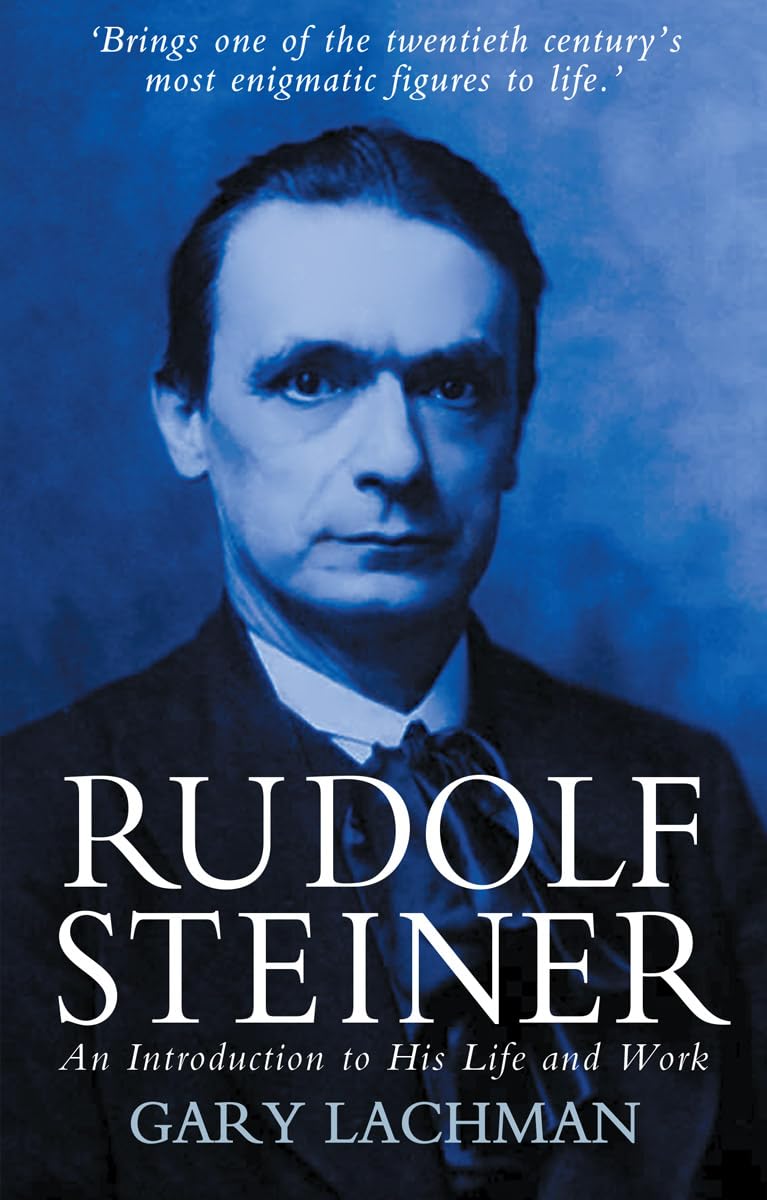
Buy Rudolf Steiner: An Introduction to His Life and Work by Gary Lachman (ISBN: 9780863156182) from desertcart's Book Store. Everyday low prices and free delivery on eligible orders. Review: A good reading - A clever and contemporary approach to the biography of the influential twentieth-century philosopher , mystic and highly creative educator, artist, scientist, who unfortunately remains a mystery despite many who benefit from his ideas mainly through the Waldorf pedagogy among other movements, like biodynamic agriculture and holistic medicine based on his Spiritual Science - the Anthroposophy . Review: Great summary - An excellent summary of Steiner's life which works as a tremendous compliment to the man's own works.
| Best Sellers Rank | 414,192 in Books ( See Top 100 in Books ) 742 in Teaching & Learning Biographies 1,289 in Religious Biographies |
| Customer reviews | 4.5 4.5 out of 5 stars (108) |
| Dimensions | 14 x 2.4 x 21 cm |
| ISBN-10 | 0863156185 |
| ISBN-13 | 978-0863156182 |
| Item weight | 1.05 kg |
| Language | English |
| Print length | 280 pages |
| Publication date | 9 Aug. 2007 |
| Publisher | Floris Books |
C**A
A good reading
A clever and contemporary approach to the biography of the influential twentieth-century philosopher , mystic and highly creative educator, artist, scientist, who unfortunately remains a mystery despite many who benefit from his ideas mainly through the Waldorf pedagogy among other movements, like biodynamic agriculture and holistic medicine based on his Spiritual Science - the Anthroposophy .
I**M
Great summary
An excellent summary of Steiner's life which works as a tremendous compliment to the man's own works.
Z**T
opened my eyes
I'm the parent of a child currently in a Waldorf nursery, who would shortly be entering the school proper in September. My partner has a cousin who is a Waldorf teacher in Germany and she is enamoured of this education style. I on the other hand have concerns, but without really knowing a great deal about Steiner, I didn't feel confident enough to act on these alone, and so I felt it was about time I informed myself about the man behind Anthroposophy so I picked up this book of my partner's from the bookshelf when I was housebound earlier this week. I found the author's honesty refreshing. While plainly someone with respect for Steiner, he refused to turn his work into a hagiography. He is not afraid to point out what he considers weaknesses in credibility in the philosophy. This book has filled in a lot of the gaps in my knowledge about Steiner. There is no doubt he was a philantrophist and had nothing but the best of intentions, however his reliance on obtaining truths via spiritual means clashes worries my empirical nature. The book left me a lot clearer about my position on his education system (which for the record is now one of mild disinclination).
M**R
A Spiritual Giant
I so enjoy reading Gary Lachman's books that I re-read them several months later and his Rudolf Steiner must be one of the best. He obviously has a high opinion of Steiner as a thinker and innovater despite misgivings about some details of his occult science. It's a pity that there was no one with Steiner's dynamism and leadership to guide the Anthroposophical Society following his death in 1925. Rudlof Steiner was slight in stature but a spiritual giant.
K**S
Start out for Steiner
Recommended if you are looking for a good introductory overview of who Steiner was and what his work was about. For an in-depth view of Steiner's life and work check out Christoph Lindenberg's biography.
P**E
Sympathetic, balanced and insightful
A sympathetic, balanced and insightful study of the life and work of Rudolf Steiner. If you want a quick 240 page account, look no further. This is it.
C**O
Good book
Very informative
D**R
Good book
Interesting and well written.
D**H
I found this an extremely interesting and well written summary of Dr. Steiner's origins, the development of his experience and his thinking. I read this to be able to communicate with a good friend of mine who has been involved with Anthroposophy since I met her in 1972. This has given me a much better understanding of Dr Steiner's wide breadth of knowledge and contribution to the world. It is easy to read and is a good lead-in to further study.
J**E
Summarizing a career as broad and spectacular as Steiner's is no easy feat. As Lachman describes in the introduction, Steiner's ideas about consciousness, the nature of thought and the relationship between the mind and the external world were, quite literally, revoluationary, and they had me rethinking the history of Western philosophy. Yet I could turn to another lecture and there Steiner would tell me about reading to the dead or about the work of the Buddha on Mars...and a kind of `Tilt' sign would light up in my brain Practical revolutionary practices, followed by seemingly zany and impossible claims. Can we remove the parts we like from Steiner's amazing body of work while dissecting the imaginative but bizarre accounts of reincarnation, death and spiritual beings? I don't know if we can, curative education, biodynamic farming and Waldorf Schools have yielded amazing results but are ultimately based on Steiner's perceptions of the spirit world. Quite a paradox. What I appreciated the most about Lachman's work were his attempts to summarize the most revolutionary concepts from Steiner's writings and lectures which, to my knowledge, these summaries were successful and are important in their own right. The balanced approach towards Steiner's life is equally important, I feel like I could pass this book along to a friend to introduce Steiner's ideas without scaring them off when they would have reached Steiner's dissertations on Atlantis, Lemuria, Ahriman Jesus and Lucifer in his original works. Steiner may be ridiculed by the more rational among us, especially the evangelists of materialism, yet he had insights almost a hundred years ago that are only prepared to receive. He was one of the most important thinkers of the 20th century. Yet it is a puzzle why few recognize his Philosophy of Freedom as such a seminal work. Some of the ideas I found most important included the concept that our eyes may perceive a world that is a simple, immediate perception yet really that world is already infused with the content of our inner world. That the world is merely physical and absolute is half the equation. Descartes sitting and contemplating was failing to contemplate that his perceptions were already influenced by himself. Steiner wrote, When one who has a rich mental life sees a thousand things which are nothing to the mentally poor, this show as clearly as sunlight that the content of reality is only the reflection of the content of our minds Additionally he argued that our cognition and awareness is not something extra, tacked on to our biology. Our knowledge of the world is part of the world, as important as our life is to the ecosystem. This isn't new age jargon, it is an argument against Kant's limits to knowledge. Steiner challenged humanity in the same way as Nietzsche, that there is more to the human than we can ever imagine. Yet Steiner took it a step farther to say that there were no limits to knowledge other than those set by laziness. Through a focus on timeless ideas and growth/creation process of the world around us, we can develop the active imagining most humans fail to curate. The thoughts I shared above are just the top layer of a deep career filled with thousands of lectures and revolutionary concepts. At the end, I had to conclude for myself that the fundamental practical solutions Steiner offered cannot be accepted if the tremendous imagination of his mind is ignored. This account of Steiner's life is the perfect introduction to the most important philosopher you've never read.
T**.
Good beginner's book to understand Rudolph Steiner and his teachings.
M**L
This work leaves the impression that it is not possible to discuss either the thought or life story of Rudolf Steiner separately. It is a very good introduction and should be the first book read by someone seeking to understand this prolific man who has contributed so many great things to society. Steiner's own writings are very dense and it is quite helpful to have a base foundation for his life and ideas before undertaking the task of seriously studying him. The book follows a chronological path, details of which can be dry reading, but Lachman explains how this is necessary to understand the evolution of Steiner's writing. Lachman also does an excellent job of explaining the major influences and events that shaped the character of this great man, especially how he evolved from spiritual philosopher to spiritual teacher. Some of the more notable stories include how Steiner was given the task of editing Goethe's collected works, how Steiner decided to open up his inner world to the public, the founding of the Anthroposophical Society, the (re-)building of the Goetheanum, as well as people he helped along the way. The first half of the book is mostly biographical, but it is in the latter half where the reader will understand the theories that made this man so prolific and revered. Steiner called his work Spiritual Science, in that his teachings were not to be taken as abstract theories, but as actual realities that we can all experience given the proper development of our higher faculties. The path of self-initiation into these higher worlds is, for Steiner, clear thinking, as it is thought that links us to spirit. It could be said that Steiner made it his life's work to boil down the essence of the esoteric doctrines of the ages into clear understandable prose the whole world could understand, made available to all those who choose this path. However Steiner's own writings, even the most introductory ones, are very dense and require careful study. This book by Gary Lachman does an excellent job of presenting Steiner in a readable form. Reading Steiner directly at first may be a hindrance without having a proper footing in the history and landscape of ideas out of which Steiner's thought grew. This book is highly recommended as the place to begin understanding Spiritual Science.
K**R
Many of the materials about Rudolf Steiner are so difficult to read, this is much more human and appealing. A friend and I both read this and feel that it presents more of a rounded human being, a knowable person, than the other biographies and even helps Steiner's own autobiography become more understandable.
ترست بايلوت
منذ 3 أسابيع
منذ 3 أسابيع