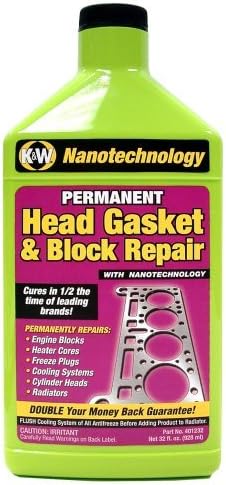

CRC 401232
Product ID: 63235082
Details
- BrandK & W
- Item weight2.5 Pounds
- Liquid volume32 Fluid
- Material
- Package informationBottle
🔧Permanent hardening bond
🚛Auto-grade durability
🧪Nanotech crack filler
🔧 Seal the deal with nanotech precision—don’t let leaks slow your hustle!
CRC 401232 leverages advanced nanotechnology to penetrate and fill cracks and crevices, forming a permanent, hardened bond ideal for automotive applications including cars, buses, and trucks. While it offers a durable seal, users should prep their cooling systems thoroughly for best results. This product is designed for professionals and DIYers seeking a high-tech, reliable stopgap or repair solution.
| ASIN | B000M8NZ70 |
| Brand | K & W |
| Customer Reviews | 3.9 3.9 out of 5 stars (330) |
| Date First Available | 1 Mar. 2006 |
| Item Weight | 1.13 kg |
| Item model number | 401232 |
| Manufacturer | CRC |
| Manufacturer part number | 401232 |
| Product Dimensions | 6.35 x 10.16 x 22.86 cm; 1.13 kg |
A**R
This product did not work and I see this as a waste of Money, will never recommend this any one in the future
C**N
I will preface this by saying that what worked for me isn't a guarantee that it will work for you. But, depending on how bad your leak issue is, it's worth a try if money is tight. My '96 Civic DX had an intermittent issue where, on long drives, the coolant would go from the radiator to the overflow bottle, but not back to the bottle when it cooled down. There were bubbles in the coolant when at idle; it looked like a cherry soda or champagne, very small, but bubbles nonetheless. I don't have access to a block tester, but I figured that was all the proof I needed that something was up. Do note, the car was NOT burning coolant, and I could effectively pour what got "pushed out" back into the radiator, and it was full again. To start things off, make 110% sure your cooling system is NOT CLOGGED UP. I am talking about the radiator/heater core, since if those are semi-plugged, this will just make things worse. If in doubt, check/replace if you can. Secondly, make sure that the inside of the cooling system is as clean as humanly possible, and that includes antifreeze too. Make sure to dispose of any antifreeze-contaminated liquid per your local regulations. I used some generic radiator flush to get things clean. Remember, the cleaner it is, the better chance it has of sticking. One area where I would deviate from the directions is that, unless you KNOW the heater core is the source of the leak, I would just get some hose from the auto-parts store and bypass it entirely to reduce the risk of it getting plugged up. Especially wise if you are unsure about the state of your heater core in terms of being plugged up or not. I ended up doing the mix with water, 30-minute idle, per the directions, but I opted to keep it in for what was going to be 500 miles of driving, but ended up being closer to 1,000, as I am in the process of moving, and didn't have the luxury of draining the cooling system, letting it dry 24+ hours, etc. Not saying that this was the right thing to do or not, but it ended up working for me. I also let the system dry closer to 36 hours since I was doing a scheduled timing belt/water pump replacement on my car, and was waiting on some last-minute parts to come in for the repair. I also blew some air into the upper radiator hose just to make sure I got as much water as humanly possible out of the block, to give this the best chance at drying. I have heard of people going so far as to blow air through the block with a hair dryer on the "cool" setting, probably overkill, but hey, can't hurt, right? I will say it was interesting when I drained the system to see actual "flakes" of the silicate that had formed, but were still very soft. Once they dried out, they would literally stick to just about anything. So if you get it on paint/plastic, RINSE IT OFF RIGHT AWAY or that stuff will stick/stain it! Good for sealing openings, not so good for your paint job. Also, it will dry the crap out of your skin, so wear gloves if you can. SO, overall thoughts. It takes a bit of effort to prep the car, and for some people, it may just be easier to pop the hood and "do it right," but for others, this may be fine as a temporary stopgap measure. I have put almost 1,000 miles on the car and have not seen the issue come back, which is encouraging to see. And I should add that's hauling at least 300+ pounds of stuff in my car too, including going up the infamous Conejo Grade, which is 4 miles of a 7% grade!
C**K
I used this in my boat engine. It a 1987 OMC 4.3l. I was getting major water in my oil. I was told by multiple people I would need a new engine or at least a new to me. Well me, not wanting to drop 3-5 grand, I decided to give this a try. It F$&%ing worked perfectly . People who have give this product a crappy review either didn't do the right process or the damage was too great. Bottom line get this stuff it truly is miracle juice for your engine
T**R
Followed instructions exactly, car was running fine, no white smoke, only had bubbling in the reservoir from the head gasket being blown and gases getting into cooling system. After using this car still has the same problem, PLUS started spitting out a ton of white smoke
A**R
I've worked on engines for decades and changed many head gaskets. I was skeptical of this product because of the low success rate of various "pour-in" products I've seen over the years. I used this on a 5 cylinder turbocharged audi engine that was leaking water into three of the cylinders. This engine would smoke a lot on start up but not so much after a few mins. My engine cooled properly and had a fresh water pump and thermostat. I used this product with the alternate directions of leaving it in for a few hundred miles. This was probably not required because when i first started it up with this product it smoked for a few minutes like usual then i took it on a 50 mile drive, it has not consumed a drop of coolant or smoked since. I would recommend trying this product, it worked for me. you MUST remove all the coolant and use only with water, and your cooling system MUST be working and cooling properly other that the head leak. Keep in mind... and the reviews reflect this..this is a bit of a crap shoot, but to me it was worth the cheap money to try before I changed the head gasket on a turbo 5 cyl audi...big pain!
Trustpilot
1 month ago
1 month ago