
قم بتنزيل التطبيق


معلومات عنا
حقوق الطبع والنشر © 2024 Desertcart Holdings Limited
قم بتنزيل التطبيق
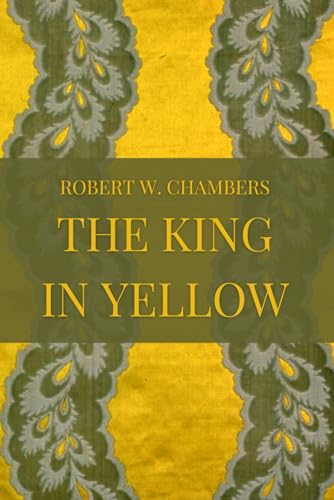

The King in Yellow [Chambers, Robert W.] on desertcart.com. *FREE* shipping on qualifying offers. The King in Yellow Review: Book texture and story good - Copy was nice, didn’t finish the book yet but it’s very good so far. Just a little hard to understand, might wanna search up some words if you get this book. Review: I read it backwards - A weird book needs to be approached in a weird way. Accordingly, I read the book backwards, chapter wise, starting with the last story “Rue Barree” then proceeding back to “The Repairer of Reputations.” It’s been suggested that the horrors of the first stories, clear and obvious, gradual ripple out into barely imperceptible connections in the later tales. I wanted to see if I could pick up on these diminishing currents by swimming back into the central vortex of horrors rather than away from them. I can’t say that I encountered any unconcealed terrors in these further out tales, although hints of dark atmosphere seem to exist, shoehorned into otherwise bright sunlit scenes of gardens, admitting disquiet notes into peaceful composition. More certain, what I did encounter was the use of the word “yellow”, usually in a description of a lamp (The Street of the First Shell), but also, more than once, as a cat’s eye color (several times in The Street of the Four Winds), and quite notably, in the final story, “Rue Barree,“ where the protagonist has a horrid nightmare of drowning in a “river of yellow ochre.” No one seems to reference this yellow nightmare mentioned so close to the book‘s ending. Furthermore, if any one of these stories had mentioned the yellow sign or the king, even just once, that story would fall right in place with the rest. Approach it like a Beatle album, with some stories having clear thematic connection, while others, though less adherent to the theme, still foster uneasy impressions and unresolved episodes, with perhaps two or three fillers thrown in for literary completeness. Notes: Rue Barree is the name of a street, but also the name of an elusive lady who lives on that street, for no one knows her real name. Cryptic and puzzling ending, darkness and marble walls, almost funereal. The Court of the Dragon is the name of the place where the main character lives. A very good story… poe-ish elements abound, especially Poe‘s “The Man in the Crowd.’’ The Demoiselle D’ys: Astounding story with a great ending. The Street of the Four Winds: a thin and hungry cat befriends a struggling artist. Very nice collar on the cat, but it’s very loose about its neck. Better find this poor cats true owner…then again. The Street of Our Lady of the Field: Dr. Byram, an old family friend, helps Hastings(Hastur?) find lodging on the Street of Our Lady of the Field. Hastings is introduced to Valentine at the garden. Weird atmosphere, a soldier playing a drum, an elusive Valentine, she wants to leave. A train ride like no other, or was it a train ride? I’ll assume it was a train ride.
| ASIN | B0CN3BVJN6 |
| Best Sellers Rank | #15,538 in Books ( See Top 100 in Books ) #13 in Science Fiction Anthologies (Books) #19 in Ghost Fiction #164 in Dark Fantasy |
| Customer Reviews | 4.3 4.3 out of 5 stars (2,078) |
| Dimensions | 6 x 0.4 x 9 inches |
| ISBN-13 | 979-8867200091 |
| Item Weight | 8.1 ounces |
| Language | English |
| Print length | 160 pages |
| Publication date | November 10, 2023 |
| Publisher | Independently published |
A**N
Book texture and story good
Copy was nice, didn’t finish the book yet but it’s very good so far. Just a little hard to understand, might wanna search up some words if you get this book.
M**.
I read it backwards
A weird book needs to be approached in a weird way. Accordingly, I read the book backwards, chapter wise, starting with the last story “Rue Barree” then proceeding back to “The Repairer of Reputations.” It’s been suggested that the horrors of the first stories, clear and obvious, gradual ripple out into barely imperceptible connections in the later tales. I wanted to see if I could pick up on these diminishing currents by swimming back into the central vortex of horrors rather than away from them. I can’t say that I encountered any unconcealed terrors in these further out tales, although hints of dark atmosphere seem to exist, shoehorned into otherwise bright sunlit scenes of gardens, admitting disquiet notes into peaceful composition. More certain, what I did encounter was the use of the word “yellow”, usually in a description of a lamp (The Street of the First Shell), but also, more than once, as a cat’s eye color (several times in The Street of the Four Winds), and quite notably, in the final story, “Rue Barree,“ where the protagonist has a horrid nightmare of drowning in a “river of yellow ochre.” No one seems to reference this yellow nightmare mentioned so close to the book‘s ending. Furthermore, if any one of these stories had mentioned the yellow sign or the king, even just once, that story would fall right in place with the rest. Approach it like a Beatle album, with some stories having clear thematic connection, while others, though less adherent to the theme, still foster uneasy impressions and unresolved episodes, with perhaps two or three fillers thrown in for literary completeness. Notes: Rue Barree is the name of a street, but also the name of an elusive lady who lives on that street, for no one knows her real name. Cryptic and puzzling ending, darkness and marble walls, almost funereal. The Court of the Dragon is the name of the place where the main character lives. A very good story… poe-ish elements abound, especially Poe‘s “The Man in the Crowd.’’ The Demoiselle D’ys: Astounding story with a great ending. The Street of the Four Winds: a thin and hungry cat befriends a struggling artist. Very nice collar on the cat, but it’s very loose about its neck. Better find this poor cats true owner…then again. The Street of Our Lady of the Field: Dr. Byram, an old family friend, helps Hastings(Hastur?) find lodging on the Street of Our Lady of the Field. Hastings is introduced to Valentine at the garden. Weird atmosphere, a soldier playing a drum, an elusive Valentine, she wants to leave. A train ride like no other, or was it a train ride? I’ll assume it was a train ride.
E**S
The shadows lengthen/In Carcosa
Human beings are fascinated by that which causes madness in us. Why would the Internet have pretty much memeified Cthulhu if we weren't? And one of the most tantalizing bringers of horror and madness is "The King in Yellow," a collection of Robert Chambers' short stories that are loosely tied together by a mysterious play of exquisite horror. The horror stories compiled here are some of the best classic horror that can be found, full of the tattered decay of the unseen and the spellbinding magic that mere words can only hint at... and the problem is that the second half of the collection is just not as interesting. The first four stories are all tied together by "The King In Yellow," a play whose story and characters are never really explored beyond a few snatches of song and some descriptions of the world where it takes place ("... twin suns sink into the lake of Hali... I saw the towers of Carcosa behind the moon"). It speaks of horrors ("the Pallid Mask") that are hinted at more than explained, and the mysterious King In Yellow, a mysterious personage in "scolloped tatters." And it is written with exquisite beauty and horror -- one character laments: "Oh the sin of writing such words,--words which are clear as crystal, limpid and musical as bubbling springs, words which sparkle and glow like the poisoned diamonds of the Medicis!" The brilliance of this conceit is that Chambers leaves almost everything to the reader's imagination. He plants a few hauntingly beautiful, unnerving images in the reader's mind ("Carcosa where black stars hang in the heavens"), and lets us imagine something so exquisite yet nightmarish that it could drive someone mad. These four stories include: *When young Hildred Castaigne is recovering from a severe head injury, he reads "The King In Yellow." As his sanity spirals out of control, he encounters a similarly crazy "Repairer of Reputations," and begins to believe he is the last scion of the Imperial Dynasty of America. *Alec visits his old friend Boris (who is married to the woman Alec loves), who has discovered a mysterious liquid that can turn anything organic into a beautiful marble. *A religious young man is pursued by a mysterious stalker, and haunted by the horrors he has seen in "The King In Yellow." *An artist struggles with his affections for his lovely model and the pursuit of a grotesque watchman, only for the infamous play -- which he has on his bookshelf for some reason -- to seep into their minds and poison them. These stories are absolute perfection, both horrifying and lyrically exquisite, especially since merely reading it can cause reactions from nightmares and illness to outright craziness (down to declaring oneself to be king of America). The problem is... well, the remaining stories do not have that quality. They're still good and often beautifully written ("The name of Sylvia troubles me like perfume from dead flowers"), but after Chambers horrified and mesmerized us, it's kind of a letdown to encounter stories that don't really do either. These stories include a guy who falls in love with a beautiful young Breton noblewoman, little realizing why their love is impossible; a series of interconnected drabbles with personified abstracts like Love and Truth; an artist has some conversations with a scrawny cat, and eventually tries to take her back to her mistress, Sylvia Elven; a tale in the Franco-Prussian War, where an artist's life is wrecked by the impending German attack; and a pair of romances among young artists in Paris. Chambers' writing is still sublimely lovely in these stories, and they do have some overarching themes that run through almost every story -- many of the protagonists are artists or close to artists, and there is a lot of yellow, a lot of flowers, and some names that keep recurring in different places (Sylvia, Hastur). But somehow the last two romantic stories just fall kind of flat, especially when death and horror aren't brought into them -- the prose is pretty, but a little too commonplace ("Her face was expressionless, yet the lips at times trembled almost imperceptibly"). Eerie, beautiful and ghastly, "The King In Yellow" collects stories that hint at beauty and horrors that the human mind can't even grasp -- and if he had filled the entire book with these, it would have been perfection. As it is, the first half is sublime, the second is merely okay.
I**N
A fantastic read!! Recommended if you like dark, cosmic horror.
J**Z
The book arrived in great condition!
I**Z
Muy bien en todo , se cumplieron las expectativas y el transportista entregó con el tiempo acordado
古**虎
原書は生の不思議と恐怖が直に感覚に湧き立つ。これが堪らないのです。
M**N
Trzymajcie się z daleka od tego wydania. Ktokolwiek przygotował ten tekst do druku w ogóle nie zadał sobie trudu, żeby sprawić, by książka była czytelna. Czcionka jest mikroskopijna, tekst wyrównany do lewej zamiast justowania, brak wcięć akapitowych. Cud, że tytuły poszczególnych opowiadań i numery rozdziałów są wytłuszczone i wyśrodkowane.
ترست بايلوت
منذ أسبوع
منذ أسبوعين