Quality of Earnings
Product ID: 53229211
Buy anything from 5,000+ international stores. One checkout price. No surprise fees. Join 2M+ shoppers on Desertcart.
Desertcart purchases this item on your behalf and handles shipping, customs, and support to Morocco.
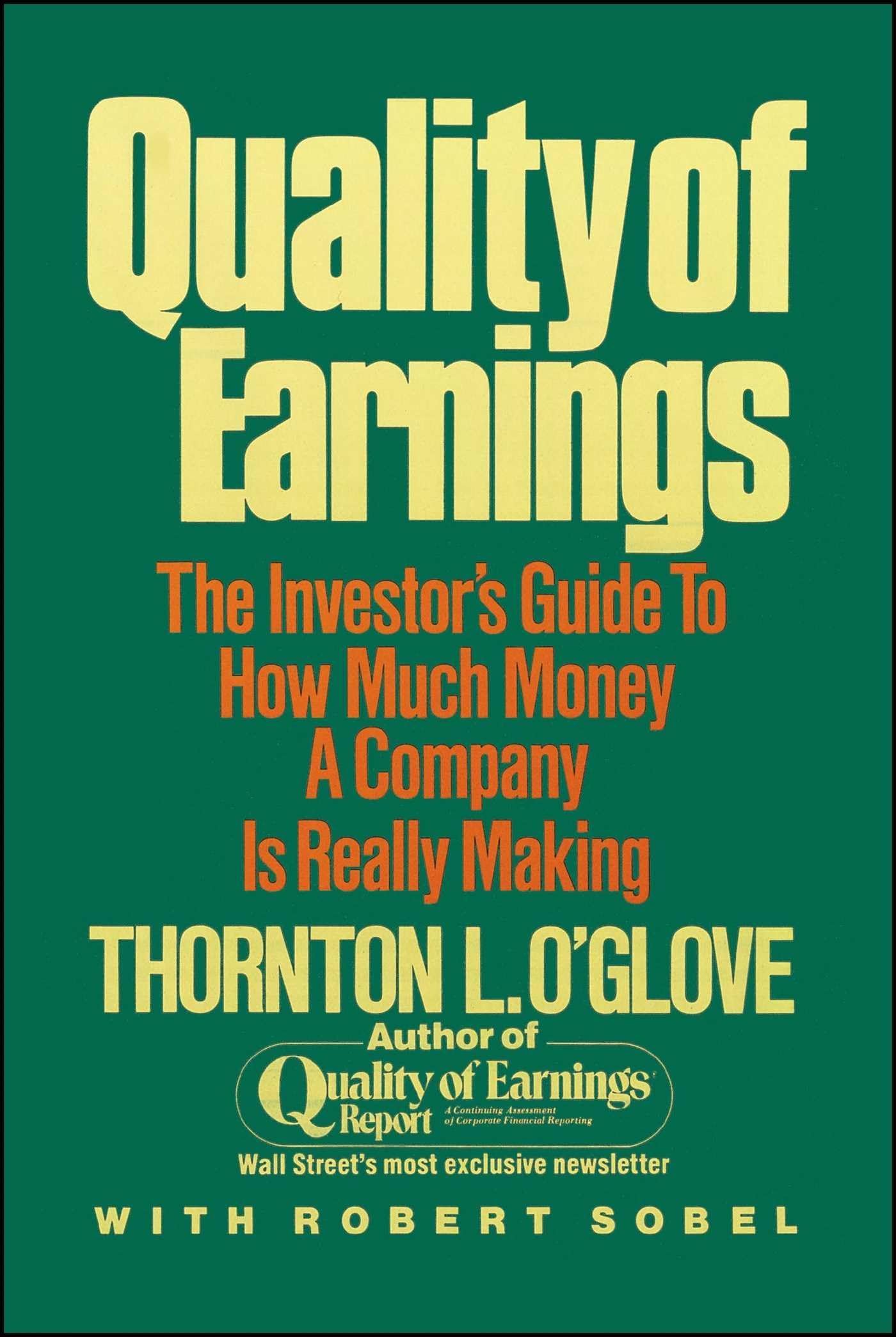
From Simon & Schuster, Quality of Earnings is an investor's guide to how much money a company is really making. From Thornton L. O'glove, Quality of Earnings is an indispensable guide to determining how much money a company is really making and for buying and selling stocks without making costly blunders. Review: Good quality learning. - Very good book, a classic and it's interesting to read about companies like IBM or Apple, but with the cut-off date around 1985. Review: Very good book for anyone wanting to step up their ability ... - Very good book for anyone wanting to step up their ability to analysis companies' financial statements. It is for the fundamental investor and gives good detail and tips for any future Warren Buffets.
| Best Sellers Rank | 119,081 in Books ( See Top 100 in Books ) 50 in Professional Financial Forecasting |
| Customer Reviews | 4.5 out of 5 stars 259 Reviews |
E**O
Good quality learning.
Very good book, a classic and it's interesting to read about companies like IBM or Apple, but with the cut-off date around 1985.
T**R
Very good book for anyone wanting to step up their ability ...
Very good book for anyone wanting to step up their ability to analysis companies' financial statements. It is for the fundamental investor and gives good detail and tips for any future Warren Buffets.
M**B
Interesting read
The beginning of the book was rather slow, but later on the author explains in clear language were to look for in the annual reports.
M**Y
Check what a company reports to IRS
This is a great book. The most valuable lesson I learned from it is to analyze the differences in income reporting to the IRS vs. reporting to shareholders. All companies keep two types of books, one for the IRS and one for shareholders. There are times when an expense can be deducted from a taxable income on the tax return, but it may not be deducted under the GAAP rules. As an investor, I am interested in knowing what a company reports to the IRS and how this number compares to what it reports to shareholders. Since most of the investors do not even bother to check this discrepancy, the dishonest management may deceive investors by hiding certain expenses. - Mariusz Skonieczny, author of Why Are We So Clueless about the Stock Market? Learn how to invest your money, how to pick stocks, and how to make money in the stock market
R**O
Buenísimo. Muy recomendable!!
Buscaba algo diferente respecto a muchos libros y con este lo he encontrado. Muy bueno!!
A**E
Very Good! Why is this not a classic?
I have never heard about this book, until Amazon recommended it to me. It sounded interesting so I ordered it, and I’m overwhelmed by how good it is. If you make your investment decisions based on the data from financial reports, this book is a must read. It shows the reader how companies can make you believe wrong or overly optimistic things and also goes into very deep depth about some important yet mostly overlooked fundamentals, like inventory. It also shows you how you can see through the blur of accounting tricks and get a better and more complete picture of the real financial situation of a company. How is this not a classic that gets quoted in almost every newer investment book. If you’ve read The Intelligent Investor this book is the next step down the road…
F**S
Timeless Lessons, Updated into Spreadsheet from Old School Value website
Now in 2014, this book is nearly 30 years old. The author probably never anticipated that all financial statement analysis could be quantified and available for FREE on the Internet. However, the simple lessons the book offers are timeless because of the clear message: The GAAP rules are flexible enough to allow companies to present earnings data in a favorable light without bending any of the rules. Below are examples of the healthy skepticism championed by the author that continue to be relevant 30 years later. The chapter dealing with Non-Recurring Earnings asks what should be done with Investment or Interest Income, are they part of operations or are they not? -- O'glove teaches how to look at earnings from Major Retailers and find that on 24% came from income other than what was sold in stores, and then poses the question about whether this should be included or excluded from the Bottom Line when analyzing whether the company is a good investment. The chapter dealing with items on the Balance Sheet, particularly accounts receivables and inventories. O'Glove teaches to look inside the inventory balance and find what contributes to that number, and analyze whether that inventory balance is due mostly to finished goods sitting on shelves, signaling future problems with slowing sales or write-offs. O'Glove uses the example of Apple under John Scully in 1985, when its finished-goods inventory nearly tripled from the prior year and Scully explained the subsequent rally resulting from better inventory turnover. The chapter on Dividends and Share Buybacks explains how increasing a dividend payout can subsequently lead to a worse return for shareholders than if the company performed share buybacks of common stock. The illustration of Wester Union is an example of companies becoming locked into paying dividends rather than a more efficient return to shareholders. BOTTOM LINE: O'Glove teaches an analytical approach that requires work, but applying these lessons properly can make the difference between investing in the next WorldCom or the next Apple. Fortunately, O'Glove lessons have been converted into an Excel Spreadsheet by engineer Jae Jun at his Old School Value (OSV) website. The financial statement data comes directly from Morning Star, the proprietary algorithms are 100% transparent and all the tools focus on finding out what happens at the Publicly Traded Company Behind the Scenes. Once you become familiar with the Spreadsheet, modify to fit your needs, observe whether companies use GAAP tricks to brighten their earnings ... All this automated into a Spreadsheet that cuts down analytical time to 10 minutes at the most, allowing you to save time and read the Annual Report footnotes of worthwhile companies.
H**X
Un ouvrage indispensable pour comprendre la finance d'entreprise !
"Quality of Earnings" est un livre fascinant qui offre une perspective approfondie sur l'analyse des états financiers d'une entreprise. L'auteur, un expert en finance, explique comment évaluer la véritable rentabilité d'une entreprise en se concentrant sur la qualité de ses bénéfices, plutôt que sur les chiffres bruts. J'ai particulièrement apprécié les études de cas et les exemples concrets qui illustrent comment des entreprises peuvent manipuler leurs résultats pour donner une image plus positive de leur performance. Ce livre fournit des outils pratiques pour détecter ces anomalies et mieux comprendre la santé financière d'une entreprise. Que vous soyez un investisseur, un analyste financier ou simplement quelqu'un qui s'intéresse à la finance d'entreprise, ce livre est une lecture essentielle. Il vous aidera à développer une approche plus critique et informée de l'analyse des bénéfices. Je le recommande vivement à quiconque souhaite approfondir sa compréhension de la finance et de l'évaluation d'entreprise !
K**A
A great seller
This seller is my highest recommendation.
Trustpilot
3 weeks ago
1 month ago