
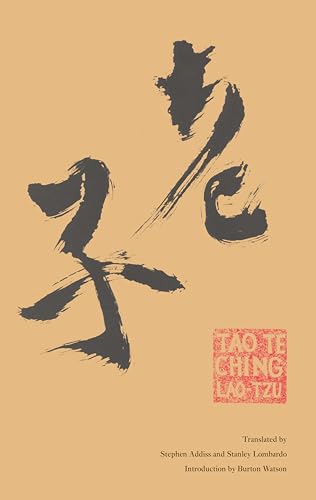
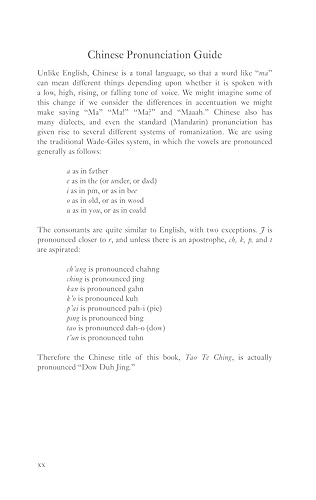
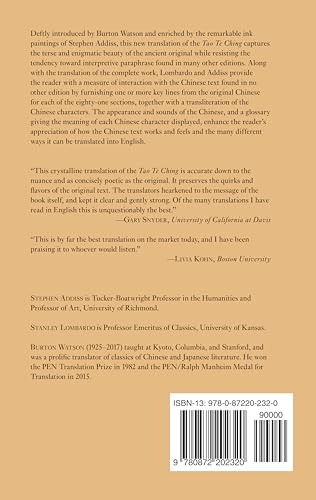

Buy Tao Te Ching (Hackett Classics) copyright 1993 by Lao Tzu, Stephen Addiss, Stanley Lombardo (ISBN: 9780872202320) from desertcart's Book Store. Everyday low prices and free delivery on eligible orders. Review: 'Subtle Illumination.' Great Translation. - Stephen Addiss and Stanley Lombardo have achieved here an excellent, readily assimilated translation of the Tao Te Ching into English, which is rewardingly enhanced by Burton Watson's very helpful introduction, in which he clearly explains in succinct fashion all the salient points necessary for the best appreciation of the text. A helpful translators' preface and pronunciation guide are also included along with a glossary of Chinese words appearing at the end of the work, in which the western style alphabetical spelling of a variety of Chinese picture writing characters is given. Attractive calligraphic illustrations are dispersed throughout the work. Not very much is known about Lao Tzu to whom authorship of the Tao Te Ching is attributed. Tradition has it that he was a contemporary of Confucius (551-479 BCE) and that the two of them met on at least one occasion, but we cannot be sure about this. Whereas Confucianism is very much a male orientated, good governance teaching from the top down aspect, Taoism confronts the vagaries of daily existence as experienced by every day folk. More is known about a later Tao teacher called Cuang Tzu whose teachings are found in The Book of Chuang Tzu, which is also available in English translations. Some may find it beneficial to read a page of this work on a daily basis, returning to the beginning after the final saying has been read. Among other helpful attributes of the work is its function as an antidote to the humbug encountered in daily life, especially that of both political and religious kinds. Those with experience of Ch'an (Zen) Buddhism cannot fail to notice how it has been beneficially influenced by Taoism. Indeed, there may well have been a mutual influence. At the beginning of the work we are told that 'naming is the mother of ten thousand things.' and that names can name no lasting things. In a way, this sets the stage for the difference between Taoist and Confucianist priorities: mother orientated for the one and father orientated for the other, except that Taoism isn't really orientated at all. It's simply knowing what it is to truly BE, which is, of course, unbeable. Review: Tao Te Ching - An excellent translation, with interesting Chinese calligraphy paintings throughout. Highly recommended. It is, I think, the closest translation to the original text, but at times it can be heartless in its literalism. It makes clear the different possibilities of meanings/interpretations of the original Chinese words, and provides unique insight into the difficulty of 'accurately' translating a text such as this. Given this however, it does translate it excellently, most excellently, but I do not recommend it if this will be your first reading of the Tao Te Ching -- if it is the first time you will read the Tao Te Ching I recommend Gia-Fu Feng and Jane English's translation as it is a better introductory translation, in my opinion. Still, this book is great, and I highly recommend it.
| Best Sellers Rank | 71,147 in Books ( See Top 100 in Books ) 26 in Taoism (Books) 44 in Academic Philosophy |
| Customer reviews | 4.6 4.6 out of 5 stars (1,506) |
| Dimensions | 13.97 x 0.64 x 21.59 cm |
| Edition | copyright 1993 |
| ISBN-10 | 0872202321 |
| ISBN-13 | 978-0872202320 |
| Item weight | 1.05 kg |
| Language | English |
| Print length | 128 pages |
| Publication date | 1 Nov. 1993 |
| Publisher | Hackett Publishing Co, Inc |
H**N
'Subtle Illumination.' Great Translation.
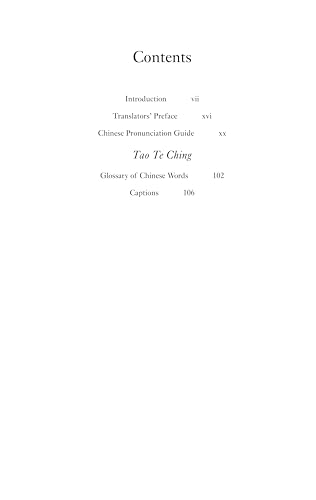
Stephen Addiss and Stanley Lombardo have achieved here an excellent, readily assimilated translation of the Tao Te Ching into English, which is rewardingly enhanced by Burton Watson's very helpful introduction, in which he clearly explains in succinct fashion all the salient points necessary for the best appreciation of the text. A helpful translators' preface and pronunciation guide are also included along with a glossary of Chinese words appearing at the end of the work, in which the western style alphabetical spelling of a variety of Chinese picture writing characters is given. Attractive calligraphic illustrations are dispersed throughout the work. Not very much is known about Lao Tzu to whom authorship of the Tao Te Ching is attributed. Tradition has it that he was a contemporary of Confucius (551-479 BCE) and that the two of them met on at least one occasion, but we cannot be sure about this. Whereas Confucianism is very much a male orientated, good governance teaching from the top down aspect, Taoism confronts the vagaries of daily existence as experienced by every day folk. More is known about a later Tao teacher called Cuang Tzu whose teachings are found in The Book of Chuang Tzu, which is also available in English translations. Some may find it beneficial to read a page of this work on a daily basis, returning to the beginning after the final saying has been read. Among other helpful attributes of the work is its function as an antidote to the humbug encountered in daily life, especially that of both political and religious kinds. Those with experience of Ch'an (Zen) Buddhism cannot fail to notice how it has been beneficially influenced by Taoism. Indeed, there may well have been a mutual influence. At the beginning of the work we are told that 'naming is the mother of ten thousand things.' and that names can name no lasting things. In a way, this sets the stage for the difference between Taoist and Confucianist priorities: mother orientated for the one and father orientated for the other, except that Taoism isn't really orientated at all. It's simply knowing what it is to truly BE, which is, of course, unbeable.
W**M
Tao Te Ching
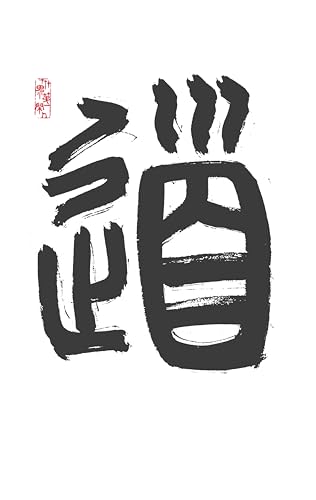
An excellent translation, with interesting Chinese calligraphy paintings throughout. Highly recommended. It is, I think, the closest translation to the original text, but at times it can be heartless in its literalism. It makes clear the different possibilities of meanings/interpretations of the original Chinese words, and provides unique insight into the difficulty of 'accurately' translating a text such as this. Given this however, it does translate it excellently, most excellently, but I do not recommend it if this will be your first reading of the Tao Te Ching -- if it is the first time you will read the Tao Te Ching I recommend Gia-Fu Feng and Jane English's translation as it is a better introductory translation, in my opinion. Still, this book is great, and I highly recommend it.
M**R
The most accurate translation - the NIV of Taoism
One amazing thing you discover with the Tao (after reading 2 or 3 versions) is that each version is different. A subtle change in how a charactor is translated can utterly change its meaning & whole verses that once had one slant can have a radically different meaning with a different translator. In the Bible you will find this when you compare a paraphrase like the The Message with literal translations like New International Version (NIV) , but the differences are often only slight & the meaning is only a little different. As the Tao is translated from a completely different language to English, it can vary wildly with its translations. Couple this with the fact that it can often be more profound in its teachings, so the differences between versions will often the reader amazed. So it is that even the first verse ('Tao called Tao is not Tao') is wildly different in meaning to the paraphrased 'The Name that can be named is not the eternal name'. And, looking through this version, I found many differences in meaning to the paraphrased versions I've been reading. For Instance, Verse 15: '...Because they do not wish to be full, they can fade away without further effort' (compared with: '...Not seeking fulfillment, they are not swayed by desire for change.') Verse 50: '...The tiger's claws find nothing to flay, Weapons find nothing to pierce. Why is this? They have no mortal spot' (compared with: '...This is the fulfilled person of the the Tao who leaves no space in life for premature death.') Some of these translations are better, some more awkward, but often they are enlightening & new. If it can be described, it is like this version has a far stronger Chinese flavor than the other versions & seems more true to what Lao Tzu intended. Added to this, this particular edition is filled with Chinese symbols next to the verses. Like the strangeness of the text itself, these have the effect of taking your mind back to the time when Lao Tzu wrote the text & of making you feel some of the 'mysterious powers' that Confucius claimed he had. So, if you've read just one version of the Tao Te Ching, then I would recommend this one as a way of completely & radically altering your perspective on the meaning of Lao Tzu's words. That said, I would not recommend it for beginners (just as I wouldn't recommend the King James Bible to first-time Bible readers). If you have just read Million Little Pieces or have just started on your Taoist Odyssey, then I recommend this pocket version: Tao Te Ching & this: Change Your Thoughts - Change Your Life to get you started. Once you're on the path though, then get this version & prepare to have your mind stretched in ways you can't even begin to imagine...
A**H
It has this zen-like blow effect on the mind, something which I can say only about this translation, by Addiss and Lombardo, having read and compared this with five other old and modern rendition of this ancient text in English.
M**S
Life in the 21st century can feel like trying to drink from a fire hose while juggling flaming chainsaws. My brain was constantly buzzing, stressed, and just... full. I'd heard whispers of the Tao Te Ching, this ancient text offering wisdom, but always pictured something dense, academic, and frankly, a bit intimidating. Enter this particular translation by Stephen Addiss and Stanley Lombardo. From the moment I held it – the quality of the book itself is lovely, and the ink paintings scattered throughout are simply beautiful – I felt a sense of calm. And then I started reading. This isn't just a translation; it feels like an invitation. The language is clear, direct, and surprisingly relatable. It strips away the unnecessary complexity and gets right to the heart of things. Suddenly, these ancient verses weren't just historical artifacts; they were speaking directly to my modern chaos. Each short chapter offers a moment to pause, breathe, and look at things from a completely different angle. It's not telling you what to do, but gently guiding you to see the world, and your place in it, with more clarity and less resistance. It's like finding a quiet, still pond in the middle of a noisy city. The inclusion of the original Chinese characters for key lines is a brilliant touch. Even without understanding the language, seeing the characters adds a layer of depth and connection to the source. It makes you appreciate the incredible effort and care that went into bringing this wisdom across centuries and cultures. Reading this book hasn't magically solved all my problems (I wish!), but it has profoundly shifted my perspective. It's given me tools to quiet the mental noise, to embrace simplicity, and to find strength in going with the flow rather than constantly fighting against it. It's a book I keep on my bedside table, dipping into a chapter or two whenever I need a moment of grounding or a gentle reminder of what truly matters. If your mind feels cluttered, your spirit restless, or you're simply curious about finding a different way to navigate the world, do yourself a favor and pick up this translation. It's not a self-help book in the conventional sense, but it's one of the most helpful books I've ever read. It's ancient wisdom, beautifully presented, offering modern 'aha!' moments on every page.
C**N
Excelente presentación, con algunos extras que valen la pena, sin embargo el libro presenta algunas manchas, es por eso las 4 estrellas.
G**N
I learned a lot about myself. This book had me breaking through inner dialogues, cutting away the forest of static in my head and let me see the light. Buy this book to read an intriguing, philosophical perspective that I personally envy. The translation was perfect and easy to follow, as long as you have a good understanding of the English language. WOULD BUY AGAIN/FOR FRIENDS AND FAMILY
A**S
This book is such a timeless beauty. There is so much to think about, and such beautiful art within to appreciate as you digest the meaningful and thought provoking poetry. Thank you Lao Tsu for this masterpiece.
ترست بايلوت
منذ شهرين
منذ أسبوعين


