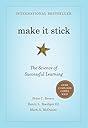


🧠 Make learning stick — because your brain deserves the best!
Make It Stick: The Science of Successful Learning reveals scientifically proven strategies to improve how you absorb and retain information. Authored by experts Peter C. Brown, Henry L. Roediger, and Mark A. McDaniel, this book debunks ineffective study habits and equips you with practical, research-backed methods like spaced repetition and self-testing. Perfect for professionals and students aiming to optimize their learning efficiency and unlock their full cognitive potential.


| Best Sellers Rank | 34,043 in Books ( See Top 100 in Books ) 3 in Educational Psychology 17 in Test Preparation for Young Adults 23 in Child & Developmental Psychology in Education |
| Customer reviews | 4.6 4.6 out of 5 stars (4,552) |
| Dimensions | 13.97 x 2.54 x 20.96 cm |
| ISBN-10 | 0674729013 |
| ISBN-13 | 978-0674729018 |
| Item weight | 499 g |
| Language | English |
| Print length | 268 pages |
| Publication date | 12 May 2014 |
| Publisher | Harvard University Press |
R**N
What's Most Important to know? The contents of this book!
This book is potentially a life-changer for me. It's been about a month or so since I read the contents and started applying the core concepts of it into my own life. I cannot stress enough the difference I have noticed in my retention ability - this, on a very difficult topic, (C++ and Problem Solving). To give a little background into why I write the review, and to hopefully encourage others who might be similar to invest in this publication: I always wondered why I couldn't transfer an uncommon ability to absorb trivia into other parts of my life, especially in an academic context. When I was in high school, I was an exceptional sponge of knowledge, and placed well in national trivia competitions. Even after high school, I won pub quizzes as 'One Man At the Bar". Why couldn't I transfer this 'skill' to more important and worthwhile pursuits? I'd always been pretty relaxed (to the point of horizontal) in my approach to studying, with a toxic combination undermining my progress. I had a natural disinclination to study, as well as an acceptance of second best, all anchored down by an abysmal sense of self esteem. Despite all of this, I always reassured myself that I could achieve things if I 'actually' tried, and stayed safe in the knowledge that "if I really work at it, I could definitely do/learn it." Failures in anything were handwaved with 'I didn't try hard enough', which may or may not have been truthful - it's difficult to objectively analyse. However, having worked hard on eliminating the self-esteem problems over the last year, and setting the bar a lot higher for myself in terms of what I'd like to get out of life, I noticed I had surprising difficulties in retaining knowledge on C++ and Programming. I had assumed that sustained study with purpose and direction would finally allow me to 'take the handbrake off' on my learning, and find a better career in programming. It came as a rude shock to see me fail to grasp and retain information that, while not necessarily easy, is certainly something that other people seem able to master in a much shorter timeframe. After a little research into what might be slowing me down (it wasn't intelligence, memory, lack of interest, ADHD, etc...), I found this book - and I now realise I simply had never learned how to study properly! Put succinctly: I had never needed to! I more or less crammed or desperately squeezed what info I could into my head before any tests/assignments (some of which, looking back, I very badly let myself down in). On one occasion, I can remember being dishonest in an official exam, although with zero benefit from a moral or personal perspective. Anyway; this book has helped me retain very difficult information in a very short time frame. I'm finally able to reel off the kind of complicated knowledge presented in books like 'C++ Primer' (incidentally, an excellent book!) in the same way that I could casually recall trivia like country capitals, the monarchs reigning during certain historical events, or the creator of specific pieces of art. Certainly, this book will not turn one into a genius overnight (or indeed, ever!) - AND there is 'work' to be put into studying and the use/creation of spaced-repetition flashcards...but just find what works for you. I cannot recommend this book enough, and look forward to moving through life with the handbrake finally removed :)
L**I
Probably the best book on the subject
The subject is: the science of how to learn efficiently. A must read especially if you learn by rereading books, notes. This should be everyone's starting point before learning anything. This includes school learning, job training and sports. It details the proven scientific principles behind how effective learning works, and how most people learn ineffectively. What it includes: Scientifically proven methods of learning that work, and their ineffective, but popular counterparts (eg interleaving as supposed massed practice (eg rereading in rapid succession), testing as a tool of learning, memory aids) What it does NOT include: Physiological considerations: eat well, sleep well, don't use stimulants etc. The use of any type of software. How to make yourself motivated to study. (there's very minimal advice on that) Pros: A lot of books give good advice, but this one gives the best. It prioritises the most important aspects of learning ie the ones which will make the biggest difference. Has a large scope, but enough depth to provide good understanding. The format makes it very easy to understand the topic and the experiments qouted let you know that the information is proven and accurate. Cons: Does not suggest the use of any software even when it would be appropriate. Eg the use of paper flash cards was suggested once, but a flashcard software is superior in every sense. I think a bit more emphasis should have been on memory aids. Format: As you would expect from any good popular science based books, there are stories and examples so that you understand the principles and the short description of the results of experiments proving them (which are referenced). Very important: This lets you know how accurate the information is. It lets you separate proven facts from opinion and specualtion. (not like there's a lot of the latter in the book anyway) It's nice that the most important bits are summed up in the last chapter from the perspective of students, teachers etc.
B**N
A good guide to learning but one that drags on unnecessarily.
I like the book overall. The tips themselves are great for students and the scientific studies mentioned are great for both educators and scientists working in cognitive psychology. The main issue I would have with the book is that it drags on unnecessarily by invoking long-winded stories that, in my opinion, add next to nothing to the substance of the book. It's a 250-page book that could be reduced to around 100-150 pages without the stories, but well worth buying overall. My advice when reading: extract the key points using sticky tabs/flags/highlighter and type those up as a step-by-step guide for specific forms of studying and then print those off to stick on the wall.
D**T
Good book
So far I've only dipped into this to extract the practical applications. I'll probably never read it fully as I don't feel it is necessary. However, I'm confident the processes the book promotes for making knowledge 'stick' are sound, and I'm glad I bought it.
R**E
Excellent for Teachers and Coaches
As a football coach I have been looking into the best ways of making sure what my players learn they remember and are able to use. This book is one of the best I have read on this subject. The ideas, and suggestions, backed up by research and anecdotal evidence, are useful and thought provoking. Some you have probably been using already others will be new to you. The great thing is you can try out these suggestions immediately whilst reading the book to see if what you have read has stuck!
A**I
Some good info, but not an ‘easy’ read
I’m someone who really struggles to take on new information. I’m trying to find was around that as my work can be quite complex. I can see that this book will be helpful but I just don’t find it the type of book that I *want* to sit and read, it’s a bit of a chore. That said, there’s some really interesting points and I will carry on chipping away at it.
W**S
Really helping me rethink my approach to my own learning as well as my teaching to be more effective.
G**I
Libro mastro sui metodi di studio efficaci ed efficienti !! Da avere assolutamente
C**E
Desde que la OCDE viene aplicando sus exámenes PISA ha habido un vacío en técnicas de aprendizaje eficaces y eficientes. Make it stick colabora, con mucho, a llenar ese vacío.
M**N
Very good lecture for you to change the way you study and teaching
O**R
Me lo compré en papel después de haber comprado (y escuchado) la versión en audiolibro en (...) (pertenece a Amazon). Es un libro que me ha gustado tanto que quiero tenerlo en papel, para poder prestarlo a mis amigos. En él descubres que ciertas formas que suponías que eran adecuadas para aprender no son las que dan el mejor rendimiento a largo plazo. Es interesante para todos, pero en especial para padres (para que unos encaminen a sus hijos hacia formas más adecuadas de aprender) y para docentes (para que vean si deben cambiar la forma en que abordan la enseñanza).
ترست بايلوت
منذ أسبوعين
منذ شهرين