![The Big Short [DVD]](https://m.media-amazon.com/images/I/81wP9xFdh8L._AC_SL3840_.jpg)
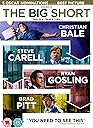
The Big Short [DVD]
Product ID: 48247151
Details
- FormatPAL
- Genrecomedy
- LanguageEnglish
- Runtime2 hours and 10
Buy anything from 5,000+ international stores. One checkout price. No surprise fees. Join 2M+ shoppers on Desertcart.
Desertcart purchases this item on your behalf and handles shipping, customs, and support to Morocco.
Adam McKay co-writes and directs this financial drama starring Brad Pitt, Steve Carell, Christian Bale and Ryan Gosling. The film follows eccentric financial analyst Michael Burry (Bale) as he uncovers an impending crash in the housing market and puts together a plan to profit from it. As Burry's predictions are spread by those who believe he is mad, a small number of people, including Jared Vennett (Gosling), Ben Rickert (Pitt) and Mark Baum (Carell), get on board with his idea in the hope of saving their assets. The supporting cast includes Selena Gomez, Rafe Spall and Karen Gillan. The film was nominated for six Academy Awards including Best Picture, Best Adapted Screenplay and Best Supporting Actor (Bale), winning for Best Adapted Screenplay. The film also won the BAFTA Award for Best Adapted Screenplay. Review: Another film about the 2007-2008 financial crash - I loved The Big Short with Christian Bale and Brad Pitt, as I also loved Margin Call starring Jeremy Irons, Paul Bettany, and Kevin Spacey. Two very different ways of dealing with the financial crash of 2007 - 2008. Two very good films. Margin Call is looking at the crash from the perspective of a company that realises that it is holding too much by way of bundled up, collateralised, sub-prime mortgages, and sells them on just in time to avert its own total demise, although some employees do lose their jobs. The Big Short is looking at the crash from the perspective of different people who all think that they are the only ones to see that mortgages granted to large numbers of people who are less than ideal mortgage borrowers is leading to house prices inevitably going up as a lot of money enters the housing market that should never have entered the housing market, and that this will inevitably lead to bust as many of those less than ideal borrowers default on their obligation to repay, and, here's the really important point, the equity in those heavily mortgaged properties is not enough to repay the lenders because those properties were too highly valued when the mortgages were taken out and when sold, if sold, would be sold for a value below the amount borrowed against that property, sometimes well below the amount actually borrowed. Although what is explained in The Big Short, and not explained in Margin Call, is that what happened was that those sub-prime mortgages were collateralised, bundled up, and each bundle given an inaccurately high credit rating by Credit Rating Agencies that had a financial incentive in giving an inaccurately high credit rating, and then sold as being a good investment to people looking to get a good yield on their money. Not only were these bundles of inaccurately highly rated sub-prime mortgages sold to private individuals, they were also sold to banks that then looked to be more wealthy, financially solid, than they actually were. If I have understood it correctly, the company in Margin Call is holding a lot of these bundles containing a lot of sub-prime mortgages, and simply sells those bundles just before those same bundles really collapse in value. In Margin Call the company does what Lehman Brothers should have done if its staff had been bright enough. The Big Short is quite different in that the protagonists specifically bet that these bundles will indeed collapse in value. I, personally, never quite got to understand the precise procedure for placing these bets, and maybe the inability to keep it simple should cost the film a star. I think that they do their best to explain it, but I don't think that they quite pulled it off. Ditto really for Margin Call. Margin Call did not quite explain enough or not clearly enough, I thought, what the product was that the company had to off-load so precipitately. The Big Short was excellent in its ending. People who should have known better did lend to housebuyers who they must have known were never likely to be able to repay their loans. Credit rating agencies gave bundles of these sub-prime mortgages a credit rating that they must have known was too high. Neither the reckless lenders nor the probably outright dishonest credit rating agencies were brought to book for the disaster they wrought. Review: A Crash isnt a Crash until you are bailed out. - Good acting great photography and direction. Its interesting, complicated and true. BUT its very dry and much of it seems to be the same thing be reiterated by either the same people of different people in a mirror. I liked it and enjoyed it, but I did get very detached somewhere around the middle. There was little of variety to give me hope. Its a good stream, probably a bottle or 2 of wine would help.









| ASIN | B01AD980BS |
| Actors | Brad Pitt, Christian Bale, Ryan Gosling, Selena Gomez, Steve Carell |
| Aspect Ratio | 16:9 - 2.40:1 |
| Best Sellers Rank | 1,310 in DVD & Blu-ray ( See Top 100 in DVD & Blu-ray ) 35 in Portable DVD & Blu-ray Players 229 in Comedy (DVD & Blu-ray) 453 in Drama (DVD & Blu-ray) |
| Customer reviews | 4.6 4.6 out of 5 stars (4,489) |
| Director | Adam McKay |
| Is discontinued by manufacturer | No |
| Language | English (Dolby Digital 5.1) |
| Manufacturer reference | 5053083069728 |
| Media Format | PAL |
| Number of discs | 1 |
| Producers | Arnon Milchan, Brad Pitt, Dede Gardner, Jeremy Kleiner |
| Product Dimensions | 13.5 x 1.5 x 19 cm; 68.04 g |
| Release date | 23 May 2016 |
| Run time | 2 hours and 10 minutes |
| Studio | Paramount Home Entertainment |
| Subtitles: | English |
| Writers | Adam McKay, Charles Randolph |
E**R
Another film about the 2007-2008 financial crash
I loved The Big Short with Christian Bale and Brad Pitt, as I also loved Margin Call starring Jeremy Irons, Paul Bettany, and Kevin Spacey. Two very different ways of dealing with the financial crash of 2007 - 2008. Two very good films. Margin Call is looking at the crash from the perspective of a company that realises that it is holding too much by way of bundled up, collateralised, sub-prime mortgages, and sells them on just in time to avert its own total demise, although some employees do lose their jobs. The Big Short is looking at the crash from the perspective of different people who all think that they are the only ones to see that mortgages granted to large numbers of people who are less than ideal mortgage borrowers is leading to house prices inevitably going up as a lot of money enters the housing market that should never have entered the housing market, and that this will inevitably lead to bust as many of those less than ideal borrowers default on their obligation to repay, and, here's the really important point, the equity in those heavily mortgaged properties is not enough to repay the lenders because those properties were too highly valued when the mortgages were taken out and when sold, if sold, would be sold for a value below the amount borrowed against that property, sometimes well below the amount actually borrowed. Although what is explained in The Big Short, and not explained in Margin Call, is that what happened was that those sub-prime mortgages were collateralised, bundled up, and each bundle given an inaccurately high credit rating by Credit Rating Agencies that had a financial incentive in giving an inaccurately high credit rating, and then sold as being a good investment to people looking to get a good yield on their money. Not only were these bundles of inaccurately highly rated sub-prime mortgages sold to private individuals, they were also sold to banks that then looked to be more wealthy, financially solid, than they actually were. If I have understood it correctly, the company in Margin Call is holding a lot of these bundles containing a lot of sub-prime mortgages, and simply sells those bundles just before those same bundles really collapse in value. In Margin Call the company does what Lehman Brothers should have done if its staff had been bright enough. The Big Short is quite different in that the protagonists specifically bet that these bundles will indeed collapse in value. I, personally, never quite got to understand the precise procedure for placing these bets, and maybe the inability to keep it simple should cost the film a star. I think that they do their best to explain it, but I don't think that they quite pulled it off. Ditto really for Margin Call. Margin Call did not quite explain enough or not clearly enough, I thought, what the product was that the company had to off-load so precipitately. The Big Short was excellent in its ending. People who should have known better did lend to housebuyers who they must have known were never likely to be able to repay their loans. Credit rating agencies gave bundles of these sub-prime mortgages a credit rating that they must have known was too high. Neither the reckless lenders nor the probably outright dishonest credit rating agencies were brought to book for the disaster they wrought.
D**N
A Crash isnt a Crash until you are bailed out.
Good acting great photography and direction. Its interesting, complicated and true. BUT its very dry and much of it seems to be the same thing be reiterated by either the same people of different people in a mirror. I liked it and enjoyed it, but I did get very detached somewhere around the middle. There was little of variety to give me hope. Its a good stream, probably a bottle or 2 of wine would help.
M**S
An Engrossing, Unusually Presented/Vaguely Comedic, Account of US-Based 'Activities' Preceding the Early C21 Financial Meltdown
I decided to get the recently-released DVD of the film 'The Big Short' as the subject matter and cast suggested it would be a decent watch, as well as provide an insight into a wide range of matters surrounding the lead-up to the global financial crisis - which essentially started in the USA in 2007. [This whole matter is obviously VERY significant, but due to it's very nature, VERY involved so it's difficult to try and summarise the main plot without mentioning so many other aspects - hence my rather lengthy review title !!!] I enjoyed watching this film and, despite the subject-matter having a foundation in greed/stupidity/downfall and it occasionally being a little difficult to follow 'events' (I refer you again to how complicated this whole subject area is, so this was likely to happen !!!), think it does a pretty good job of 'explaining' a major aspect of the crisis which has largely been 'unexplored' - despite the film being based on a pre-existing non-fiction book (with the same title). As this is essentially an 'office space' drama, with lots of dialogue and little action I think watching it on DVD was perfectly adequate - especially as it's also a modern release and the Blu-ray costs quite a bit more ! BUT, do note that the DVD extras are MUCH fewer than the Blu-ray.... ---- Now I've already explained quite a bit about the overall 'story', it's a good time to repeat the well-described Amazon synopsis for the film plot : "The film follows eccentric financial analyst Michael Burry as he uncovers an impending crash in the housing market and puts together a plan to profit from it. As Burry's predictions are spread by those who believe he is mad, a small number of people, including Jarred Bennett, Ben Rickert and Mark Baum, get on board with his idea in the hope of saving their assets." The book this film is based on was written by Michael Lewis, who also wrote a book called 'Moneyball' which also made it to the silver screen and who's subject-matter is similarly convoluted (the statistical analysis of Major League Baseball player performance), but still able to 'entertain'. The links do not stop there, as several of the cast from 'Moneyball' are also in 'The Big Short', with Brad Pitt being the most notable despite him having quite a small part in this later production - I think he gets 'inflated' billing due to his fame but also because this time he helps produce the film..... Other artificialities exist since, for example, Marisa Tomei and Melissa Leo are billed as cast 'stars' yet appear for barely a few minutes and (most significantly), whilst the Michael Burry character is the MAJOR driver for the plot and the most important personality, Christian Bale who plays him is on screen for not much longer than those other examples ! Fortunately, what for me was the most prominent character (Mark Baum) is played by someone who puts in a stonking performance and most of us already know/like = Steve Carell. The next most featured actors are the 'team' of John Magaro and Finn Wittrock, with the better-known Ryan Gosling trailing them.... Other personalities make cameo appearances courtesy of that 'unusually presented' aspect mentioned in my review title, as cutaways to them appearing as themselves occur early on to provide various explanations for pertinent financial terms/practices which relate to the story.... ---- So, we have the plot and background, know the main characters and how some technical explanations are provided. What the film does is to tell the story of that plot, with those mentioned 'devices', by covering how a number of unconnected hedge-fund managers and low-level financial 'investors' dealt with the predictions of looming financial disaster to profit from it in the lead-up to the meltdown, and it's aftermath. Confused ? You probably will be ! BUT, if you rely on the film presentation and dominance of Steve Carell to lead you through it all you should end up both enlightened BUT also entertained; with a final realisation of sadness, as so many people ended up on the wrong end of the crisis - excepting many were the instigators of their own demise through factors such as greed or stupidity.... Much is obviously sad/bad, but humour does exist due to the snappy way things are presented/structured (eg those cutaways plus a zippy musical soundtrack) and of course the comedic personality of Carell - despite the actions of his character being really quite serious/ruthless. The production values are quite basic as much is office-based (the film 'only' cost $28million to make) but the film presents itself very well nonetheless; it looks and sounds fine on DVD. However, the DVD extras fall short of the Blu-ray with only the "In the Tranches" casting featurette appearing - so nearly 50mins of extra featurettes and then some deleted scenes are absent.... I've attached a photo of the DVD slipcover back as Amazon omits it. Despite this I think the DVD is all that is needed as it's the film that's the essential feature, so it being presented well in SD is good enough to provide us this portrayal of such an important period from or recent past, with a logical progression thought the related events and some notable acting performances.
R**4
So that's what happened
Don't normally go for this type of "financial skullduggery" exposure type film. However, I lost everything in the Crash 2007/2008 and am determined to find out why this happened to me when I had done absolutely nothing wrong. Now I know the shady goings on behind the Bubble and its bursting. What I don't understand is why didn't the perpetrators go to jail? This film is a bit impressionistic first time through, but on second and third viewing things fall into place. You'll need more than one viewing to understand the financial concepts I suspect, and the story line falls into place brilliantly. Based on real people and real events, this film is worth than the documentaries I've seen about the Crash.
L**.
Ottimo, da vedere assolutamente!
J**R
La película llegó a tiempo y en buen estado. Muy interesante película explicando una de las mayores crisis en USA.
M**T
C'est vraiment un bon film.
E**O
Top
R**E
„The Big Short“ schafft es, ein eigentlich komplexes Finanzthema extrem spannend und verständlich zu erzählen. Der Cast ist top, die Dialoge sitzen und der Humor passt perfekt zum ernsten Hintergrund. Die Blu-ray überzeugt mit sehr guter Bild- und Tonqualität, dazu interessante Extras. Pflichtfilm für alle, die Finanzthemen, echte Geschichten oder starke Filme lieben.
Trustpilot
2 weeks ago
5 days ago