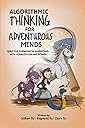

Algorithmic Thinking for Adventurous Minds: Quest for Fundamental Algorithms with Visualization and Python
Product ID: 332495833
Desertcart purchases this item on your behalf and handles shipping, customs, and support to Morocco.
Algorithmic Thinking for Adventurous Minds: Quest for Fundamental Algorithms with Visualization and Python [Xu, William, Xu, Raymond, Xu, Claire] on desertcart.com. *FREE* shipping on qualifying offers. Algorithmic Thinking for Adventurous Minds: Quest for Fundamental Algorithms with Visualization and Python Review: Excellent book - I bought this book for my 8-grader. Here is his review on the book: I'm an 8th grader and would like to thank the contributors of the book for making it possible for learners like me. To begin, “Store Encounter with Dynamic Programming” inspired me most since it provided me with a sense of various critical thinking methods that have changed my overall perspective on problem-solving. In addition, I most definitely gained a lot of knowledge about understanding details in codes like recursion and greedy formulas. These thinking techniques are based on the use of repetition (in the case of the recursive method) and maximizing with the largest value (in the case of the greedy method). Overall, I thought this book is unquestionably unique in many ways due to the incorporation of a story that bodes extremely well with the points that are being delivered. Also, this book has tons and tons of information and I can’t stress enough about all the splendid work that the authors have done with not only text, but also the use of diagrams, flowcharts, etc. I had an amazing time reading this book and keep up the good work! Review: A welcoming introduction to selected algorithms for middle/high schoolers with basic coding skills - With a cute backstory and lovely illustrations, this book makes some of basic algorithmic concepts a lot more approachable for younger students to learn. A suitable grade range would be 5th graders to early high school students with prior basic coding knowledge. It gives and overview of these concepts: Fibonacci (recursive and iterative), greedy, dynamic programming, map/graph/tree minimum spanning trees and shortest paths: Prim, Kruskal, Dijkstra, breadth first search, and depth first search. If you’re in the late teens or college and beyond, you might find the backstory to be more distracting than helpful, as it would be too childish. The book has actual Python code, suitably commented with helpful explanations. There are also flowcharts and diagrams to help readers understand. It also includes fun historical facts of how some of these algorithms were discovered. The reason I took away a star is because the book's title states it as a "quest for fundamental algorithms used in competition and job interview", which might be a bit misleading as it omits some important basic concepts used in competition and interviews: sorting (huge), binary search tree, data structures, and performance analyses (worst/average/best). The book also doesn't explain in depth some concepts, but that's understandable and even desired as an introductory book. For an algorithm-learning beginner a book with 183 pages is perfect (this book), 300 pages would be scary, and 1000+ pages would be overwhelming. In conclusion, this is a very good **introductory** to algorithm book, but I think the authors should have stated that clearly so buyers would know exactly what to expect. ======== After you read this book, or if you already have some fundamental algorithm knowledge, and if you'd like a complete and thorough understanding of algorithms for competition, you should get the ironically named "Introduction to Algorithms" book, aka CLRS, with over 1000 pages of information used as a textbook for many college and graduate level CS classes. Unlike this Algorithmic Thinking for Adventurous Minds book which you should read cover to cover, the CLRS book you should NOT read from cover to cover as it contains too much information for even college students. https://www.desertcart.com/Introduction-Algorithms-3rd-MIT-Press/dp/0262033844 P.S. I think some of the authors are still in high school, which is really impressive. It’s an amazing feat to produce a high quality book.
| ASIN | B093KQ299N |
| Best Sellers Rank | #2,535,641 in Books ( See Top 100 in Books ) #865 in Programming Algorithms #2,168 in Python Programming #70,538 in Schools & Teaching (Books) |
| Customer Reviews | 4.1 4.1 out of 5 stars (5) |
| Dimensions | 6 x 0.45 x 9 inches |
| ISBN-13 | 979-8743231201 |
| Item Weight | 12.2 ounces |
| Language | English |
| Print length | 189 pages |
| Publication date | April 23, 2021 |
| Publisher | Independently published |
S**U
Excellent book
I bought this book for my 8-grader. Here is his review on the book: I'm an 8th grader and would like to thank the contributors of the book for making it possible for learners like me. To begin, “Store Encounter with Dynamic Programming” inspired me most since it provided me with a sense of various critical thinking methods that have changed my overall perspective on problem-solving. In addition, I most definitely gained a lot of knowledge about understanding details in codes like recursion and greedy formulas. These thinking techniques are based on the use of repetition (in the case of the recursive method) and maximizing with the largest value (in the case of the greedy method). Overall, I thought this book is unquestionably unique in many ways due to the incorporation of a story that bodes extremely well with the points that are being delivered. Also, this book has tons and tons of information and I can’t stress enough about all the splendid work that the authors have done with not only text, but also the use of diagrams, flowcharts, etc. I had an amazing time reading this book and keep up the good work!
S**M
A welcoming introduction to selected algorithms for middle/high schoolers with basic coding skills
With a cute backstory and lovely illustrations, this book makes some of basic algorithmic concepts a lot more approachable for younger students to learn. A suitable grade range would be 5th graders to early high school students with prior basic coding knowledge. It gives and overview of these concepts: Fibonacci (recursive and iterative), greedy, dynamic programming, map/graph/tree minimum spanning trees and shortest paths: Prim, Kruskal, Dijkstra, breadth first search, and depth first search. If you’re in the late teens or college and beyond, you might find the backstory to be more distracting than helpful, as it would be too childish. The book has actual Python code, suitably commented with helpful explanations. There are also flowcharts and diagrams to help readers understand. It also includes fun historical facts of how some of these algorithms were discovered. The reason I took away a star is because the book's title states it as a "quest for fundamental algorithms used in competition and job interview", which might be a bit misleading as it omits some important basic concepts used in competition and interviews: sorting (huge), binary search tree, data structures, and performance analyses (worst/average/best). The book also doesn't explain in depth some concepts, but that's understandable and even desired as an introductory book. For an algorithm-learning beginner a book with 183 pages is perfect (this book), 300 pages would be scary, and 1000+ pages would be overwhelming. In conclusion, this is a very good **introductory** to algorithm book, but I think the authors should have stated that clearly so buyers would know exactly what to expect. ======== After you read this book, or if you already have some fundamental algorithm knowledge, and if you'd like a complete and thorough understanding of algorithms for competition, you should get the ironically named "Introduction to Algorithms" book, aka CLRS, with over 1000 pages of information used as a textbook for many college and graduate level CS classes. Unlike this Algorithmic Thinking for Adventurous Minds book which you should read cover to cover, the CLRS book you should NOT read from cover to cover as it contains too much information for even college students. https://www.amazon.com/Introduction-Algorithms-3rd-MIT-Press/dp/0262033844 P.S. I think some of the authors are still in high school, which is really impressive. It’s an amazing feat to produce a high quality book.
P**5
Book Review
The sections that inspired me the most so far were the greedy sections because it showed me that the code can easily be applied to real life situations where you are trying to maximize your satisfaction. Some key knowledge points I learned from this book are new syntax for python that makes coding a lot more efficient and faster, new algorithms that can help me solve USACO problems, and new approaches to solve problems. This book is unique because it uses flowcharts and other diagrams to help readers understand the algorithm. The book also includes lots of interesting facts, pictures, and tells a story to make the book more interesting to a wide variety of readers.
A**2
fantastic book
When i first read the preview of this book, i thought maybe silly for a old guy (40+) like me to order this. But do not at all feel silly or embarrassed now :) Fantastic insights & very well done. Gave me a lot better insight into the different knapsack related problems , as well as the graph (MST). Kudos to the authors. keep it up. Maybe a similar book on BTree's or disk related data structures & the like. :)
P**E
Probably good for younger people as it is too childish for me. I bought the very expensive physical copy and now I realized it is available on kindle unlimited. Good initiative though, looking forward to reading more books from the author as they progress in their writing/technical career.
Trustpilot
3 weeks ago
3 days ago