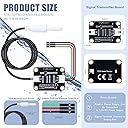
🌟 Dive into precision liquid analysis with CQRobot TDS Sensor!
The CQRobot TDS Meter Sensor offers a waterproof probe and wide voltage input (3.3V-5.5V) with analog output compatible with Arduino and Raspberry Pi. Designed for scientific research, teaching, and liquid quality analysis, it delivers ±10% accuracy at 25°C and supports high-resolution data capture via ADS1115 ADC module, making it ideal for professional and hobbyist projects alike.


| ASIN | B08KXRHK7H |
| Best Sellers Rank | #104,973 in Industrial & Scientific ( See Top 100 in Industrial & Scientific ) #21 in Conductivity Meters & Accessories |
| Brand | CQRobot |
| Current Rating | 4 Milliamps |
| Date First Available | October 9, 2020 |
| Item Weight | 1.76 ounces |
| Item model number | CQRSENTDS01 |
| Manufacturer | CQRobot |
| Material | PLA_(Polylactic Acid), PE_(Polyethylene) |
| Maximum Supply Voltage | 5.5 Volts |
| Measurement Accuracy | +/- 10% F.S. (25 Degree Celsius) |
| Output Type | Analog Voltage |
| Package Dimensions | 4.13 x 2.83 x 0.67 inches |
| Specific Uses For Product | laboratory, scientific research, teaching, liquid quality analysis, online analysis |
| Style | Modern |
P**H
Best TDS sensor available!
Product arrived quickly and was exactly what was needed. This is a great sensor that can be used for many different projects. Easy to set up. Will work well for my hydroponics project.
S**N
Accurate and useful.
It does take a little bit of programing knowledge as the documentation is poor and muddied by a couple different libraries for essentially the same product. With a little bit of perseverance and general arduino knowledge you can get it working. I've had it running for a week now just to make sure it stayed calibrated reasonably well and it's been great. I currently have mine running on an ESP32 DevkitC with wifi connectivity hosting a local web interface and tracking the readings for a week at a time. You can see over the data each time i've bumped the nutrients so it's following my trend line well. Be aware, you'll need a TDS meter that you trust in order to calibrate it but once you get it dialed in it's great. Also here's my basic breadboard test of it to show how simple the circuit is.
J**A
Good probe, but some IMPORTANT TIPS....
Works well. Some tips... - Download and Use the GravityTDS.h library instead of using the sample code. MUCH simpler and easier to implement. - Remember to pull off the cover from the tip of the probe! I didn't even notice the probe cover for the first 20 mins of trying to get it to work. - For most accurate results, buy a separate temperature probe and code your project to have the temperature sensor provide the temperature compensation value for the TDS sensor.
J**Z
Un sensor muy útil para proyectos de calidad de agua. Se alimenta de 3.3 V a 5.5 V y entrega señal analógica de 0 a 2.3 V, lo que permite integrarlo sin problema con Araboardes de 3.3 V o 5 V.
S**G
Check the code on there Wiki
Great product, easily connected with my Raspberry Pi with an additional ADS1115, be sure check there wiki for the code.
A**E
Inaccurate and poor information
This is the same TDS meter you'll get from Gravity as well, just rebranded. Multiple brands exist for this one product. This meter is just not accurate after testing on both the raspberry pi and arduino mega. Even with calibration the meter is off by huge margins (over 50%) at 0 - 2000 ppm range. It seems the higher the salienity of the solution being measured the less accurate. After preparing multiple test solutions of 0 ppm, 100 ppm, 500 ppm, and 1000 ppm using distilled water and pouring hours of time into trying to get this thing to produce any semi-accurate readings I have to conclude this thing is just junk. Either I got a bad one or it just doesn't work. No information as to exactly how the device works either, confusing specs like 5v input but only 0 - 2.3v output? How does an ADC interpret this then if the output range is lower than the vref range?? No explanation, no datasheet, no documents, only a shotty wiki entry online that has some poorly written and misspelled code on it.
A**R
Not good for hydroponics, works for regular water
It only goes up to 1,000ppm. Most hydroponics are 900 to 2,000ppm. Works great for water, aquarium or pool but claiming hydroponics is a stretch.
A**A
Excelente producto que necesitaba para proyectos de la universidad
R**O
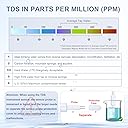
TDS Meter Sensor, usado en conjunto con medidores de pH y similares, permite determinar la calidad del agua en el ámbito que nos interese. Los valores de referencia difieren de un país a otro por lo que se recomienda leer la normativa local previamente a su uso a nivel profesional, pero como norma general, cuanto menor es el valor leído, mejor será la calidad del agua. El módulo, de muy buena factura, se puede alimentar en el rango de 3,3 voltios a 5 voltios, tiene una salida analógica que varía su nivel de 0 a 2,3 voltios dependiendo de las medidas de partículas disueltas en el agua por litro que está fijado de 0 a 1000 ppm (parts per million. Realmente la medición se da en miligramos de sólidos disueltos por litro de agua). Tiene un consumo de corriente de trabajo de 3 a 6mA y una precisión de más menos 10% a 25ºC. La temperatura máxima a la que se puede usar con fiabilidad es 55ºC. Consta de un conector físico tipo PH2.0-3P con su cable incluido para su conexionado al microcontrolador de interés y otro conector XH2.54-2P para conexionado de la sonda que viene incluida. La longitud total del módulo y sus cables es de unos 83 centímetros. Las dimensiones del módulo TDS es de 42*32mm. La factura es muy buena y presenta una calidad más que aceptable con un funcionamiento estable. En la página del fabricante viene un programa ejemplo para arduino y blackberry que he probado con arduino y que funciona perfectamente. A ésto, tengo que añadir que si se quiere usar con librería, el fabricante no incluye ninguna por lo que en este caso tendríamos que irnos a librerías de fabricantes más conocidos como Adafruit o, directamente, al fabricante de copias de gran calidad también que es DFRobot. Es un módulo muy útil para aprendizaje y para uso profesional que recomiendo totalmente.
N**C
I had an older generic TDS meter board that was not working right, it seemed to "max out" at 400 ppm. I replaced it with this board and now get readings I expect, the probe seems very accurate even without calibration. It has some odd connectors with clips, they are quite nice but not the normal ones. I believe they are JST PA/XA connectors, not the usual PH/XH. Not a problem if you want to use the ones it comes with, but means you can't use cables/TDS meters you already have without changing the connector.
G**T
this tds sensor module includes a control board, a probe with rather long cable (54cm) and wires set for connecting it to arduino/raspberry pi (need 3 extra male to male wire jumpers if connect to arduino) it is very easy to use, it simple return a ppm value from the signal terminal to analog pin, probably less than 5 minutes to finish a liquid test app if you’re familiar with these platforms i used the module with arduino, tested quality of tap water, boiled water, water from coffee dip tray and rain water the result was quite unexpected: tap water and boiled water were 48ppm, both were in ideal drinking water level, muddy water from coffee dip tray was just 68ppm, i thought it would be much higher the most surprising result was that, the water i collected from rain had only 12ppm, very pure, not much dissolved solid inside in conclusion, this sensor is great for educational purpose, to let student understand more about tds, but definitely it’s not fit for determining drinking water quality, as tds does not measure harmful contaminants in water all in all, this product fit for its purpose, i’m very happy with it, would recommend it
C**E
Module permettant des mesures de l'eau, de très bonne qualité. L'ensemble est robuste et bien conçu. Longueur de câble suffisante pour atteindre un récipient de test. Compatibilité raspi et arduino (ou dérivés). Les modèles de codes proposés gratuitement permettent la prise en main aisée du produit.
C**Y
Usato per un progetto di misura della salinità, é risultato semplice da implementare sia dal lato software che hardware.
ترست بايلوت
منذ أسبوع
منذ شهر