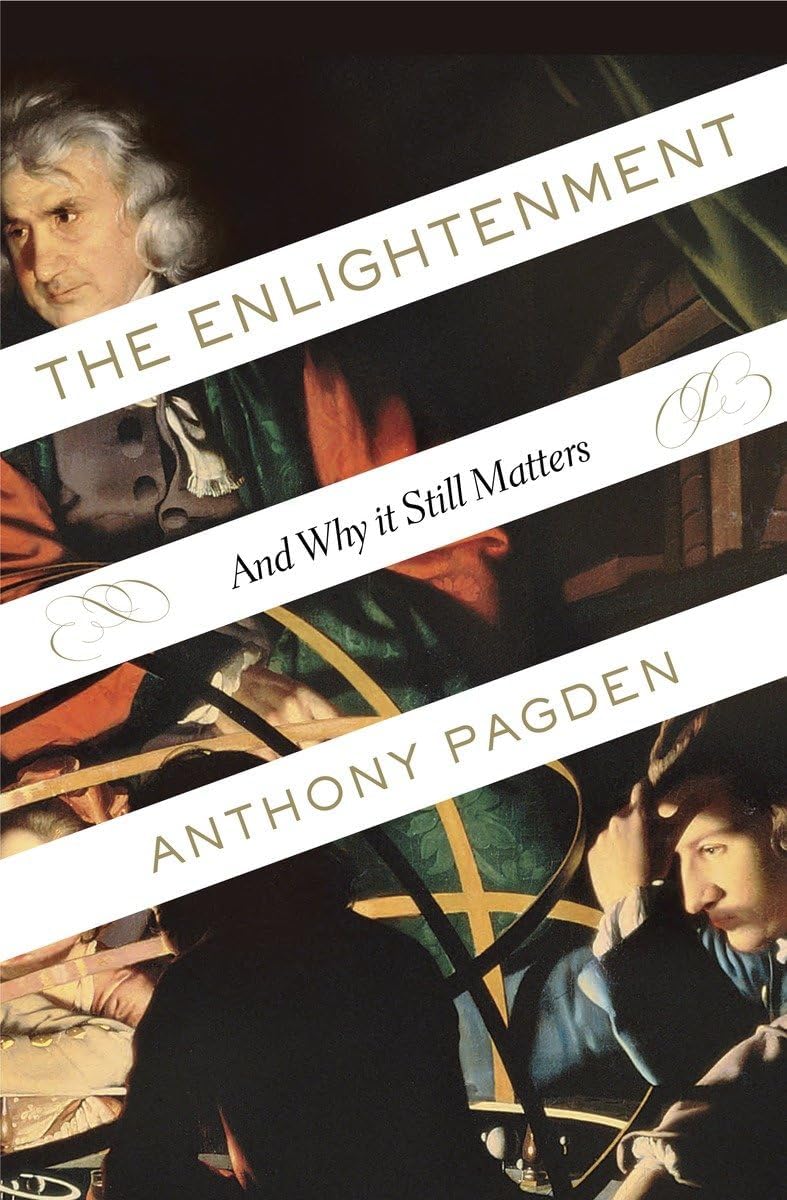
The Enlightenment: And Why It Still Matters
Product ID: 237639
Desertcart purchases this item on your behalf and handles shipping, customs, and support to Morocco.
The Enlightenment: And Why It Still Matters [Pagden, Anthony] on desertcart.com. *FREE* shipping on qualifying offers. The Enlightenment: And Why It Still Matters Review: Flashes of Insight to the Enlightenment - The Enlightenment by Pagden is a compelling book. It is not a history, it is not a work of comparative philosophy, and it is not a work of political theory. It is a view of the enlightenment by topics and through the focus of these topics it draws in the principal players in the Enlightenment again and again, intertwining their views in an ever more complex web. Each time Pagden does so he addresses another set of issues and often brings current affairs to the fore as well. The core of the Enlightenment was the focus on reason and its tremendous powers and the total abhorrence of institutional revealed religion. Faith conflicted with reason. The Enlightenment totally rejected the Scholastics and their use of reason and logic. In a strange way reason dominated even the experimental efforts that surrounded the Enlightenment figures. The author states in his Preface that reason was not overthrowing the passions, but that the claims of reason were to be rejected as well as accepted. The author does also address the concern of Eurocentrism and the placing of the Enlightenment on a secondary state, a place where he believes it is not to be. The author begins with an attempt to define the Enlightenment, or "Enlightenment" as process. To be enlightened meant being critical and for this capability it meant the use of reason (p 21). He provides a remark from Kant that it is but a few men, since most men and all women are but sheep, which use reason. For others if they can pay others for such things as what to eat, what is moral, then there is no need to think, reason. Yet amidst the mass of historical references the definition of either Enlightenment or the Enlightenment still is elusive. It is built upon reason, but it also appears to be a period based upon a revolt, a revolt from the way things were done, and especially the way one held religious belief. Chapter 1 presents a somewhat historical context for the beginning of the Enlightenment. On p 33 there is a discussion of the end of the Thirty Years War, with the Peace of Westphalia. This event, the War, still hangs over much of central Europe. Many of the political divisions were religious divisions, and these divisions set the stage for conflicts for centuries to come. Chapter 2 describes the change which the Enlightenment brought. It also presents one of the most convolved sentences I have ever read. On p 66 the author states: "The Enlightenment, and in particular that portion which I am concerned, was in part, as we shall now see, and attempt to recover something of this vision of a unified and essentially benign humanity, of a potentially cosmopolitan world, without also being obliged to accept the theologians' claim that this could only make sense as part of the larger plan of a well-meaning, if deeply inscrutable, deity." There are eight commas. But the sentence does accurately describe exactly what the author intends it to be. Yet it is also exemplary of style, which at time may be a bit daunting for the reader. On p 69 the author provides insight to the debate that lurks below the surface between Hobbes and Rousseau. For Hobbes mankind was fundamentally and aggressive animal and needed the Leviathan to control them. For Rousseau mankind was originally pristine pure and was thereafter corrupted. Both men reached their conclusions by reason devoid of any scientific evidence or facts. That in a sense was the fatal flaw of the Enlightenment. It assumed the overwhelming power of reason as a sine qua non. On p 77 there is a discussion of natural law and its deficiencies. The author states: "The entire scholastic theory of moral and political life rested, as we have seen, on the idea that our basic understanding of the law of nature was made up of certain "innate ideas" or "innate senses". Then on p 79 he addresses the assault by Locke on this principle by stating: "Few historians of philosophy have paid much attention to this length onslaught on the notion that there might exist no "innate Principles" or Innate Characters of the Mind which are to be Principles of Knowledge" beyond "a desire of Happiness and aversion of Pain". There was thus on the one hand a rejection of innate laws of nature, one that could be reasoned, and the application of reason to all existence. Chapter 3 is a Chapter regarding a world without God. To some sense it is the Enlightenments fracturing of the past centuries and an attempt to break loose. He contends that man and the result of the Enlightenment can adapt to a civil society san religion. As he says on p 109: "If it appears to do so now, that is only because of the fear that the Church has, over the centuries, inculcated in it." The author seems to align himself very much with those iconoclasts of the Enlightenment as one progress through this chapter. He continues in Chapter 7 with a discussion of laws. On the one hand we have Montesquieu, and on the other hand we have Robespierre. As he states on p 309: "Furthermore, political virtue was conceived of as a sentiment and not, as Montesquieu put it, "the consequence of knowledge". True, the virtuous citizens had to be able to distinguish good laws from bad, but they did not require any special knowledge to do that; they did not need to understand precisely what a republic actually was, or how its institutions operated, or did they - as the ancients would, in fact, have assumed that they did - have to be actively involved in it, in order to love it; for the "last man in the state can have this sentiment as can the first"." There are times when I had difficulty discerning the author from his subjects. This sentence gave me pause. If citizens were to distinguish good laws from bad, how much did they truly have to know? Does this not apply especially to any republic, where representation in a legislative body reflects to some degree the public? I believe the author has some point to be made here but they are somewhat poorly extracted from the sources. On p 321-322 the authors delves into the Great Society of Mankind by an interesting allusion to foreign aid. To him it would have been an unacceptable concept in the Enlightenment but as an act consistent with Enlightenment thinking it would be congruent. In his Conclusions he discusses the enemies of the Enlightenment. The discussion is generally in line with modern thinking but there appear to be several divergences. On p 395 there is a discussion of Communitarianism. The author states that Communitarians have much in common with 19th Century nationalists. He discusses the source as Hegelian in part. But he sees the Communitarians as enemies of Enlightenment thinking. This discussion is very interesting and worth a read several times. He again returns to the Thirty Years War as that seminal event which in a manner kicked off the Enlightenment. For most Americans this is an event at best hidden in the dark past of the World History book. However for a European, this is a dividing line between the past and the present. It was a war of the people, a war of faith, not a war of territory. Even today one feels it when dealing with Poland, Sweden, Austria, Germany, France and so forth. But the Enlightenment is also a collection of characters. The author brings them to life in his style of topical discussion. Voltaire becomes almost a current day Cable TV commentator, irascible, while at the same time amassing a personal fortune. He went after the Catholic Church, in the guise of attacking religion, but praised the British for their religious tolerance while at the same time the British were massacring the Irish for their faith. At the other extreme he discusses de Tocqueville and his view of the Americas while not discussing the de Tocqueville writing on Ireland the French Revolution. There is a wealth of books on the Enlightenment and those of Gay, Cassirer and Israel are but three that come to mind. This book is not in that class. The former are historical works that flow in some linear manner; either temporally of thematically. This book is kaleidoscopic in style, with flashes of insight coming and going and then within those flashes incorporating vignettes of the main characters who are players on the stage of the Enlightenment. This is not a text of the type of Skinner who may include all players so that the ones that we see so often are placed within an historical context. This book, in summary, is a delight to read, albeit not in a linear fashion. It has brilliant flashes of insight and explanation, yet there are times when one yells back at the words in total disagreement. This book draws out thinking in some depth about the Enlightenment more than a linear historical work. It was a delight to read. Review: Here’s to hoping the enlightenment isn’t over... - I am not new to reading of the enlightenment. But before this book my impression was limited to the dismantling of the dogma of religion, the Rise of liberal democracy and the elements surrounding the French and American revolution. This book has taken me beyond those important ideas and uncovered the origins of the patria. The idea of patriotism. The roots of community thinking. Somehow the focus on understanding the core of human nature in civilization as an enlightenment goal had escaped me. Not to mention the subsequent thought imagining the construction of future utopian civilization, a global community under a common law. The United Nations, the EU. And now today, astoundingly, we seem to be confronted with a possible unraveling or recoiling of our progress toward those ideals. The rise of nationalism, the forces threatening to break up the EU, the rejection of our wall of separation by the radical Christian Right in the US, the apparent resurgence of white supremacy. Either by a decline in our actual core body of rational intelligence, or a frightening rise in the voices of anti intellectualism, we seem to be witnessing the dumbing down of America, driven and even celebrated by the forces of the extreme right. At the same time, we have the extreme left driving hard toward that global goal of equality and dignity and community. What will it take to regroup and revive that spirit of humanity’s progress?
| Best Sellers Rank | #590,855 in Books ( See Top 100 in Books ) #973 in Modern Western Philosophy #5,823 in European History (Books) #11,775 in World History (Books) |
| Customer Reviews | 4.3 4.3 out of 5 stars (165) |
| Dimensions | 6.5 x 1.3 x 9.5 inches |
| ISBN-10 | 1400060680 |
| ISBN-13 | 978-1400060689 |
| Item Weight | 1.94 pounds |
| Language | English |
| Print length | 528 pages |
| Publication date | April 23, 2013 |
| Publisher | Random House |
D**Y
Flashes of Insight to the Enlightenment
The Enlightenment by Pagden is a compelling book. It is not a history, it is not a work of comparative philosophy, and it is not a work of political theory. It is a view of the enlightenment by topics and through the focus of these topics it draws in the principal players in the Enlightenment again and again, intertwining their views in an ever more complex web. Each time Pagden does so he addresses another set of issues and often brings current affairs to the fore as well. The core of the Enlightenment was the focus on reason and its tremendous powers and the total abhorrence of institutional revealed religion. Faith conflicted with reason. The Enlightenment totally rejected the Scholastics and their use of reason and logic. In a strange way reason dominated even the experimental efforts that surrounded the Enlightenment figures. The author states in his Preface that reason was not overthrowing the passions, but that the claims of reason were to be rejected as well as accepted. The author does also address the concern of Eurocentrism and the placing of the Enlightenment on a secondary state, a place where he believes it is not to be. The author begins with an attempt to define the Enlightenment, or "Enlightenment" as process. To be enlightened meant being critical and for this capability it meant the use of reason (p 21). He provides a remark from Kant that it is but a few men, since most men and all women are but sheep, which use reason. For others if they can pay others for such things as what to eat, what is moral, then there is no need to think, reason. Yet amidst the mass of historical references the definition of either Enlightenment or the Enlightenment still is elusive. It is built upon reason, but it also appears to be a period based upon a revolt, a revolt from the way things were done, and especially the way one held religious belief. Chapter 1 presents a somewhat historical context for the beginning of the Enlightenment. On p 33 there is a discussion of the end of the Thirty Years War, with the Peace of Westphalia. This event, the War, still hangs over much of central Europe. Many of the political divisions were religious divisions, and these divisions set the stage for conflicts for centuries to come. Chapter 2 describes the change which the Enlightenment brought. It also presents one of the most convolved sentences I have ever read. On p 66 the author states: "The Enlightenment, and in particular that portion which I am concerned, was in part, as we shall now see, and attempt to recover something of this vision of a unified and essentially benign humanity, of a potentially cosmopolitan world, without also being obliged to accept the theologians' claim that this could only make sense as part of the larger plan of a well-meaning, if deeply inscrutable, deity." There are eight commas. But the sentence does accurately describe exactly what the author intends it to be. Yet it is also exemplary of style, which at time may be a bit daunting for the reader. On p 69 the author provides insight to the debate that lurks below the surface between Hobbes and Rousseau. For Hobbes mankind was fundamentally and aggressive animal and needed the Leviathan to control them. For Rousseau mankind was originally pristine pure and was thereafter corrupted. Both men reached their conclusions by reason devoid of any scientific evidence or facts. That in a sense was the fatal flaw of the Enlightenment. It assumed the overwhelming power of reason as a sine qua non. On p 77 there is a discussion of natural law and its deficiencies. The author states: "The entire scholastic theory of moral and political life rested, as we have seen, on the idea that our basic understanding of the law of nature was made up of certain "innate ideas" or "innate senses". Then on p 79 he addresses the assault by Locke on this principle by stating: "Few historians of philosophy have paid much attention to this length onslaught on the notion that there might exist no "innate Principles" or Innate Characters of the Mind which are to be Principles of Knowledge" beyond "a desire of Happiness and aversion of Pain". There was thus on the one hand a rejection of innate laws of nature, one that could be reasoned, and the application of reason to all existence. Chapter 3 is a Chapter regarding a world without God. To some sense it is the Enlightenments fracturing of the past centuries and an attempt to break loose. He contends that man and the result of the Enlightenment can adapt to a civil society san religion. As he says on p 109: "If it appears to do so now, that is only because of the fear that the Church has, over the centuries, inculcated in it." The author seems to align himself very much with those iconoclasts of the Enlightenment as one progress through this chapter. He continues in Chapter 7 with a discussion of laws. On the one hand we have Montesquieu, and on the other hand we have Robespierre. As he states on p 309: "Furthermore, political virtue was conceived of as a sentiment and not, as Montesquieu put it, "the consequence of knowledge". True, the virtuous citizens had to be able to distinguish good laws from bad, but they did not require any special knowledge to do that; they did not need to understand precisely what a republic actually was, or how its institutions operated, or did they - as the ancients would, in fact, have assumed that they did - have to be actively involved in it, in order to love it; for the "last man in the state can have this sentiment as can the first"." There are times when I had difficulty discerning the author from his subjects. This sentence gave me pause. If citizens were to distinguish good laws from bad, how much did they truly have to know? Does this not apply especially to any republic, where representation in a legislative body reflects to some degree the public? I believe the author has some point to be made here but they are somewhat poorly extracted from the sources. On p 321-322 the authors delves into the Great Society of Mankind by an interesting allusion to foreign aid. To him it would have been an unacceptable concept in the Enlightenment but as an act consistent with Enlightenment thinking it would be congruent. In his Conclusions he discusses the enemies of the Enlightenment. The discussion is generally in line with modern thinking but there appear to be several divergences. On p 395 there is a discussion of Communitarianism. The author states that Communitarians have much in common with 19th Century nationalists. He discusses the source as Hegelian in part. But he sees the Communitarians as enemies of Enlightenment thinking. This discussion is very interesting and worth a read several times. He again returns to the Thirty Years War as that seminal event which in a manner kicked off the Enlightenment. For most Americans this is an event at best hidden in the dark past of the World History book. However for a European, this is a dividing line between the past and the present. It was a war of the people, a war of faith, not a war of territory. Even today one feels it when dealing with Poland, Sweden, Austria, Germany, France and so forth. But the Enlightenment is also a collection of characters. The author brings them to life in his style of topical discussion. Voltaire becomes almost a current day Cable TV commentator, irascible, while at the same time amassing a personal fortune. He went after the Catholic Church, in the guise of attacking religion, but praised the British for their religious tolerance while at the same time the British were massacring the Irish for their faith. At the other extreme he discusses de Tocqueville and his view of the Americas while not discussing the de Tocqueville writing on Ireland the French Revolution. There is a wealth of books on the Enlightenment and those of Gay, Cassirer and Israel are but three that come to mind. This book is not in that class. The former are historical works that flow in some linear manner; either temporally of thematically. This book is kaleidoscopic in style, with flashes of insight coming and going and then within those flashes incorporating vignettes of the main characters who are players on the stage of the Enlightenment. This is not a text of the type of Skinner who may include all players so that the ones that we see so often are placed within an historical context. This book, in summary, is a delight to read, albeit not in a linear fashion. It has brilliant flashes of insight and explanation, yet there are times when one yells back at the words in total disagreement. This book draws out thinking in some depth about the Enlightenment more than a linear historical work. It was a delight to read.
G**.
Here’s to hoping the enlightenment isn’t over...
I am not new to reading of the enlightenment. But before this book my impression was limited to the dismantling of the dogma of religion, the Rise of liberal democracy and the elements surrounding the French and American revolution. This book has taken me beyond those important ideas and uncovered the origins of the patria. The idea of patriotism. The roots of community thinking. Somehow the focus on understanding the core of human nature in civilization as an enlightenment goal had escaped me. Not to mention the subsequent thought imagining the construction of future utopian civilization, a global community under a common law. The United Nations, the EU. And now today, astoundingly, we seem to be confronted with a possible unraveling or recoiling of our progress toward those ideals. The rise of nationalism, the forces threatening to break up the EU, the rejection of our wall of separation by the radical Christian Right in the US, the apparent resurgence of white supremacy. Either by a decline in our actual core body of rational intelligence, or a frightening rise in the voices of anti intellectualism, we seem to be witnessing the dumbing down of America, driven and even celebrated by the forces of the extreme right. At the same time, we have the extreme left driving hard toward that global goal of equality and dignity and community. What will it take to regroup and revive that spirit of humanity’s progress?
G**L
An invaluable book
This is a brilliant book! This is material I have pondered for many years, but Pagden does a marvelous job of tying multiple loose strings together. His literary style leaves something to be desired: there are run-on sentences of 70 or 80 words, and paragraphs that are a page and a half long, but the particular point of view keeps smiling through: we are children of the enlightenment, and we seldom appreciate what a radical change the writers from Hobbes to Locke to Hume to Rousseau to Kant brought about. This is an insightful reading of the intellectual history that has done much to make us who we are....
T**S
Enlightenment History From Beginning To Romanticism
If you want to know about the Enlightenment in general, this is the best book, I think. Pagden wrote about its history and its transformation. Also, Pagden went on to why the Romantics rebelled against their Enlightened parents. And, when thinking on what is written here, the ideology of Deism is better understood, and it is also easier to understand why many of our Founding Fathers agreed with that and on philosophy. Pagden even acknowledges the horrors that occurred because of Enlightenment, which I think a lot of books forget.
R**R
Very scholarly ad readable !
S**O
I have edited my original review. This book is without doubt a superbly clear guide to the history of thought, with a focus on the "Enlightenment". Books that cover philosophical thought are often very hard going - this one isn't; and yet the coverage is quite deep and extraordinarily useful. I would buy this if I were taking A level or undergraduate studies. Anthony Pagden is without doubt intensely passionate as well as, without question, extraordinarily knowledgeable. What is really good about this book is that, somehow, he has found the time to write, throughout, in a thoroughly engaging, clear and interesting style. I do some writing myself, and have come to the conclusion that many modern non fiction books are less good because the writer wasn't able to devote sufficient time to their writing. Pagden's book has no such weakness. Either the publisher properly reimbursed him, or he is simply passionate about his topic and communicating his passion and knowledge. Either way - this book is splendid, and splendidly useful. One small negative - my own copy is an early printing, perhaps pre-publication, and has rather too many typos and errors - the editor I hope has corrected these for the latest edition.
C**L
Un libro de calidad que trata un tema interesante, elaborado con cuidado y elegancia. Tanto el contenido como el continente son de primera calidad. Lo recibí sin mucha demora y en perfectas condiciones.
E**R
I loved this book, it is academic, but at the same time easy for anyone to grasp, broad in its depth and well organised. It talks about all the main protagonists of the enlightenment and what they contributed to the body of enlightenment ideals that gave rise to constitutional democracies and inspired the league of nations, the united nations, the European court of human rights, as well as the EU itself. It is a tonic for those tired of hearing how liberal democracy is utopian--Pagden underscores this point and illustrates how the enlightenment philosophers, chiefly Kant, argued that getting there is not the point, the important thing is that we base representative republics on it. ("Only in such a society is man, even if he is not good in himself, nevertheless compelled to be a good citizen".) This underscores, I should think, Habermas's ceaseless defence of the modern project. It also echoes something the great Irish academic philosopher Maeve Cooke said in a conference I attended, that if we don't strive for the good life, what else is there for us? What else is there indeed? Brute human nature unleashed? Anyone who wants to know what that might look like need only gaze in the direction of South Africa today... The only negative thing I would say about this book is that there were quite a few typos that I found very annoying. Might have expected more from the Oxford University Press, but perhaps proofreaders and editors have fallen victim to austerity as well.
V**D
Histories of ideas can be contentious. I would argue that the ultimate evidence that the Enlightenment stills matters lies in the fact that it still arouses passionate debates. Any attempt at retelling its origins, identifying its main protagonists, and stating what defines it, is bound to trigger in equal measure agreement and dissent. I celebrate that this book is written taking sides, and that however much historical objectivity is sought, the many choices the author makes belies it. As an unapologetic liberal, who likes to think of himself as a citizen of the world and finds the root of many of his convictions in the Enlightenment, I too am biased. The only thing preventing me from giving the book five stars is the author's baroque prose. It makes me wonder if Pagden thinks in Spanish and translates in his head when writing. However, you get used to his style quite quickly, and it still is a very recommendable read.
Trustpilot
2 weeks ago
1 month ago