Desertcart purchases this item on your behalf and handles shipping, customs, and support to Morocco.
🚀 Rackmount Revolution: Faster, Stronger, Smarter!
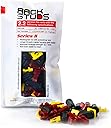
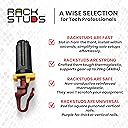
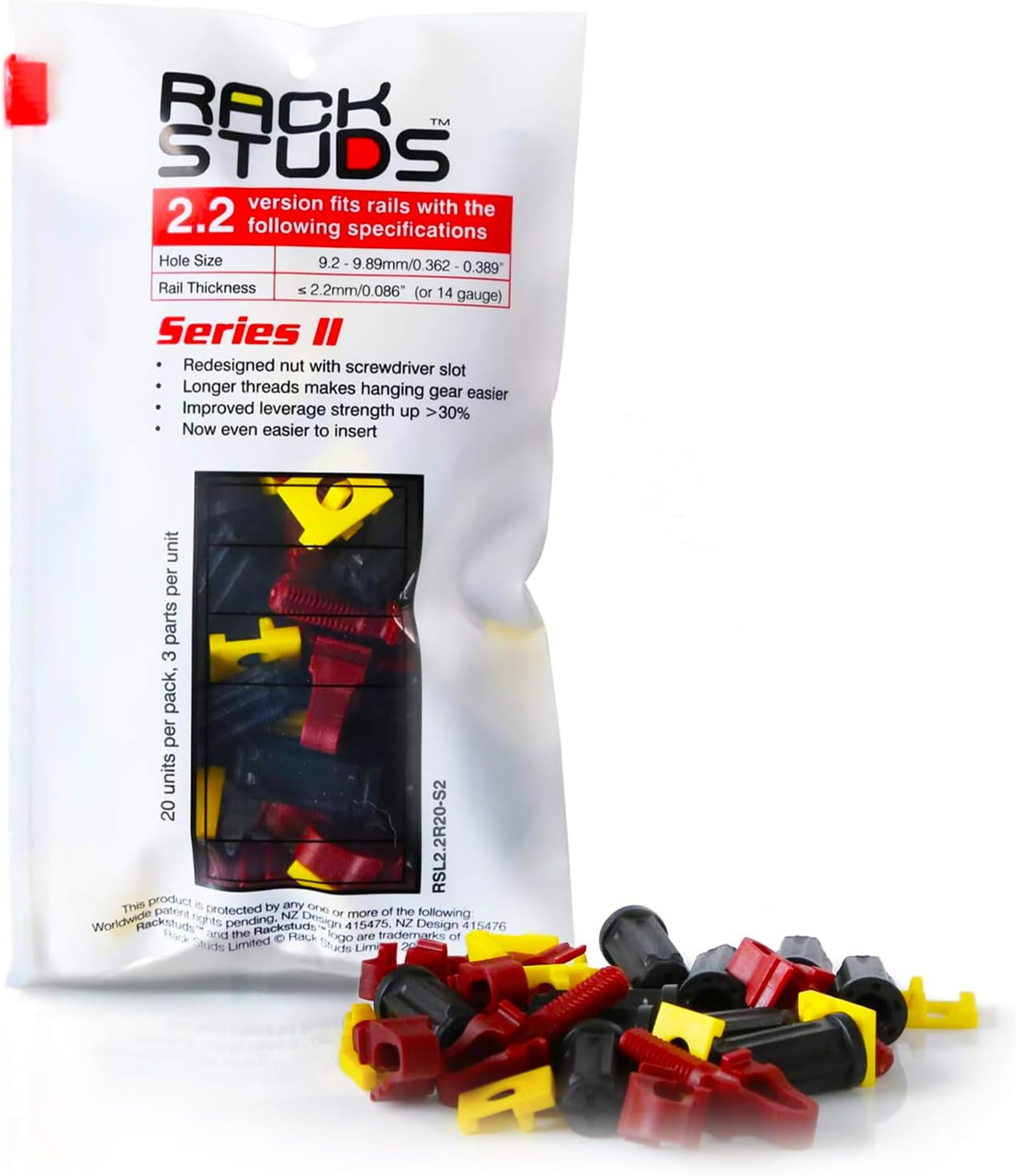
Rackstuds R20 Series II are high-performance server rack screws designed to replace traditional cage nuts, enabling 30% faster installation with single-handed mounting. Made from durable thermoplastic used in automotive parts, these red 2.22mm screws fit standard 19" racks with square punched rails, offering a reliable, hassle-free, and time-saving solution for professional-grade rack mounting.


| ASIN | B07W585S5B |
| Best Sellers Rank | #1,020 in Musical Instruments ( See Top 100 in Musical Instruments ) #3 in Recording Studio Rack Accessories |
| Brand | Rackstuds |
| Color | Red |
| Compatible Groove Diameter | 2.22 millimeters |
| Customer Reviews | 4.6 out of 5 stars 1,412 Reviews |
| Fastener Type | Cage |
| Finish Type | Plastic |
| Finish Types | Plastic |
| Item Diameter | 2.22 millimeters |
| Item Weight | 0.08 kg |
| Manufacturer | Rack Studs Limited |
| Material | Grivory |
| Material Type | Grivory |
| Model | Red |
| Number Of Items | 20 |
| Number of Packs | 20 |
| Number of Pieces | 20 |
| Outside Diameter | 2.22 millimeters |
| Part Number | RSL2.2R20-S2 |
| Set Name | Rackstuds R20 Series II |
| Size | 20 Pack |
| Size Name | 20 Pack |
D**L
These are realy finer savers
One of my customers first told me about these. I was skeptical about them. I mean how strong can a plastic threaded stud be? Well, strong enough it turns out. From an engineering perspective rack mount devices, particularly items which are mount to front rails only and are 1 Rack Unit high, are a nightmare. The stress loads are rediculous. It always feels like I bought some cheap table at Ikea and as soon as I sit down it will all end in a big crash. The lower fasteners on things like switches take an awful lot of strain, and I really figured these plastic studs would just snap off and all my gear would come crashing down. So far, I have not broken one of these things though. I am careful not to over tighten them though. They are plastic threads, so there is much less chance of the screw caps backing out than with metal threads. You only need to snug them. There is no reason to put any more load on them than necessary. There are two real plusses with these. First your fingers won't be hurting and bloody after you have to rack or unrack a bunch of gear. The second plus is you can actually mount a piece of gear between two existing pieced of gear with these. With old fassion cage nuts good luck getting nuts on the back of a rail with a piece of equipement above and below where you need to mount the new stuff. You usually have to pull something out to get the room to install the nuts on the back. These all install from the front, so it's no problem at all. Do check your rail thickness though. Rack Studs come in red (for thin rails) and purple (for thick rails). Make sure you use the correct ones for your rails (Why can't the industry standardize on rail thicknesses???) Anyway, overall, I'm a fan of these things. They are a little pricy compared to standard cage nuts and screws but I'll gladly pay the difference to save my fingers, and to be able to rack gear without having to pull stuff out to install nuts before re-installing everything.
N**Y
Great for server rack installations
The Rackstuds R20 II have completely revolutionized the way I manage my server racks. These innovative rack screws are a huge improvement over traditional metal cage nuts, making installations and maintenance so much easier and faster. The design is ingenious—they snap into place securely and hold equipment firmly without the hassle of using tools or dealing with sharp metal edges. One of the best features of the Rackstuds is how user-friendly they are. I was able to install equipment by myself, which is often difficult with standard screws. They stay in place perfectly and allow for easy adjustments if needed. The vibrant red and yellow colors are also a plus, making it easy to spot them when working inside dimly lit racks. What really sets them apart is the durability. Despite being made of high-strength polymer, they can handle the heavy loads of my rack-mounted equipment just as well, if not better, than metal screws. I’ve never had any issues with them loosening or failing, which gives me great confidence in their performance. Overall, the Rackstuds R20 II have simplified my rack setups, made installations faster, and are much safer to use. I highly recommend these to anyone who manages server racks or IT equipment—they’re well worth the investment!
R**J
the new normal
Other reviewers are missing the point. Do you even rackmount bro? The manufacturer is likewise missing the point in their advertisement. They do an absolutely horrible job of extolling the true virtues of their overpriced product. (price will be the last point in my review.) Cage nuts are trivial to install and remove. You can use an expensive tool $35 or a cheap tool $1. Or a screwdriver. For about $10 you can get a toyota camry level of tool that just gets the job done and isn't otherwise much to look at. For $35 and up you can get a ferrari level of tool that is overpriced, doesn't do it's core job any better than a camry, but gives the owner some extra satisfaction. Regardless of tool choice, cage nut installation and removal is a solved problem. The actual problems these things solve is: 1. cage nut quality is all over the board. People buy the dirt cheap unbranded chinacom cage nuts and then complain that they suck. duh. buy APC or other brand name for consistent performance. Even then, the cost is still in the noise so why worry about pennies. just like your basic screw and nut which seems like you can't mess it up, well it turns out that these things are in fact precision parts, requiring careful quality control. whereas, rackstuds are of consistent high quality from a single manufacturer. you can't buy a poorly performing one -- yet. 2. if you are especially fat-fingered, or not dexterous, you may drop the cage nuts as they go in or out. there are times where this creates a problem. the design of the rackstud doesn't preclude dropping them (esp. the yellow "washer" part), but since they are completely handled from the front with no tool, the risk is very, very much reduced. 3. cage nuts have inherent slop. most importantly, vertically. sometimes you may find that something doesn't fit in the opening left for it, due to tolerances eaten up by the cage nut slop and varying hole clearances of the device mounting tabs. you'll sometimes have to loosen up the surrounding equipment. not super awful, but nonetheless annoying. it's not possible to mount something "dead center" in the rack space allotted for it. normally everything sits at the lower extreme afforded by the cage nut and you can end up with a device not fitting properly. further, this puts a certain pressure on the cage nut, although personally i've never experienced a failure due to this. this might be more of an issue for racks that have to be transported. whereas, rackstuds have no detectable slop, only the inherent tolerance of the part itself. the rackstud itself is always right in the center of the slot opening. the only vertical slop is due to the hole clearance of the device's mounting tabs. 4. cage nuts, depending on manufacturer, often make it impossible to secure something tight/flat/perpendicular to the rails. the nut itself often cannot pull up against the cage securely as if the nut/cage/rail assembly were a single piece, so you end up with devices and shelves that have an inherent wobbliness to them. this can be very annoying for some situations. whereas rackstuds install perfectly tight against the rail as a solid assembly, and give you a flat reference surface against which your equipment mates. 5. best for last! especially so for heavier equipment, cage nuts don't provide any guide for installing a device. if you have a gap underneath you have to very awkwardly balance the device while starting 2 bolts to stabilize it in place. because of the long depth of most devices, even just a few pounds can be difficult. and the smaller the opening below, the more difficult because you can't reach underneath very well. this can be super challenging. i've never heard of anyone else doing this, but i use 2 long shoulder screws as guides, similar to how guide pins can be used to install wheels on bolt-mounted uprights, like BMW. (american cars tend to use studs, not bolts.) even though the solution is simple, it's annoying and it's an extra unnecessary installation/removal step. whereas rackstuds are, well , studs. so you have a built-in guide for install/remove. ========== now for the downsides. 1. the price is absolutely horrible. definitely not worth it. i think they are missing the mark on the price/volume curve. obviously these are essentially free to manufacture (plastic basically costs nothing). of course they put a lot of design work into it and want to maximize return early on, but at this price they are killing their sales volume, IMHO. made in NZ which drives up the cost but still, it's plastic. 2. i wish they would make a nut version, for mounting equipment with captive screws. all the benefits 1-4 above would still be captured vs cage nuts. likely it would have to have a rivnut insert. i'm guessing plastic threads have to be formed differently than metal ones. as a side note, COUNT your studs. amazon shipped me a package missing many studs and all the thumbscrew/nuts. clearly this was a customer return that some useless degenerate waste of space sent back after using a bunch. if the price were more reasonable this wouldn't happen ... or if amazon would throw away returns rather than put them back in inventory as new. these ship in a zipper pouch that you can't tell if it's ever been opened. rackstuds should use a sealed kind of pouch instead where you have to tear the seal on first use. if the thumbscrews hadn't been missing i wouldn't have noticed that i was shorted on the studs as well. <breathe>
R**N
Just try them.
I have seen these mentioned on youtube for probably a couple of years now but having racked hundreds of systems in however many years (probably more like a thousand) I honestly thought these were kind of a gimmick. Decided just for the heck of it to give them a shot since I'm finally assembling myself a homelab rack. All I can say is I completely understand why people love these now. The only real flaw is you wont be able to use them for everything since a lot of rails mid mount on servers and the rackstuds will interfere with rack ears on said server. If they come out with a version that gets around this I'd give them a shot but especially if you are mounting decently heavy 1U or 2U equipment solo these just make the job 100% easier. In my case I had a decently heavy 2U UPS mounted in probably about 2 minutes. While not the heaviest I've mounted solo the fact that there is no 'lean' on the UPS and it feels solid with so little effort is pretty dang nice. I also mounted a 1u switch painlessly but as it happens that switch is way too loud so it will be getting replaced. The switch does 'lean' but most of the weight is at the back of the switch and it's not like I'm worried about it somehow falling out of the rack so overall it's fine, just something to be aware of. While I doubt I'll ever use these in the DC's I work in (more's the pity) these are great for my use at home and while fairly expensive compared to the conventional rack nuts more than enough of them come in 1 pack for my needs at home. I'd definitely recommend, especially if you don't need a ton of them. Edit; I'm using the Red 2.2mm in a Vivo 22U rack I got from Amazon.
S**E
IF THE WASHER WON'T FIT, TRY THIS
When I saw this product, it piqued my interest as to how easy it is to use when compared to cage nuts. However, once I have gotten them i found that the washer is quite hard to insert into the rackstud. Depending on what rack you have, you may or may not have issues with it. I am using a OEM rack and in order to put the washer in for me, I had to use the black screw cap to push the washer in. The steps are as follow: 1) Insert the rackstuds at 45° horizontally, make sure the side with the washer insert is facing inwards to the rack. Push until you hear a click, then straighten the rackstud. 2) Put the washer onto the rackstud as inward as possible, and line it up horizontally. 3) Screw in the black cap until the washer goes into the insert on the rackstud. (Or alternatively, you can put your rack equipment first then only screw on the cap) 4) The washer should insert successfully and you are done. You can watch the short video I uploaded to see how the washer gets inserted. Note: It is important that the rackstud is not slightly swayed to the side, or the washer will not go in, hold the rackstud as straight as possible. If the washer rotates when you put on the cap, simply hold it still while screwing the cap in. Your millage may vary but this is what worked for me. Overall, I will still recommend the rackstuds if it is cost effective for you as the risk of injuring the fingers when compared to using cagenuts are lowered (at least for me). Hope it helped :) Cheers
J**S
Still holding strong years later
Worked as a great alternative to regular cage nuts. Installation was way easier from the start, no fighting with a cage nut tool or worrying about them popping out mid-install. They've held up perfectly since going in, and years later they're still standing strong with no signs of loosening, rusting, or wearing out. If you've ever dealt with the hassle of traditional cage nuts, these are a genuine upgrade worth making. Reliable, low-maintenance, and clearly built to last
J**N
Super easy to rack and stack
These things are awesome!
S**N
Peace of mind with a great and clean looking product.
I absolutely love these screws, the plastic is of great quality and they are great value for the money. I personally use these to lock in my disk drives and computers into my rack mount and I couldn't be happier. They are so easy to install and use. They a couple different ones for different server racks and I had a question so I messaged the manufacturer and they were quick to get with me and to verify which one would work and they were correct. They worked good with my Riveco rack I bought also from Amazon.
S**N
Alles ok
Alles ok
E**T
Excellent Solution for Rack Mounting – Highly Recommend!
I recently installed the Rackstuds - R20 Rack Mount, and I couldn’t be happier with my purchase! These rack studs provide a fantastic, tool-less solution for securing my equipment. The installation was incredibly straightforward—just push them into place, and you’re good to go! The build quality is impressive; they feel sturdy and reliable, giving me confidence that my gear is secure. The flexibility of being able to easily add or remove equipment without any hassle is a game-changer for my setup. I also appreciate how they minimize the risk of cross-threading, which can be a problem with traditional rack screws. Overall, I highly recommend the Rackstuds - R20 for anyone looking to simplify their rack mounting process. They’ve made my life so much easier, and I’ll definitely be purchasing more for future expansions!
D**N
Wow
These make racking so much easier compared to cage nuts. Especially since I'm a home user without professional experience.
D**I
Great product for a fair price.
Great product. Strong and able to easily hold switches and routers. I use mine on Ubiquiti gear without issue. These make it easy to get gear in and out of racks. RRP is a fair price for the product.
P**L
Great concept but weak
Nice concept, but the plastic nuts are weak in terms of fastening them with a screwdriver. I have a few nuts which are unusable because the plastic stripped away.
Trustpilot
2 months ago
3 weeks ago