

🚀 Elevate your visual storytelling—capture life’s moments before they slip away!
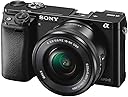
The Sony Alpha a6000 is a mirrorless digital camera featuring a 24.3MP APS-C sensor, a 179-point hybrid autofocus system, and up to 11 frames per second continuous shooting. Its compact design pairs with a versatile 16-50mm power zoom lens and a 3-inch tilting LCD, making it an ideal choice for professionals seeking DSLR-quality images in a lightweight, travel-friendly package.


| ASIN | B00I8BICB2 |
| Age Range Description | Adult |
| Aperture modes | F2.8 |
| Are Batteries Included | Yes |
| Aspect Ratio | 16:9, 3:2 |
| Auto Focus Technology | Center, Continuous, Contrast Detection, Face Detection, Live View, Multi-area, Phase Detection, Selective single-point, Single, Tracking |
| Autofocus | Yes |
| Autofocus Points | 25 |
| Best Sellers Rank | #28,896 in Electronics ( See Top 100 in Electronics ) #50 in Mirrorless Cameras |
| Bit Depth | 14 Bit |
| Brand | Sony |
| Built-In Media | AC Adapter AC-UB10, Eye Piece, Micro USB Cable, NP-FW50 Lithium-Ion Rechargeable Battery (1020mAh), Neck Strap, Sony 16-50mm f/3.5-5.6 OSS Lens (Black), Sony Alpha a6000 Mirrorless Digital Camera with 16-50mm Lens (Black), Warranty |
| Camera Flash | Built-In |
| Camera Lens | 16-50mm Power Zoom Lens |
| Color | Black |
| Compatible Devices | Smartphone |
| Compatible Flash Memory Type | Memory Stick Pro Duo, SDHC, SDXC |
| Compatible Mountings | Sony E (NEX), Sony FE |
| Connectivity Technology | HDMI, NFC, USB |
| Continuous Shooting | 11 FPS |
| Crop Mode | APS-C |
| Customer Reviews | 4.5 out of 5 stars 1,710 Reviews |
| Digital Scene Transition | zoom |
| Digital Zoom | 2 |
| Digital-Still | Yes |
| Display Fixture Type | Tilting |
| Display Maximum Resolution | 3072 x 1728 |
| Display Resolution Maximum | 921600 |
| Display Type | LCD |
| Dots Per Screen | 921600 dots (assuming the screen size is 3.0 inches diagonally) |
| Effective Still Resolution | 24.3 MP |
| Expanded ISO Minimum | 100 |
| Exposure Control | Automatic, Programmed AE |
| File Format | JPEG (DCF v2.0, EXIF v2.3), RAW (Sony ARW 2.3) |
| Flash Memory Bus Interface Type | Internal |
| Flash Memory Speed Class | 10 |
| Flash Memory Type | SD/ SDHC/SDXC, Memory Stick Pro Duo/ Pro-HG Duo |
| Flash Memory Video Speed Class | V60 |
| Flash Modes | Automatic, Fill Flash |
| Flash Sync Speed | 1/160 sec |
| Focal Length Description | 16 to 50mm (35mm Equivalent Focal Length: 24 to 75mm) |
| Focus Features | Hybrid |
| Focus Mode | Direct Manual Focus (DMF) |
| Focus Type | Manual Focus |
| Form Factor | Mirrorless |
| Generation | 1 |
| Global Trade Identification Number | 00027242878822, 04905524974362 |
| HDMI Type | Type D Micro HDMI |
| Hardware Interface | USB |
| Has Color Screen | Yes |
| Image Capture Type | Stills & Video |
| Image Stabilization | No |
| Image stabilization | No |
| Item Weight | 12.16 ounces |
| JPEG Quality Level | Basic, Fine, Normal |
| Lens Construction | Optical Stabilization |
| Lens Correction Type | Chromatic Aberration, Peripheral Illumination |
| Lens Type | Interchangeable |
| Manufacturer | Sony |
| Manufacturer Part Number | ILCE6000L/B |
| Maximum Aperture | 3.5 Millimeters |
| Maximum Focal Length | 50 Millimeters |
| Maximum Image Size | 24 MP |
| Maximum Shutter Speed | 1/4000 Seconds |
| Memory Slots Available | 1 |
| Memory Storage Capacity | 64 GB |
| Metering Methods | Multi, Center-weighted, Spot |
| Minimum Focal Length | 16 Millimeters |
| Minimum Shutter Speed | 30 seconds |
| Model Name | ALPHA A6000 |
| Model Number | ILCE6000L/B |
| Model Series | Alpha a6000 |
| Movie Mode | Yes |
| Night vision | No |
| Number of Diaphragm Blades | 7 |
| Optical Zoom | 3 x |
| Photo Filter Thread Size | 40.5 Millimeters |
| Photo Sensor Resolution | 24 MP |
| Photo Sensor Size | APS-C |
| Photo Sensor Technology | CMOS |
| Real Angle Of View | 29.8 Degrees |
| Recording Capacity | 29 Minutes |
| Remote Included | No |
| Screen Size | 3 Inches |
| Self Timer | 10 Seconds, 2 Seconds |
| Sensor Type | CMOS |
| Series Number | 6000 |
| Shooting Modes | Continuous Shooting |
| Skill Level | Professional |
| Special Feature | Fast Hybrid AF and 179 Phase-Detect Points; Up to 11 fps Shooting; Full HD 1080/24/60P Video |
| Specific Uses For Product | Photography, Videography |
| Supported File Format | JPEG (DCF v2.0, EXIF v2.3), RAW (Sony ARW 2.3) |
| Supported Image Format | AVCHD, JPEG, MPEG-4, RAW |
| Total Still Resolution | 24.3 MP |
| Total USB 2.0 Ports | 1 |
| Total USB 3.0 Ports | 1 |
| Total USB Ports | 1 |
| Total Video Out Ports | 1 |
| UPC | 027242878822 |
| Unit Count | 1.0 Count |
| Video Output | HDMI |
| Video Resolution | FHD 1080p |
| Viewfinder | Electronic |
| Viewfinder Magnification | 0.70x |
| Warranty Description | 1 year coverage for labor, 1 year coverage for parts |
| White Balance Settings | Auto, Cloudy, Color Temperature, Custom, Daylight, Fluorescent, Incandescent, Shade, Underwater |
| Wireless Technology | Yes |
| Zoom | Optical Zoom |
D**E
I said I wouldn't buy one...but I did.
I didn't just wake up one day and say, "Screw it, I'm buying a new camera!" I actually spent quite a bit of time online reading and watching reviews from competent sources, including several who aren't known as Sony fans. The consensus seemed to be that it is a competent camera that performs well above its price range. Following are my impressions of my new travel companion. Look and Feel/Menus and Customization: While it lacks the brick-like, all-metal build of the NEX-7, it feels solid and the fit and finish is excellent. the controls are enough different from the 7's to cause me a little fumbling at first but after a day or two, I wish the 7's controls could be updated. The custom function buttons are very useful and the Alpha-style menu is a huge improvement (NEX-7 firmware update please, Sony!) The lower resolution viewfinder is listed as a negative on most of the review sites but I have to strain to see a difference and it handles dim light a bit better than the 7 with less color static. The rear LCD is the same as the 7 but here the new menu system is a vast improvement with a Fn button that allows direct interaction with the status indicators on the LCD sort of like the A700 DSLR. Very, very easy to access settings. The pop-up flash features the same articulated setup as its predecessors that allows for bouncing within it power limits. My only gripe is that Sony abandoned theexcellent Minolta hotshoe for the newer "multi-interface" shoe. I will probably pick up one of the $30 adapters and a new small to medium flash that fits it directly but honestly, I seldom use flash while travelling and I am keeping my A77 (or its successor) for events and studio stuff. Come to think of it, my Alien Bees radio flash commander will fit the new hotshoe without an adapter! Ok...a small plus for the new shoe. The only NEX-7 feature I miss is the dual rear dials while shooting in manual. Not a big deal since I use A-mode most of the time and I won't miss the inadvertent exposure adjustment caused by the outer dial when not in manual mode. Since we're back to controls for a moment, I have to praise the design genius that located a custom button right next to the shutter button. I have programmed it to control focus assist magnification and it has made using manual focus and fine adjustments much easier. 179 Point Hybrid Autofocus: Wow. The NEX-7 is no slouch but was never noted for its blazing autofocus. The A6000 is noted for its blazing autofocus and rightly so. I shoot with the NEX cameras a lot more than the A77 these days and am always shocked when I pick up the DSLR and focus on something. Pop! it's in focus! Well, all I can say is that any new mid-range DSLRs had better have crazy-fast autofocus and huge burst buffers or mirrorless hybrid-focus cameras are going to start eroding their market share even more than they are now. Lightning fast with more focus area options than I care to write about. The three-zone multi-point focus like on the A77 has become my favorite but I will be exploring more during the months leading up to our next trip. It does hunt a bit in really low light but no worse than most and better than some DSLRs at and above its price range that I've played with. The autofocusing with the 16-50 PZ is pretty amazing and if it is any better with a lens like the 70-200 f/4 FE lens, it may lead to a lot of soul-searching before I spend any money on a new DSLR. Burst Shooting: Burst shooting? You betcha! I am used to really fast burst shooting from the A77 and wasn't disappointed. The A6000 is only 1 fps slower than the A77's 12 fps speed-priority mode and will maintain autofocus and metering for each frame. The A77 has to "slow down" to 8 fps to match that. The buffer is a lot larger than the NEX-7 and even larger than the A77. Unlike the A77, it needs 15-20 seconds to clear after a long burst (up to 49 JPEG/22 RAW) which may be an issue if you shoot a lot of action. If you only shoot heavy action occasionally or limit yourself to short bursts to catch the peak moment, the burst speed and its ability to track focus performs far above entry-level DSLRs and most-mid-range models. Image Quality: The NEX-7 was a incremental step up from the A77 in my opinion, probably due to not having the mirror stealing some of the light. The A6000 is at least one full stop better in low light and in my opinion, shoots acceptable (your mileage may vary) images up to ISO 12,800. At low ISO in good light, all three produce spectacular detail with excellent color. the A6000's AWB with CFL or incandescent lighting is hit and miss but that is true for almost any camera these days with 1000 different temperatures available in residential lighting. Fortunately, setting a custom white balance is ridiculously easy and the results are spot-on. Bottom line? If you are coming from a NEX-7, you will be pleasantly surprised. if you are coming from a "Sweet-Sixteen" camera by Sony, Nikon, Pentax or any other that uses the Sony 16.1MP APS-C sensor, you're in for a bigger surprise. The detail captured with a good lens and normal care in how you shoot is pretty amazing. Why I Now Need WiFi on a Camera: 'Cause this one has APPS! (See below.) Other than that, it is of marginal use at this time since I use a Windows phone. While I prefer the performance, desktop integration, awesome camera and intuitive interface, it's a bit of a pain to be last on the dev list for things like camera controls and smart home stuff. I will likely dig out my old RAZR Maxx and set it up as a camera remote control just to say I did. In practical use, I seldom (if ever) need a remote in a way the wireless Sony RMTDSLR2 can't provide. Why I Now Need Apps on a Camera: You know that convenient, inexpensive wireless intervalometer you use on your older NEX camera for time-lapse and astrophotography? Yeah...that one. The one that doesn't exist. Well, now there's an app for that. There are several apps available with many of them being free. Some of the paid apps have the same functions as those already on the A6000 and seem to be available as upgrades for the web-enabled models that don't have the option built-in. The Time Lapse app is really pretty cool. In addition to all of the interval settings, it can be set to create a movie automatically at the end of the sequence. There are also Motion Shot and Star Trail apps that look like they have some potential. The Time Lapse intervalometer app was only $10 (cheaper than the wired Chinese knock-off controllers) and has me smiling for now. The Return of Tethering: Absent from Sony/Minolta cameras I've owned since my Konica-Minolta A2, tethering has returned! It's pretty limited but I'm hopeful that it will evolve. Hey, it's a step forward! The New 16-50 Power Zoom: My original SELP1650 that came with my NEX3 was a good walkabout lens with reasonably good image quality and was amazingly compact (for what it is) when powered down and retracted. I bought the A6000 with another 16-50 and a kit because of the sad little reminder sitting on the desk in front of me as I write this. During a recent trip to Disneyland, I snapped a picture in the courtyard between the two parks upon arrival then proceeded immediately into the park. Immediately. Quicker than the time-out setting on my camera. The time-out that would have retracted the lens and kept it from wedging between my hip bone and the turnstile as I went through. BlackRapid is still my favorite strap but I learned a valuable lesson involving strap length, clearance and the fragility of kit lenses. So how much better does the younger sibling of the permanently extended, slightly angled corpse sitting on my desk perform? Can't tell. My old copy was pretty good and this one seems to be at least as good. Focusing speed seem about the same so I would guess that any improvements were minor refinements. Not as sharp as the Sigma primes but as a travel lens with jacket pocket portability, it is hard to beat. The Only Camera I'll Ever need?: No. That camera doesn't exist yet. I will not be selling my A77 or NEX7 anytime soon. The 7 is still a workhorse and while it lacks some of the next-generation improvements, it is still the great camera that lured me into buying it a couple of years ago. It will also be a better second body than my trusty little NEX3N. The A77 is still superior in handling long lenses and its battery life with the battery grip is good for any day of shooting. I may replace it if Sony comes out with an A-mount version of the A7 family with Canikon-killer features but for now it still has a home. That wraps it up for now. Having come from an A77 and a NEX-7, I am not "blown away" by the A6000 but I am very pleased with its performance and not at all regretful of the (reasonable) expense for what now appears to be a decent upgrade of several vital performance points.
S**4
Best there is in a compact SLR
I recently set out to find a good camera capable of DSLR quality images but in a compact, lightweight, and easy to carry around design. After carefully reviewing this camera as well as several others in its class, I settled on the a6000. I am pleased to say I love this camera. The quality of images is outstanding with the large sensor and high mega pixel count. The camera packs a lot of features to it. I love how fast the focus is and the amazing fps. My only major criticism of the camera: The lack of being able to use the auto bracket and timer mode simultaneously. This is a serious flaw that Sony needs to address and hopefully will with a firmware upgrade. It is possible to get the results you need but in a harder work-around. So if you do a lot of HDR photography for example, this is something you will want to consider. I have a few non-serious nitpicks: -Some have criticized the battery life of the camera. While it could definitely be better, for the type of shooting I do (mostly travel photography and occasional high speed continuous shooting for action shots), I have been able to deal with it. But I also ordered two non-Sony brand batteries to use as back up which helps a lot. I recommend obtaining extra batteries to have on hand. The camera does feature a battery life meter on the display (indicated in %) to help you know when the battery is getting low. - The camera doesn't come with a body cap. While these are inexpensive and easy to obtain, it is nice to have a cap on hand, especially being a mirrorless camera where the sensor has nothing in front of it when a lens or cap is not attached. - A wall battery charger would have been nice. Instead, you must charge the battery via the camera and plug that in to the wall. Lame. Do yourself a favor and order separately, a wall charger and extra batteries for this camera. There are some non-Sony brand chargers/batteries on amazon you can get inexpensively. I ordered two non-Sony brand extra batteries and a wall charger bundled for about $25 and they work well and the charger also charges the real Sony battery. - Hopefully there will be more choices of Sony E mount lenses in the future. The ones I have used so far are good though. If rating this camera a 4.5 were an option, I would choose it. Only because of the issue of not being able to use the bracketing and using the timer simultaneously. But it wasn't enough to dock it a full point as it is something I am hopeful Sony can fix with firmware changes and is something I can live with if they don't. All in all, this camera has exceeded my expectations and is a joy to shoot with. You will especially love this camera if you don't want to carry a big heavy SLR around but still want excellent quality pictures. For my needs, this the best camera I have ever owned and I imagine it will last for a long time!
A**G
Sony A6000 - A backpacking camera - Update!
Major update: I made my first long backpacking adventure in the Ansel Adams wilderness with the Sony A6000 camera. Wow, what a beautiful place! 8 days hiking and about 800 photos - well actually 1,700 but many of them are bracketed pictures. Anyway a great test in real world conditions. Most importantly I was able to capture great photos! I shifted between manual, aperture, shutter, auto ISO, bracketed exposure and all the other settings seamlessly. I even switched between two lenses while on the trail! A fixed 19mm to the 55-210mm lens (I did not bring the 16-50mm Sony lens since it seems to be too fragile for trail work.) It took a while to learn where the controls are located, but once understood easy to use. I used a cheap IR remote and that worked well too. I brought a tiny tripod and that was handy - no need for the bigger tripod. The way I use it is not a point and shoot camera. Ok so it works, but what else? The sensor is not as good for dynamic range as the Canon 5d so getting full dynamic pictures requires a bit more effort. It is much harder to get proper exposure. My solution was to use the bracketed feature - what a great feature and easy to select. It ended up that most of my shots are bracketed which triples the number and size of the files. Big deal - memory is cheap. I pick the exposure I like, then can do an HDR pass if I like. (All photos are in RAW). It works. The camera has a panoramic setting for really wide shots. Much easier for getting those big vistas quick and dirty. I sometimes also capture for after the fact stitching, but the panoramic setting works OK - not always successfully - the feature is fussy and fails on occasion (like when there is a waterfall in the scene). But in general it's OK I was worried about dust, but no problem. I changed lenses about 10 times and cleaned the sensor twice. I don't see any artifacts. But then the battery - it eats batteries like crazy!! I went through a full charge in a single day. I carried two batteries and a solar charger. I was OK for the 8 days, but add the weight of the charger to your backpack! (I needed the charger for my iPad mini as well and was the local "power broker" for others on the hike to re-charge their iPhones - I traded charges for chocolate :) I am still looking for a better manual for the camera. I still don't some of Sony's control names and what it does. Still very pleased! === Original Posting: The usual background: I normally use a Canon 5D Mark III DSLR camera (5D) as a recreational camera - not professional, but I sure like to take good photos. I had upgraded from a Nikon D80 a few years ago and really appreciated the full sensor size and the much better low light on the Canon. I also have a Nikon Coolpix AW100 underwater camera when I need something rugged and really water proof. But taking a 4 pound camera on backpack adventures was too much, so I have been looking for a light weight camera that could give me as close to the same capabilities as the Canon 5D - a high standard. I have purchased and used a dozen or so of the point-and-shoot cameras. Canon Elf, Powershot, Nikon, Lumix, etc. They are not good enough for any of my serious photos - due to both the lack of viewfinder in bright scenes, the crappy controls for exposure/aperture/ISO shooting, and the compression artifacts on the captured scene. The Nikon Coolpix AW100 doesn't take great photos, but better than an iPhone. They just don't do raw. And you need real glass to take good pictures. I will continue to bring my waterproof Nikon camera with me for those really wet experiences, but I wanted something more than a point and shoot and less than a 4 pound professional camera. I wanted a camera that gave me a viewfinder - outside the LCD screens of all cameras just doesn't work (additionally I need glasses to see up close and it was not easy taking outdoor shots and needing to put on my glasses to see the silly screen - or not see the screen in bright sunlight). I wanted light weight, RAW capture, full manual control in addition to shutter priority/aperture priority. I wanted one that could do decent video and focus during the shot while zooming. I wanted one that I could recharge via USB (I bring solar power with me for iPad GPS use - I have power to spare). I wasn't sure if interchangeable lenses was important. A good built in would have been OK. Flash? Well OK if it was there - most built in are marginal at best, but in the back country it might be the only thing I had. So I settled on the Sony A6000. I went ahead and got two lenses - the starter lenses (16-50mm and a 55-210mm). I also got an extra Sony brand battery (more on this later). Canon 5D: 3.75 pounds (70-300mm lens, one extra battery) Sony A6000: 1.7 pounds (55-210mm lens, one extra battery) - but I will probably bring both lenses which brings it to 2.0 pounds and I will also have 16-50mm lens. So a 2 pound saving in weight - an expensive 2 pounds, but you also get the flash, a wifi remote control to an iPad, real video, and with an app the ability to do time lapse capture. And it is smaller. Much smaller. While I continue to think that the pictures from the 5D are better (especially in low light), the A6000 gives it a run for the money. The 5D can do spectacular video, but the 5D doesn't do autofocus while capturing and I can's see the back panel in daylight making the 5D almost useless for amateur event capturing. A6000 wins hands down for video for me - I focus on still images with an occasional video thrown in. I was concerned about not having through the lens SLR viewing, but honestly I like the A6000 just as much. The on-screen viewing and information is all I need to know the framing, the expressions, if I have focus and how the exposure is going to turn out. The resultant pictures are always much better than what I see through the viewfinder. This is a big win for me. (I do wish there was an easy control to turn the big screen on/off - I want to conserve power so I use viewfinder only, but there are times I want to see the screen - the menu seems to be the only way to get there. Minor bitch. If Sony cares they could fix it in software.) The A6000 has a reasonable number placement and number of on-camera controls. Menu keys and quick access seems OK - not perfect, but nothing is. I don't use it in auto mode - strictly A, S or M mode and they work just fine. I didn't buy it to be a point and shoot. Pictures have been stunning so far. I will know more after my extended hike, but so far I'm pleased. WAY better than any other point and shoot I have owned. So there are some short term problems - I am an Apple Mac user so the software from Sony does not work on the latest operating system so I need to remove the SD card. So what -- it's what I do most of the time with all my cameras. Apple has not released the software to read A6000 raw images so I only use the fine compression JPEG. Actually better than I expected, I will go to raw when the Mac software is upgraded. The A6000 does seem to really drain batteries. My 5D lasts a good week on a single charged battery and I don't think A6000 will make it through a full day - but again I will know more after my extended trip. I purchased some spare cheap batteries, but the A6000 rejected them with a menu screen saying they were incompatible. I paid three times more for the Sony official battery - it worked. I also got an external charger - a good purchase. The A6000 has built in WiFi (no GPS) for communication to iPad/iPhones (and probably other devices). It's cool to control and see what the camera sees and move pictures to a better display. Of course you can also take pictures with the iPad. Could just be a toy, but I like it. It is not that easy to set it up - but OK. It's an ease of use thing... I am not impressed with the placement of the SD card in the battery case. It is right against the door so my fat fingers have trouble grabbing the card. I fixed it by putting a tag on the card so I can pull/hold it. That fixed it. Just a design flaw with an easy fix. I have noted that the sensor seems to attract dirt. I have needed to clear the sensor more than once. (I could see the dust footprint in images.) I don't know if the static properties of the sensor are not resistant to dust or the placement of the sensor or I'm just a dirty person. I have not had this problem with the 5D. I'm going to the dusty grand canyon next week and it will be a real test. I'm pleased with the two lenses. I might get another prime lens, but I'm a bit worried about the dirt aspects. I am pleased the A6000 has interchangeable lenses. I do wish the A6000 was a bit more weather resistant, but I would trade light weight for the weather aspects. I would like to get rid of the back display - the viewfinder works just fine for me. I turn the back display off anyway to save batteries - and put it in airplane mode. I have not tested the flash. I really like the time lapse application that you can buy from the Sony App store. That looks like fun. I wish it could do 2fps capture, it seems to be minimum of 3 seconds per capture. It claims 1/second, but that didn't work for me. I probably have some setting wrong. Sony uses strange language on their menu items. Probably all camera manufactures use non-standard language - so I will need to buy some book to explain what they mean. The users guide is useless IMHO. (i.e. DRO/Auto HDR -- Compensates automatically for brightness and contrast. - so what does THAT mean?) All in all I'm very pleased with the A6000. I will continue to bring my 5D and my Nikon Coolpix AW100 underwater camera when I don't need to go super light weight, but the A6000 can capture great images. If I learn more after a few hiking adventures I'll share that in the future. ======== Update: I took the A6000 on a 10 day Grand Canyon adventure - three days off the grid with no power-up. It's not a fair test since I had both the A6000 and a 5D. I primarily used the A6000 for video and time lapse capture. The 5D became my primary camera for still pictures - I really like that camera. [I will update this again after a 7 night off the grid hike in July with ONLY the A6000.] Battery Life: What I learned is that the A6000 in time lapse mode is power hungry. It will record about 2 to 3 hours of time-lapse and the battery will be drained. Good news is a 10W solar panel brings it back to life in a short time - few hours. I never ran out of juice with this combo while taking MANY time-lapse sequences. Your battery mileage may vary, this is NOT the reason I got the A6000 - I got it for still photos in the back country. I will really test that on the next hike. Dirt: I was pleased that with all the dust encountered I did not have a serious problem with sensor dust. After coming back I did a quick test and found a few dust areas, but within acceptable range. I will bring either a small can of air or a air duster with me to clean the sensor after a few lens changes. There is a sensor cleaning mode - hard to find in the menus - but I can't tell if that or the air duster is cleaning the sensor. I think it is a problem for Sony to address in the future. Ruggedness: This is not a really rugged camera. The camera was mounted on a tripod and a wind gust slammed the camera into the ground - an area with small rocks. The lens hit first and was damaged beyond repair. Just a slight bending of the adjustment rings and it was history - no glass damage. The little motors that move the lens in/out just can't overcome the -now- oval (not round) rings. I now have a nice paper weight for home (PS I registered the camera with my homeowners policy after purchase and was given a full replacement - no deductible. Thank you State Farm.) The body was not hurt. Bottom line, these are more delicate lenses than you find on a good professional SLR. I suspect the same for water / moisture - not that rugged. Viewfinder: The viewfinder is very acceptable. No where near as good as an SLR, but still acceptable. Framing and focus works great (my biggest concern) and the exposure information is better than an SLR (Sony calls it a zebra display). It is hard to see very dark regions of the scene and it does blow out the highlights - not like looking through glass. I would like image review to be on the screen and not in the viewfinder. It looks like I'm going to turn off image review in order to keep the viewfinder live between shots - I will miss this confirmation review - but turning off the viewfinder for 2 seconds after each shot means I might miss the next shot. Manual Controls: Hey, it works! I can quickly get to all the needed settings - ISO, Aperture, Shutter speed, exposure, manual/shutter priority/aperture priority, etc. in a quick and simple way. Yes, it takes some use to learn where they are, but it works. This was one of my big concerns - I wanted a real camera that can take the difficult and challenging exposure shots. The A6000 meets my needs! Image quality: This is the reason I got the camera. The sensor is not as good as the 5D by a long shot. At ISO6400 there is noticeable grain. Not unacceptable, but not the clean low light performance of a full frame camera (that costs 4X). I also notice color fringing - well the lenses are not prime. [Note to self - get a prime lens.] I'm shooting RAW again (Apple updated the software) so I'm pretty pleased with the image quality. I don't hesitate bringing the A6000 when I want to get good pictures - especially given the light weight/size of the camera. Bottom line: I'm still pleased. It is head and shoulders above any other point-and-shoot I have used. It does what I want for exposure control. It's not as good as a full-frame sensor SLR, but fits a great spot in my image capture tool lineup. Someone asked an interesting question "Is this a good starter camera?" I think the answer is yes, but only if you are planning to learn about photography and plan on spending significant time to grow into the camera and what it takes to capture complex images. More to come after 7 days of backpacking end of July...
I**7
My new everyday carry camera : )
Taken for what it is - which is not a full DSLR - this camera is incredibly impressive! Lightweight, compact, and just about on par with any other crop sensor camera I've ever owned, this thing has become my go-to everyday carry camera. Coming from the world of DSLRs, I almost dismissed this thing outright given how light it is. My background is in wildlife photography, and in that arena, a DSLR still reigns supreme - for my money, and just about every other serious photographer. But short of when I'm intentionally out with an active agenda, this is the camera that I will in all likelihood throw in my messenger bag to have handy when unexpected opportunities come up. This camera, 35mm and 50mm fixed lenses, and a zoom just in case - I bought a used 55-210 not long after - will cover 99.9% of the subjects you'll ever shoot. The power zoom that comes in the kit is by no means a bad option - takes adequate photos, and preserves the selling point of the tiny size of the camera. But fixed lenses will always help you take better, faster, and sharper photos. I guarantee it! One area in which I do think this truly does, from a fundamental standpoint, win out over a DSLR, is that it is mirrorless. It is the future; the technology gets better by leaps and bounds, and Sony did by most accounts get this one right. It's not touchscreen, the menu isn't really well laid out, and the placement of buttons and dials take some getting used to if you're coming from a DSLR background. But anybody looking to start in photography could do way worse than a Sony mirrorless. The real time changes that you notice from your manual settings adjustments are far more forgiving than trying to learn stops of light and the compensations of shutter speed, aperture, and ISO on a DSLR. That immediate feedback on an LCD and in the viewfinder as well takes a lot of the guesswork out of the equations, and keeps you from having to constantly readjust to get things quite right. Learn here, and if you feel like progressing to higher end DSLRs, which still edge out mirrorless cameras as professional tools for the image quality they yield, you can certainly go that route. But in a camera like this, with more than enough megapixels you will ever feasibly need, and a perfectly fine sensor size for someone not looking to do huge blown up prints of their work, you'd be hard pressed to do better for the price. And like the saying goes - the best camera for any opportunity is the one you have on you. If you want better quality than your phone is capable of, this is a camera that is light enough and small enough to come with you wherever you go.
M**G
DSLR quality in smaller package.
Very unhappy right now - one of the key functions of the camera is dead. I upgraded from Nex 5T to this model instead of Nex 6 because Nex 6 does not have NFC. With Nex 5, i was using NFC all the time to transfer pictures form camera to my phone via Sony PlayMemories app, it worked great and was very convenient when travelling. A6000 does have NFC, but the camera I've received was not able to connect to my phone - Sony Xperia Z2, which is newest flagship Sony smartphone - how funny is that! I was also not able to connect to my wife's HTC One, whereas my Nex 5T is connecting to both phones with no issues. So I went online and read reviews in Google Play store - a lot of users of Sony PlayMemories app is complaining about the same thing - they can't connect camera to the phone using NFC. The problem is not limited to particular phone model, but rather this is camera related issue - I've seen people with Samsung Galaxy S4, S5, Sony Xperia Z, Z1, Z2, Motorola, etc, being unable to connect after purchasing Sony Alpha A6000. I called Sony service, they kept me on the phone for an hour insinuating that I'm not able to connect to the camera because my NFC or Wi-Fi on the phone is disabled, but after multiple tests they made me do and when I demonstrated that I'm able to connect to the same phone with Sony Nex 5T, I was told that it is hardware problem that is quite common on this model. I'll return this camera to Amazon. Revised on 6/26/2014 I've purchased another A6000 from different seller on Amazon - NFC on this one works just fine. My overall impression of this camera - I like it a lot. I'm enthusiast amateur photographer for 20 years, you can find 1D series full frame Canon cameras and L lenses in my closet, and I know how to use it. For many years I have not used any other camera but DSLR because there was huge quality difference between DSLR and regular compact camera, and I was used to the results DSLR and high end lenses were giving me. But those cameras are big and heavy, L lenses even more so, so as much as I love to use it when I go out with sole intention of taking pictures, those are not really handy to carry around for anything else. For example, when I go with my family for weekend trips, to the beach, etc - places you go to have fun, but not necessarily for photo session. This is especially true when you have small kids to take care about, their stuff to carry, etc. A6000 (and Nex 5 for the matter, I only upgraded to A6000 because of viewfinder) with kit lens (SEL1650 PZ) is giving me enough quality that I can be very happy with pictures taken with it. And it's so small I can carry it around all the time. Please mind that I'm talking here about casual family shots, landscapes, etc, not shallow DOF portraits taken with 85mm f1.8 lens or sports shots that require 70-200 f2.8 lens. I know A6000 limitations and never tired to use it for this kind of photography. Also, SEL1650 is not super sharp lens (which is normal, because it is small zoom lens and you can't beat the laws of physic), if you are pixel peeper you will see it right away, but this is not the point here. What is important is the fact that A6000 with kit lens gives you picture quality of regular APS-C DSLR with kit lens, but is almost as small as regular compact camera. As long as you understand this, you will be very happy with it. Plus, it gives you RAW format, so if you know Photoshop or Lightroom like I do, you can really do magic - APS-C sensor in A6000 is doing very good job, so you have enough pixels for cropping, sharpening, etc. To sum it up: - if you are upgrading to A6000 from regular compact camera, you will be amazed by picture quality and the very smart intelligent automatic picture taking mode - if you are buying A6000 in addition to DSLR, you will not be disappointed with the quality and you will be very happy with A6000 size. Either way, it is win-win, I can really recommend this camera. 4 star rating is based on the fact that there is not many cameras I rate at 5 - like Canon 1DX or 5D MKIII.
C**5
Awesome camera and a amazing price
I was looking for a camera to use more for travel and hiking where my full frame Canon camera and lenses are just too big and heavy to lug around. I was concerned that any camera I compared to the image quality of the Canon would leave me disappointed. After doing a lot of research I tried the A6000, and it is exactly what I was looking for. It has very good image quality and the high ISO noise is very close to what I get from my Canon and it has close to the same resolution in the APS-C sensor. My other concern moving from my DSLR was focus lag which many point and shoot camera have where you press the shutter and then sometime later the shutter fires leaving me with a missed or blurry shot. The A6000 has incredible AF and locks on very quickly, it does hunt in lower light but no worse than my Canon so I was still very happy with the AF. The EVF is worth mentioning too, because it is big and bright and while it isn't as clear as a OVF it is nice enough that many times I forget I am using an EVF. I would caution that the 16-50mm power zoom, while nice and light and compact is pretty soft in the corners and there is some distortion at the 16mm end of the focal range. The out of camera jpg's correct for the lens distortion and look very nice, with rich colors and a large dynamic range. The wifi and NFC are nice for quickly uploading pictures to a phone or tablet, I use a Nexus 10 and have had no problems with the Sony app for sharing pictures and remotely controlling the camera. The wifi remote control leaves something to be desired as it is very limited it what it can control on the camera, but it works well enough to see the live view and snap the shutter for selfies or group shots. To make this my perfect camera it would need just two things, one is a built in level for the live display and the other is longer battery life, which drains fairly rapidly with the live display on. It is worth picking up at least one spare if you plan on staying out all day with this camera.
A**O
I'm in love!
It's a great camera. It is made very well and it didn't cost very much. I did a lot of study, before making my decision. When I heard professionals were using this camera, I was sold. The more I read about cameras, most experts would say that the greater the Megapixels the better the camera. This camera has 24.3 Megapixels and the images are phenomenal. Amateur photographers would be overwhelmed over all the technology that went into the Alpha a6000. They might even say, it would be beyond their intellect. I disagree, it is a great camera for idiots and for professionals. You can grow into its capabilities at your own pace. But for the Amateur, it can become a simple point and shoot camera with using the proper settings. I have read very little dislikes for the camera. One critic didn't like the fact that it had no audio jack. It's true, but have you heard the audio from the built in microphone? It's great! It sounds like its coming from a very expensive microphone. Another critic didn't like the fact that the small screen didn't flip up to the front of the camera for selfies. If you want to see yourself during self portraits, use your tablet or smart phone. You can get free apps that makes your phone into a remote with viewing capabilities. If you use your tablet, you must be connected to the internet. I discovered after using the USB cord to transfer photos to my PC that you can very easily transfer them wirelessly with the free software that Sony supplies. If you have a internet connection, you do not have to connect by USB cord to your PC. This camera is Wi Fi certified. When you buy the camera, buy some extra batteries and a charger. I also bought a UV haze filter for lens protection 40.5 mm. I also bought a hand strap instead of using the included neck strap. I don't like the way the neck straps sometimes get in the way. Make sure you get a screen protector, and a SD card. You'll want to keep your camera in the best shape, you'll be wanting to cherish your Sony Alpha a6000 for many years to come.
M**T
Decent body/sensor, but that lens...
The build quality of the camera is really nice, it looks and feels great! But one of the biggest reasons I give this 3 stars is because of the lens that comes with the camera. It makes it feel like a cheap point-and-shoot and I think i might be returning it. For context, my previous camera was a Canon Rebel T3. I like to do nature photography as a hobby every now and then, and felt my T3 was getting kinda old and not doing everything I needed. Plus I was really tired of the loud KA-THUNK-SHH sound every time I took a picture, so I really wanted to go mirrorless. The A6000 looked really promising, buuuuut... I just can't get past this lens. First, there is no zoom ring, but a zoom "switch" of sorts that toggles an electronic zoom function. Electric zoom?? For those who have never used a proper zoom ring, that might not matter so much. But coming from the zoom ring on the lens that came with my T3, I really can't stand it. It's slow, and there is no granular control, and feeling the motor as the lens moves just... feels really, really gross. The focus ring on this lens is kinda strange too. when you turn it, it sends a signal to the camera to electronically change the focus, rather than the ring itself changing the focus. So the focus changes in little steps rather than being granular, as it would be with a proper focus ring. Plus, there's this weird acceleration applied to it, so if you turn the ring a small amount, but turn it fast, the focus will change a lot; but if you turn it a lot, very slowly, the focus won't change nearly as much. Coming from the T3, it just doesn't feel right at all, but again if you never used anything different, you might not care so much. Of course, you can buy this camera without the included lens (body only) and get a different lens, but buying a quality lens can sometimes cost more than the camera itself. For an amateur like me, i just want the best value I can get, and buying a DSLR or mirrorless camera with the default ~18-55mm lens always seems to be cheaper than buying separately. Another note: I might have been expecting too much from this camera when I bought it, but in the tests I have done with it, I feel like my phone camera does way better in low-light situations than this does. This camera has an ISO range of up to 25,600, but even at just 800, the grain/noise in the low-light photos is incredible, especially around the edges of the image. I guess I figured with a sensor this large, it might be able to do a bit better. I was at least expecting it to be a step up from my T3, but it might even be a step down, if I'm being completely honest. Though if there is enough light, the images do come out very crisp. My T3 only had 12MP, and I was constantly feeling limited by that resolution... having 22MP on this feels pretty great. If you're coming from a Canon or Nikon DSLR, the lens that comes with this camera might really throw you off. But if you've only had point-and-shoots, or have never had a camera other than the one on your phone, you might not be bothered by any of this at all. I guess this camera just wasn't quite everything I was expecting it to be.
ترست بايلوت
منذ يومين
منذ 5 أيام