⏳ Take control of your time and power—because your smart home deserves smarter timing.
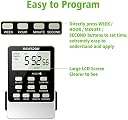
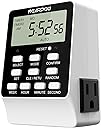
The NEARPOW Dual Digital Light Timer features two independently controlled grounded outlets with up to 18 programmable ON/OFF schedules, supporting 24-hour and 7-day programming. Designed for indoor heavy-duty use, it offers precise timing down to one second, a large LCD display, daylight saving adjustment, random vacation mode for security, and a child lock function. Its rechargeable backup battery ensures settings are retained during power outages, making it ideal for managing lights, appliances, and home systems efficiently and securely.


| ASIN | B07H1D267F |
| Best Sellers Rank | #71,687 in Tools & Home Improvement ( See Top 100 in Tools & Home Improvement ) #68 in Wall Timer Switches |
| Brand | NEARPOW |
| Brand Name | NEARPOW |
| Color | White |
| Customer Reviews | 4.2 out of 5 stars 2,012 Reviews |
| Item Dimensions D x W x H | 1.89"D x 2.64"W x 4.02"H |
| Manufacturer | NEARPOW |
| Manufacturer Part Number | NP-TIMER-NEW |
| Material | Acrylonitrile Butadiene Styrene |
| Material Type | Acrylonitrile Butadiene Styrene |
| Number of settings | 18 |
| Product Dimensions | 1.89"D x 2.64"W x 4.02"H |
| Unit Count | 1 Count |
M**N
Great timer, but it helps to know some key things the manual doesn't tell you.
Once I understood how this time really worked, my feeling afterwards was, "geesh, this really is a good timer". But it's important to know some key things because the timer's programming, doesn't really support how human's think. It just wants to be programmed and it lets you worry about all those requirements you may have that don't fit. I'm a former IT Systems Engineer, and I had some trouble with it, but my background help me understand how it works a lot easier than some others might. Hopefully by sharing some of the questions I ran into, will help others understand and use the Nearpow more easily and effectively. So my requirements centered around purchasing a timer to turn off and turn on an Internet Router, so that when I wake up the next day, the router's settings will have been refreshed. I also want to save electricity because I don't need my router on when I'm sleeping, and it also reduces the probability of hackers tapping into my network. I want the router to go off at 1am and go back on at 5am in the morning. So I get my Nearpow one afternoon and I try to set it up. The first thing you'll notice is that while it may be seemingly logical to set up (even with the lousy instructions), most people setting up a router like this will want to program their Nearpow, but continue using whatever it's programmed to turn off/on NOW. The instructions don't tell you how to do this. In my example, when I set up the on/off times, the timer was OFF, and there's no way to turn it manually ON (believe it or not). So even though it seemed easy enough to program, I had 2 very basic questions. QUESTION 1: HOW IN THE HECK DO YOU PROGRAM THIS THING, BUT BE ABLE TO USE THE DEVICE YOU'RE TRYING TO TURN ON/OFF, NOW????? QUESTION 2: HOW DO I TEST WHETHER I SET UP THE PROGRAM CORRECTLY? QUESTION 3: THE OUTLET WHERE I NEED TO PLUG THIS INTO IS TOUGH TO GET AT. ISN'T THERE AN EASY WAY TO SET IT UP, THEN PLUG IT IN WHERE I NEED TO? The answers to these questions are that you can plug this in the wall and program it wherever it's easier, then plug it into the wall socket where it needs to be working. In fact, because it has an internal battery to remember it's settings during a power failure, you can actually program the Nearpow without it even being plugged in. But I recommend that you program it with it plugged into some socket, because I believe that when it's unplugged, you will NOT be able to test your settings properly (Question 2). So with it plugged into the wall somewhere convenient, now you have the satisfaction of knowing that you can program the Nearpow somewhere where it's easier. So the majority of the customers who buy this timer, you're probably like me. You're trying to turn something on/off that you want to be able to continue to use NOW. Well, the Nearpow (believe it or not) has no manual way to turn your device on or off. Now each outlet has 9 programs where you set on and off times. When you're setting up your on and off times, the manual does NOT tell you two very important things: 1) Whichever of 9 programs you decide to set up for a given outlet, you must enter an on AND off time. 2) Secondly, for each on/off program pair, you can set up the on time to be BEFORE the off time. These two items are important because the way the programming works, you cycle through each of the 9 programs and the ON position is presented first. For some, it's logical to assume that if you wish for the outlet to go OFF first, then you might think you need to skip entering the ON time for program one, and instead just enter the OFF time. Then continuing this thinking, because you want the device to be turned ON next, you should enter your ON time next in program 2. Setting up the Nearpow this way, will NOT work. Each program must have an on and off pair. The other reason this pairing is important to understand is that if your requirements are to turn OFF the device first and then turn ON the device back on later, by setting the program pair with the ON time AFTER the OFF time, will tell the NEARPOW to turn that outlet on NOW! So now you should understand that if your requirements are like mine, you can program the Nearpow to execute at later times, but have that specific outlet turned to the ON position NOW so that you can use the device NOW. This answers Question 1. And understanding that you can program your Nearpow at a convenient outlet and turn one or both outlets ON now, aids you in being able to test whether you programmed the Nearpow properly. Simply plug in the Nearpow in any convenient outlet. Program your Nearpow with the lousy instructions but take into account the observation I've mentioned above, and you should be able to test whether each outlet works and can be programmed to go ON or OFF at a specific time. As an example, program your Nearpow to turn a device OFF ten minutes from now. After you set up the program, if set up properly, as I mentioned, that outlet's red light should be on already because your OFF time is set for a time BEFORE the ON time. Now simply wait for the OFF time to occur and the red light should go off. For those of you whose requirements are to turn something ON first, then your ON time would be BEFORE the OFF time. This case is much easier to test. You'd simply program you ON/OFF pair (say 10 minutes from now) and then wait for the red light to go on at the ON time, then go out at the OFF time. One final note: Once you program your Nearpow, if your requirements are such that your OFF time is BEFORE your ON time for an outlet, when the outlet is plugged in the socket where you programmed it, the red light will be on. But once you unplug the Nearpow to move it to it's final outlet location, the red light will go out briefly until you plug it back in. But all of your programming will still be intact, and as I mentioned before, because the outlet is ON, you can plug your device(s) in the Nearpow and continue to use them. Hope this helps others to use this device. It's great for turning a router on and off at a specific time because the timer doesn't require a WIFI connection to run properly. It simply runs off of a program that is powered by the electrical socket or a backup battery.
K**R
It doesn't get any better
The Nearpow T19S is a steal. This is an extremely versatile programmable timer. It has 2 electrical outlets. Each can be controlled separately and independent of the other outlet. Not only can you set separate timers for each outlet but each outlet can have multiple on/off times programmed each day. Each day of the week can be programmed differently if you want. The attached pics show the position of the outlets as well as the wall plug in. I believe the outlets will accomodate most wall wart electrical plugs. There is a bright red indicator light that shows which outlet is currently receiving power. The programming instructions aren't as detailed as they should be. If you sit down and study them for a few minutes it's not too hard to understand what they mean. Once you figure it out it's very easy to set. Don't be afraid to play with the programming functions. If you make a mistake there is a reset button that clears whichever outlet you were programming and you can start over. I use this to control the waterfall feature in my yard. One outlet controls the water pump and the other outlet controls the lights on the fountain. They timed differently and the timer works flawlessly. For the price this timer is a real steal. I highly recommend it
R**.
Programming not the easiest..........
Well, I read and read the reviews. Some were helpful, most were not. Anyway, I bought this timer, read the instructions that are helpful, to a point, but not fully. Watched the video which was also helpful, but not completely. I couldn't the timer to do what I saw on the video, for a long time. So, I persevered, and plodded through. I finally got both timers set up, but it still did not work. The instructions do not clearly mention that you must "confirm" each program after it has been set up. After confirming both programs, the timer took over and did its thing, properly. I am using this timer to control two aquarium filters that I want to run during the day and night, but at different times. It seems to be working correctly for now. I only have one program set for each timer. It appears as though there are 10 programs available for each side of the timer. I will update if there is any fault.
P**.
Dual Outlet Timer Independent Schedules
Excellent timer, many options for two separate outlets including independent scheduling.
J**S
Works amazing
Well some reviews say that it is complicated to set up I can kind of agree but once you get the hang of it it works perfect It does what I want to do where say for example I set for one day for The time to come on at 9:00 p.m. and shut off at 10:00 a.m. And then the next day I tell it to turn on at 9:00 p.m. and shut up at 9:00 p.m. It automatically rolls within the day so for example the first time frame day when it turns on we'll roll into the next time day frame of when it needs to shut off And with that that makes me really satisfied with this timer and highly recommend it for anyone that is looking for a timer that allows you to do different time frames on when you want your appliance or whatever to turn on Not to mention it's great that you can set 9th sets on the same plug in an automatically will use all nine sets as long as there's not a loop within the day of the week
D**E
way more complicated than it needs to be.
seriously!? i need a PHD in vintage VCR/Stove clock setting to just have the basics of setting this thing. why can't it just have basic navigable minus with a proper UI as apposed to guess work as to what sequence you need to push buttons to get things to do what you want. i didn't have too much issues setting the time, but programing the actual on-off function... GOOD LUCK! i tried fallowing the instructions to no luck. watched a YouTube tutorial. useless. i would HIGHLY suggest avoiding this and just get 2 separate "egg timer" style ones with the pins you pull. yea you have to reset it with every power outage situation but at least you don't need a PHD to operate it.
M**H
Great product & very simple to program using setup video
Great product. Works as advertised. I found it incredibly easy to program using the video in the product photos. I didn’t even need to peak at the directions and took just a few minutes to program it. Both outlets are functioning independently. Exactly what I needed. I can recommend this product without reservation.
P**M
Not as hard to program as you might think
This is a really nice digital timer, though I have many seen comments saying that it is difficult to program, I didn't find this to be the case. Since their are two timers, one for each outlet and if you intend to use most or all of the 18 available on/off settings, there a couple of things that may help make it easier. 1st: I found following the flow chart in the instructions to be the most helpful, as opposed the verbal instructions. 2nd: For each programmed on time there must also be an off time, 3rd: Before programming, write down all your on/off times in order for both timers/outlets. This eliminated a lot of confusion for me, since I used all 18 set times.
ترست بايلوت
منذ شهرين
منذ شهر